Monday, July 31, 2006

Lots of “moves”….5-foot nothing point guard John Lucas III signed with the Houston Rockets…the son of former Rocket John Lucas Jr., played with the team under two separate 10-day contracts last season as a rookie…Lucas went undrafted out of Oklahoma State, where he was selected the Big 12 player of the year in 2004…the Orlando Magic re-signed Trevor Ariza, a restricted free agent the club acquired in a midseason deal with the New York Knicks. Ariza played in 57 games with both the Magic and the Knicks last season, averaging 4.6 points and four rebounds per game. Ariza, 21, was originally selected 43rd overall by the Knicks in the 2002 NBA Draft…Phoenix Suns signed free agent Sean Marks to a one-year deal…the Charlotte Bobcats re-signed swingman Bernard Robinson…swingman Jamal Sampson signed with the Denver Nuggets…the Indiana Pacers signed free agent Maceo Baston, who spent the last three seasons playing in Israel…the New York Knicks signed Washington forward Jared Jeffries to an offer sheet believed to be for about $30 million over five years, according to published reports Saturday…the Wiz will have seven days to match the offer…the Nets picked up center Mikki Moore from Seattle for a 2009 second-round draft pick… the Bucks have agreed to send centre Jamaal Magloire to the Trail Blazers for point guard Steve Blake and backup centers Brian Skinner and Ha Seung Jin…

OK after all of this movement, the last one piques my interest…why would the Blazers want Magloire? They just signed Pryzbilla to a long-term deal and then drafted LaMarcus Aldridge…now they add another centre? You know they’re DYING to get rid of Darius Miles…could they be contemplating sweetening any potential trade offering of Miles by including Aldridge in the deal? Think about it, why else would you go get another centre?

By the way, Steve Blake is obviously insurance in case Mo Williams shits the bed as the new starter in Miwaulkee…

Big Internet rumour out there saying that a former member of the T-Wolves Medical staff is claiming that Wally Sczerbiak’s left knee has no cartilage left and is now bone on bone…Sczerbiak is only 29 years old…

Anthony Johnson spoke to the Indianapolis Star about his trade to the Mavs. Responding to the Pacers’ concern that he wouldn’t be willing to accept a backup role to Jamaal Tinsley, Johnson said, “If Jamaal came in in great shape and played the way he’s capable of playing, I wouldn’t have had no problem with that. At the same time, though, if there’s a competition and I’m playing the best, I feel like I should play the most. I just know the best guy should play and that’s how I feel about that.” Johnson added, “It’s no secret they (the Pacers) have issues. You can talk about injures, but you also have to talk about professionalism and being ready to play when the ball goes up. We didn’t have the ship pointed in the right direction as far as being rested, being ready to play and playing with pure heart.”…basically he’s saying the Pacers suck…

Los Angeles Lakers forward Luke Walton recently taped his acting debut on the CBS soap opera "The Young and the Restless," in which he plays a game of one-on-one basketball with actor Kristoff St. John. The episode will air Aug. 30…no doubt following in the footsteps of his his father Bill Walton who played himself in such forgettable movies as "He Got Game" and "Forget Paris."

Here’s the schedule for basketball related events for the rest of the summer:

Aug. 19-Sept. 3 - FIBA men's world championship (Sapporo and Saitama, Japan) – US team beings it’s redemption…
Sept. 8 - Hall of Fame enshrinement (Springfield, Mass.). – Dominique and Joe D, but no AD…
Oct. 2 - Players report to their teams no earlier than 11 a.m. (local time) -
Oct. 3 - Training camps open.
Oct. 5 - Start of the preseason schedule.
Oct. 30 - Rosters set for opening day, 6 p.m. EST.
Oct. 31 - Start of the 2006-07 regular season.

1) John Hollinger of ESPN.com with some AI trade ideas:

Five possible Allen Iverson trade scenarios

The dog days of the summer are here, which means only one thing in the NBA world: trade rumor season. With the list of top free agents whittled down to just a select few names, and teams otherwise sifting through the scraps, our attention is now turned to the great many players who are already under contract. Some undoubtedly will change addresses between now and when the season starts, and most observers feel that this particular summer will see brisk action on the trading front as the result of a lame free-agent market. Unquestionably, the biggest name available on the trade market is Philadelphia's star, Allen Iverson. While the Sixers recently said they have no intention of dealing Iverson right now, they were shopping him for most of the summer. Even today, many folks around the league will tell you, sotto voce, they believe he's still available.
Available or not, Iverson is one player who gives us a great example of how to use a great fan-friendly tool on this site -- ESPN.com's Trade Machine, which evaluates any proposed trade and tells you whether it works under the salary cap. Using this tool, as well as heavy dollops of common sense, we can evaluate five potential destinations for Iverson, what players might have to be included in order to make a deal workable, and what the odds are of something actually getting done with one of these teams:

GOLDEN STATE - Troy Murphy, Ike Diogu, Mickael Pietrus and Zarko Cabarkapa for Iverson

If anybody outside of Philadelphia is likely to undergo a late-summer face-lift, it's the Warriors. And after apparently failing in their pursuit of Al Harrington (Indiana is expected to nab him in a sign-and-trade deal thanks to its mammoth trade exception), Golden State's brass can turn its attention to Iverson. With several inexpensive young talents on board, a deal with the Warriors could certainly give Philly the post-Iverson boost it needs. The trade above represents a broad outline, but here are several variants depending on which players quicken the pulse of Sixers GM Billy King the most. For instance, Pietrus could be replaced with Andris Biedrins at Philly's choosing, or if the teams waited until October, the Warriors could replace Pietrus with the combo of Monta Ellis and either Keith McLeod or Andre Owens (both of whom were traded from Utah in July, so they can't be moved again in a package deal for three months). Additionally, Diogu or Murphy almost certainly would be conveyed to a third team since they both play the same position as Chris Webber. Another monkey wrench involves waiting until October, then adding both McLeod and Devin Brown to the deal as cap ballast, allowing the Sixers to dump Kyle Korver's contract in the Bay. Alternatively, the Warriors might insist on adding some combo of McLeod, Brown and Owens to the deal just to keep them under the luxury-tax threshold. In any event, this deal doesn't look as great for the Sixers as it does for the Warriors, unless Philly places a very high value on Diogu and/or Ellis. Murphy overlaps with Webber, and pairing the two is unthinkable from a defensive perspective, so getting him should be a very low priority. Even more, Murphy's contract runs two years longer than Iverson's, so the Sixers won't get much in the way of cap relief.

Odds: 7-1

NEW YORK - Steve Francis, Maurice Taylor, Malik Rose, Channing Frye and Nate Robinson for Iverson, Kyle Korver and Sam Dalembert

New York would be the logical place to turn if the Sixers were focused mainly on cap relief. Jalen Rose's expiring $16 million deal alone would be enough to trade straight up for Iverson, or the Knicks could spread the cap relief over two years by combining Malik Rose (whose deal expires in 2008) and Maurice Taylor (whose numbers are up after this season). But the most likely scenario (not that any of these are likely, mind you) would need to be a blockbuster, because New York already has two expensive point guards (Stephon Marbury and Steve Francis). Adding Iverson to that group wouldn't make much sense unless the Knicks could unload one of their two current point guards. In this scenario, both teams would need to pull in other players to make the deal equitable, as a straight-up Francis and Channing Frye for Iverson deal is unlikely to cut the mustard in Philly. As a result, a bigger deal giving the Sixers more cap relief by dumping the contracts of Korver and Dalembert seems more realistic. Jalen Rose could just as easily replace the Taylor-Rose combo in the deal above, and any of the Knicks' youngsters could swap for Nate Robinson, as well. Finally, if this type of deal ever came to fruition, a third team (and perhaps a fourth) would almost certainly need to get involved. The Knicks already are paying close to $100 million at the center spot and wouldn't seem to have a need for Dalembert, while the Sixers probably would want to deal Malik Rose for a backcourt player.

Odds: 25-1

ATLANTA - Josh Smith, Tyronn Lue and Josh Childress for Iverson

The Hawks are an inviting destination for Iverson because they're sitting on nearly $10 million in cap space to make a deal work, and at any rate they will have a trade exception worth several million dollars if and when they sign-and-trade Harrington to Indiana. Dealing with the Hawks would accomplish two of Philly's goals -- getting cap relief and talented youth -- so the bigger question is whether the Hawks are in position to make a play. Atlanta's fractured ownership situation certainly complicates matters, and GM Billy Knight has been one of the league's most reluctant deal-makers since he's come to Atlanta. To pull off a deal for the Answer, Atlanta would need to include Josh Smith or Marvin Williams at a minimum. My guess is that Philly would prefer Smith since he'll be able to contribute immediately and will provide some of the crowd-pleasing moments that would make up for Iverson's loss. Josh Childress makes a nice sweetener who can fortify a lackluster second unit, while Tyronn Lue is the easiest part of the puzzle -- Atlanta wouldn't need an extra point guard, the Sixers would, and Speedy Claxton can't be traded until December 15. The other benefit of this deal is it would give the Sixers a huge trade exception that they could use until next summer, potentially giving them a leg up in free agency despite being over the cap. The fly in the ointment here would be on the Hawks' side of the ledger. Iverson would certainly provide a short-term attendance boost -- he's one of the few visiting players who reliably packs 'em in at the moribund Philips Arena. But one has to wonder if it's wise to add a 31-year-old guard whose greatest skill (quickness) is the one that declines most rapidly with age. This is particularly true when the cost is Smith, a 20-year-old jumping jack with 3-point range, and when the team went 26-56 a year ago and appears to be years from contending for anything important.

Odds: 8-1

BOSTON - Wally Szczerbiak, Al Jefferson, Delonte West and Dwayne Jones for Iverson

Boston has been considered the leading Iverson suitor for some time, and looking at its roster it's easy to see why. The Celtics have hordes of young players to mix and match as part of a deal depending on Philadelphia's tastes -- Gerald Green, Kendrick Perkins, Tony Allen or Ryan Gomes could replace Jefferson or West if that was whom the Sixers preferred. Plus, Boston has the benefit of two large contracts (Wally Szczerbiak's and, if they wait until late September, Theo Ratliff's) that can be used as the main building block of a deal. Additionally, the C's wouldn't mind lightening the roster a bit. The Celtics have 14 guaranteed contracts for next season plus two undrafted players (Allan Ray and Kevin Pittsnogle) that they might prefer to keep, so making a 4-for-1 deal like this one would alleviate the overcrowding. Another variant would add Philly's Kyle Korver and Boston's Brian Scalabrine to the mix, because the scenario above doesn't provide Philly with much cap relief. Allowing Philadelphia to dump Korver's contract on Boston in return for the even-more-useless but slightly-less well-compensated Scalabrine would give the Sixers more cap relief than the above scenario affords. Boston could even take things a step further and add Ratliff on the Boston side and Dalembert on Philly's, but it's unlikely that the Sixers would accept such a glaring difference in talent just to drop the final years of Dalembert's contract.

Odds: 5-1

DENVER - Kenyon Martin and Andre Miller for Iverson

The Nuggets have a few different scenarios that might work for Philly. The most plausible involves Kenyon Martin and Andre Miller, who combine to match Iverson's salary almost perfectly. Miller would slide right into the point guard job in Philly, while Martin and Chris Webber could alternate games at power forward depending on whose knees felt better that night. (Or, more realistically, the Sixers could convey Martin to a third team with a need at power forward). Since Martin doesn't fit well, the Sixers might make a deal work without him -- even though he's the guy the Nuggets really want to trade. Miller and Ruben Patterson's expiring contract would be enough to get a deal done, with somebody like Linas Kleiza likely throw in to give the Sixers a decent young player and keep the Nuggets under the luxury-tax line. Denver also has two No. 1 picks next year, at least one of which it could use as a sweetener to try to get Philly to accept Martin. In the Nuggets' best-case scenario, the Sixers take Martin and Patterson, with Kleiza and a future No. 1 lumped into the mix as added incentive. Denver also might be open to a shooter like Korver getting added to the mix, with either Eduardo Najera or a signed-and-traded Reggie Evans going back to Philly. However, just because the Nuggets could get a deal done doesn't mean they're on the phone pushing for it. One gets the sense from Denver's recent flurry of maneuvers that they've moved on to other things, and that might be for the best anyway. For all Iverson does, he's not much of an outside shooter, meaning he does nothing to address the team's most glaring need.

Odds: 15-1

2) David Aldridge of the Philadelphia Inquirer wonders what’s going on with the Sixers management:

Snider's patience appears bottomless

Is that it? Are we done? Did Billy King finish "changing the culture of how we play and the way we approach things" without telling us? Is your head spinning after counting all the new, young defensemen Bob Clarke said were coming? More to the point, what's Ed Snider's scorecard saying? Snider's patience with Clarke and King is nothing new. Clarke has had carte blanche to trade anyone and everyone off the Flyers' roster for 12 years. King has been around since 1997, and fully in charge since 2003. Let's say this up front: There's nothing inherently wrong with being patient. Most of the time, it's a positive characteristic. In sports, knee-jerk reactions fueled by sports-talk intolerance are a cliché, and unworthy of the person that actually signs the checks. The Maras, who have owned all or part of the NFL's Giants for eight decades, are patient men - the Giants have had just two general managers, the late George Young and Ernie Accorsi, since 1979. So are Bill DeWitt and the owners of baseball's St. Louis Cardinals, who have let GM Walt Jocketty alone for 12 years. Same in Atlanta, where John Schuerholz has built and rebuilt the Braves a half-dozen times since his arrival in 1991 - and hasn't been cashiered despite the Braves' relative lack of playoff success. The patron saint of patience, Steelers chairman Dan Rooney (two head coaches in 36 years), gave coach Bill Cowher chance after chance after chance to win a Super Bowl - until he finally did. But there are few cities where Cowher would have been able to lose three conference title games at home and still have his gig. So, patience is fine - if the teams are successful. That doesn't describe the tenants of Wachovia Center the last few seasons - unless you aspire to frequent first-round bouncings. After cratering at the end of last season, King vowed the team would be different in 2006-07. No, he didn't come out and say that Allen Iverson and Chris Webber would be gone, but we all know how hard he has tried to move both players in the last month. If Boston had agreed to give up its draft pick so that the Sixers could draft Randy Foye, Iverson would be looking at Back Bay property right now. Clarke said he knew the Flyers needed to get quicker and younger on the blue line after the Buffalo Sabres blew past his defensemen in the first round. And he has acknowledged that he can't go through another season with both Antero Niittymaki and Robert Esche in net; someone's got to go. But, so far, the summer's work has netted... chum. The Sixers have acquired nobody. No veterans who could bring in the toughness and defensive talent that would get them out of this eighth-seed hell they're in. King is now reduced to hoping rookie draft picks Rodney Carney and Bobby Jones, along with guard Willie Green, returning from a knee injury, can provide the defensive hustle and legwork. "I said I was changing the culture. I didn't say I was changing players," King said yesterday. To that end, King says his players will work better with members of the media next season. He says that there will be improvements in "customer service, how we approach the fans, how we approach everything... . It may not be things that people notice. I'm talking about the professionalism of representing the 76ers on and off the court, how we interact with our fans in the arena. I think we have to take a close look at everything we do in the organization, and it starts with me." On the court, King says that Maurice Cheeks will have a new defensive system in place next season - which sort of implies that Cheeks didn't have one last season. Clarke says that injuries explain the Flyers' second-half swoon last season. And he has pointed out that he did his busy work last summer, when he brought Peter Forsberg from Colorado and Derian Hatcher from Detroit and Mike Rathje from San Jose - players whose salaries obviously limit what Clarke can do this off-season. And his priority continues to be re-signing free agent Simon Gagne. Even assuming that ultimately gets done, and that Forsberg's ankle indeed allows him to play in October rather than January, the few off-season additions such as veteran defenseman Nolan Baumgartner... well, are they upgrades? Improving from within, infusion of youth, better coaching... it sounds like the stuff of a team heading north from spring training. Which, coincidentally, is around the time the Sixers and Flyers have been finishing up of late.
There's no need for Snider to pull a Jim Dolan and put his GMs on a one-year timetable. But a little heat in the kitchen wouldn't hurt.

3) Ian Thomsen of SI.com with an article on the Raps assistant GM:

Learning some new tricks - Famed Italian GM Gherardini goes to school in Toronto


The top basketball mind in Europe was studying for his next assignment like an American teenager preparing for the SAT. "It's the collective bargaining agreement," said Maurizio Gherardini, holding up his thick copy of the NBA's financial rulebook when I visited him at his office in Treviso, Italy, in early June. "Whenever I'm on the road, I've got this. I work with it just like in school." Gherardini -- who at 50 years old was considered by most to be the Jerry West of European GMs -- opened up the pages to reveal that he had been applying a yellow highlighter to the key passages, which in itself also reveals that the Raptors' new assistant general manager will take nothing for granted in his new position. While some of the NBA's most respected executives laud him -- his fans include San Antonio's R.C. Buford, Denver's Jeff Weltman and Dallas' Donnie Nelson, who discussed hiring Gherardini before he was signed this summer by Raptors president Bryan Colangelo -- Gherardini doesn't assume that his managerial skills will instantly succeed in the New World. "I understand that I may not be good enough, because of the simple fact that nobody has ever tried it before," said Gherardini of his transatlantic conversion to the NBA. "I look at it as a learning experience." Shortly after winning his fourth Italian league championship, Gherardini shared an emotional farewell with his colleagues at Benetton Treviso, the Italian club near Venice that he had been operating as GM for 14 years, and took the long flight overseas to embark on his new career. In joining Colangelo in the front office, Gherardini became the first European to earn a leadership position with an NBA franchise. Gherardini has already influenced the Raptors' decisions to recruit forward Jorge Garbajosa, who will bring toughness to their frontline; Anthony Parker, the expatriate American swingman who has spent most of his career starring in Europe; and potentially 6-foot-11 Uros Slokar, a second-round pick of the Raptors last year who has played for Gherardini at Benetton Treviso since 2003-04. These names are unknown in the U.S., but they are versatile role players who will instantly improve the Raptors' chemistry. If newly acquired point guard T.J. Ford can maintain his health throughout the year, Toronto is going to be one of the most entertaining teams in the league and a dark-horse playoff contender in the East. Influential as he has become in Toronto, Gherardini also demonstrates a sense of humility, as evidenced during the time the Raptors' management team was questioning whether to spend the No. 1 pick in the draft on Andrea Bargnani, a 7-foot shooter from Benetton Treviso whom Gherardini himself discovered four years ago playing for a small club in Rome. After the Raptors won the draft lottery it was widely assumed that Gherardini would try to convince Colangelo to use the pick on 20-year-old Bargnani, but Gherardini took the opposite approach: He waited for Colangelo, player personnel director Jim Kelly, consultant Wayne Embry and coach Sam Mitchell to reach their own opinions. "In Bargnani's situation, I'm not saying a word," said Gherardini in early June. "I'm letting them study the guy and decide what they want to do. If they want me to, I can tell them how I saw Bargnani grow through the years. But I'm the only one of all their people [who] cannot make comparisons: I don't know [LaMarcus] Aldridge or [Tyrus] Thomas or Rudy Gay." In the end Gherardini was able to corroborate Colangelo's gut feeling that Bargnani was the best choice. Bargnani is athletically gifted, he handles pressure and he was far and away the best-trained player in the draft, thanks to a player-development system -- which is more thorough and sophisticated than those at many NBA clubs -- assembled by Gherardini within an annual budget estimated at less than $11 million, which also covers the salaries of players, coach David Blatt and Gherardini's front office. The Bargnani episode also created suspicion that Gherardini was hired simply because of his relationship with the No. 1 player. The truth is that Gherardini's move to Toronto was in the works long before the Raptors' unexpected acquisition of the top pick in the lottery. Gherardini's rise to the top of his profession is a variation of the American Dream, told with an Italian accent. In his hometown of Forli, midway between Milan and Rome, Gherardini was a young boy when he started attending games of the local professional club, whose star American was the former Canisius player Tony Gennari. "I remember being one of those crazy fans standing outside the gates," Gherardini said. "On Sundays the game was at 5:30, and we were at the arena at like one o'clock because it was always overbooked." Gherardini won a scholarship to spend the equivalent of his senior year of high school in the U.S., graduating from McClure High School in suburban St. Louis. Gherardini's love for basketball was betrayed by a body type that brings to mind a young Tommy Lasorda, but he spent his year abroad learning fluent English and becoming sophisticated -- by Italian standards -- in the ways of American basketball. Upon returning to Forli, the local team asked Gherardini to help recruit a player from the U.S. "They didn't know how to find an American player," said Gherardini, who placed the calls overseas that ultimately brought Steve Mitchell, a former star at Kansas State, to Forli. Gherardini was then asked to serve as Mitchell's interpreter, which led to his promotion to assistant coach at the age of 19. Gherardini became the 26-year-old GM of Forli in 1981. By then he had embarked on a parallel career as a banker to provide money for his young family. "I hated banking," said Gherardini, who would become head of the international department for Banca Commerciale Italia, the nation's largest bank. "But if you work in a bank you respect the importance of numbers, which gives you a different way of looking at the nature of a business. I always tell my people, 'Don't think it's something wrong to raise your hand and say you can't do something.' There are situations where you are going to have to say no, because if you don't say it then you're going to have to pay for it sooner or later." In '92 Gherardini took over at Benetton, where his star player was Toni Kukoc. On the eve of the European championship game in Athens, Kukoc had a lengthy meeting with Chicago Bulls GM Jerry Krause to discuss his move to the NBA the following season. Gherardini felt betrayed by this meeting, as Kukoc played a poor game the following day and Benetton was upset in the championship game by the French club Limoges. But instead of hopelessly trying to shut out the marauding NBA teams -- which remains the tactic of many European clubs today -- Gherardini opened his doors to the Americans by sharing information with NBA scouts and developing international player camps, including the Reebok Euro camp in Treviso that is a must-attend for NBA teams each June. Gherardini also has developed the world's most sophisticated international scouting system, with associations in more than 35 countries in Europe and Africa. The Raptors will benefit from that network. The question that perplexes Gherardini's friends is why he would want to leave Europe. With his wife, Luana, and their two children, he was living in the beautiful home in Treviso that used to be rented to Kukoc. The walls are adorned with an eclectic anthology of modern art that Gherardini has collected over the years; in a corner of the living room is a black leather chair that used to belong to Mike D'Antoni. It was known throughout the continent that at least five major European clubs were trying to hire Gherardini before he signed with Toronto. Gherardini moved overseas for the same reason that he instituted an open-door policy that enabled the NBA clubs to scout his players in Treviso. "The basis of our philosophy is that players need to be able to dream," he said. "It's important that they need to be able to fulfill their dream. If you're a basketball fan, you know that the ultimate dream is the NBA. For me the goal is to learn from the NBA -- to learn how things are being done, and you can only learn this from the inside." Even as a 19-year-old assistant in Forli, Gherardini dreamed of someday working in the NBA; in another, more reasonable sense, he never imagined it could happen. But now the growth and influence of European basketball -- an influence he helped drive -- has helped make his own American Dream come true.

4) Chris Sheriden of ESPN.com with a cautionary tale from Spencer Haywood for Team USA:

Haywood recounts 1968 Olympic

LAS VEGAS -- A long time ago on a train from Moscow to Minsk, Team USA learned a slightly painful lesson about how the playing field isn't always level in international basketball. LeBron James, Dwyane Wade and their cohorts should take note. "They told us we'd be riding a train together with the Soviet team, but when we got on the train it was a sleeper car with these teeny-tiny bunks. The Russians weren't there, and they showed up in Minsk raring to go after flying over our heads to get there," said Spencer Haywood, who recounted a few of his tales from the 1968 Olympics to ESPN.com at a restaurant across the street from Team USA's current training facility on the UNLV campus. James, Wade, coach Mike Krzyzewski and the rest of Team USA will reassemble Monday for the second stretch of training camp before heading overseas for six weeks and experiencing some weird stuff firsthand. If Haywood's recollections provide a guide, they'll have plenty to talk about once they get back. "We were playing the Soviets in one exhibition, and we were up like 25 when they called timeout. All of a sudden, they were clearing out the gymnasium. Like 10,000 or 12,000 people. When they were all gone, we looked up at the scoreboard and they had changed it. The Russians were ahead by two. The next day in the local papers, the headlines said: "Soviets Upset Americans." It would be farfetched for this year's version of Team USA to come back with a story anything like that one, but there will be something strange to discuss by the time the World Championship in Japan ends Sept. 3 and the Americans head back home. Two years ago, the Athens Olympic men's basketball team stopped in Turkey during its pre-Olympic tour, and several members of the traveling party had the wits scared out of them by a hotel bombing a few miles away from their own hotel. Six years ago, the Sydney Olympic team was left speechless after playing an exhibition in Saitama, Japan (the site of this year's World Championship medal round) in which the cavernous arena was so silent during the game, a baby in the upper deck cried out "Mama," and the players down on the court heard it. The American team will practice for three days in Las Vegas before playing its first exhibition against Puerto Rico, then boarding a charter flight to Asia. The first stop is the port city of Guangzhou, China, once the southern terminus of the ancient Silk Road. The U.S. team will play exhibitions there against China and Brazil before making the short hop to Hong Kong for three days of practice, then moving on to Seoul, South Korea, for exhibitions against Lithuania and Korea. Finally, on Aug. 17, the Americans fly to Sapporo, Japan, for their opening round of the World Championship, where they'll be grouped with Italy, Senegal, Lithuania, Puerto Rico and Slovenia. The round of 16, the quarterfinals, semifinals and gold medal game will be played at the SuperDome in Saitama, not far from where Ray Allen jinxed the Amrericans six years ago on the bus ride into Tokyo from the airport when he asked aloud where all the traffic was. Sure enough, the bus ground to a halt moments later in a typical bumper-to-bumper Tokyo roadjam. This American team, which was pared down to 15 as Adam Morrison, Luke Ridnour and the injured Shawn Marion were cut at the end of the first stage of training camp last week, will have to fight through the travel fatigue and try to be at its peak at the end of the World Championship, and by then it'll have been more than a month since they set foot on American soil. If the U.S. team wins its final four games, captures the gold and qualifies for the Beijing Olympics, the snapshots the team members will bring home in their heads will evoke memories they'll cherish. Many of the most memorable non-basketball moments often occur on tours leading up to international competitions, and Haywood remembers scrambling to get a copy of his birth certificate that his mother kept tucked in a Bible back home in rural Mississippi in order to get a passport so he could travel to the Soviet Union and Finland for a pre-Olympic tour 38 years ago. "The Russians were all coming up to me telling me to defect. They'd tell me black people weren't treated right in the States," Haywood recalled. "But they were feeding us horse meat and calling it filet mignon, and they were driving around in these tiny little cars. I asked them: 'Can I get a pizza delivery?'" Haywood was only 19 at the time, having made the squad as a little-known college freshman out of Trinidad (Colo.) Junior College who had grown up picking cotton in Mississippi for $2 a day. His 1968 team was expected by many to falter after losing Pete Maravich, Elvin Hayes, Wes Unseld, Calvin Murphy and Rick Mount for one reason or another. He recalled meeting sprinter Jesse Owens, who won a gold medal at the 1936 Olympics."He told us this is the biggest thing you're going to do, because defending your country's honor is the biggest thing you can do. When some of the people were calling for black athletes to boycott, he looked us all in the eye and said 'You think you're having problems now? How would you like to play against Hitler?'" The 2006 version of Team USA is an apolitical team heading off into a world where anti-American sentiment has grown in the past couple of years, though there's been a lack of the publicly stated security fears that scared a few of the best American players off the Athens roster two years ago. One of the biggest concerns for the players is what they'll be eating, though they'll be proud to discover that USA Basketball officials are quite adept at meeting their needs. Six years ago after they knocked off Spain in a pre-Olympic exhibition game at the strangely silent Saitama SuperArena, some two dozen buckets of Kentucky Fried Chicken awaited them in the post-game locker room. Haywood promises they'll relish the experience so long as they keep their eye on what's important -- coming home winners after the past two U.S. teams failed to, finishing sixth at the 2002 Worlds and third at the 2004 Olympics. "Do you know how embarrassing it must be to walk around thinking you're the best players in the world, but you weren't? Those players (from 2002 and 2004) are just now realizing the shame they brought upon American basketball. "Those guys didn't realize it was going to be that big of a deal, but this is a major deal for Americans," Haywood said. Let's hope the new guys understand as much. Otherwise, the tales they tell when they get back home will be tainted. Haywood, who laughed his way through each of his tales from '68, can smile about them now because he brought home a gold medal which he still keeps in a small light blue satchel and pulls out for special occasions -- one of which will be a pep talk this week with the current members of Team USA.
"Everyone wants to knock off Americans. That's what these guys don't understand," Haywood said.

Thursday, July 27, 2006


So long to Alvin “Boogie” Williams, always my favourite Raptor. He played his ass off and worked his ass off and eventually played and worked his knees off…Williams leaves the Raptors with career averages of 9.1 PPG, 4.1 APG and 2.5 RPG, but his best years were 2001-02 (11.8 PPG, 5.7 APG, 3.4 RPG) and 2002-03 (13.2 PPG, 5.3 APG, 3.1 RPG) both years in which the Raptors were in the playoffs. Williams is all over the Raptors history books as he owns the Raptors’ consecutive games played streak at 187 (April 16, 2000 – Dec. 11, 2002), has played more games in a Raptors uniform (360) than any player in franchise history, holds the Raptors career record for assists, and it was his clutch jump shot at Madison Square Garden in 2001 that sealed the franchise's only playoff series win against the New York Knicks… While a provision in Williams' contract allowed the Raptors to release him and pay him only half of the approximately $14 million (U.S.) remaining on his contract, Bryan Colangelo, the Raptors' president and GM, voluntarily negotiated a sweeter settlement for a loyal employee. Williams had a rep as a tremendous ballhandler and very clutch shooter, both of which were justified…but most of all, I will remember his as a guy who just did not quit, always defended the other teams best guard, and had the best lean forward, cross the ball back to his left hand to a pull up jumper move I’ve ever seen, a move that Philly superstar Allen Iverson claims Williams taught him and he uses to great effect to this day…

Terrific preview coverage of all D1 conferences here: http://sports.espn.go.com/ncb/news/story?id=2516801

The Hornets signed SG Rasual Butler and PG Bobby Jackson yesterday…word is Jackson hurt himself signing the contract and is out 4-6 weeks, while Butler disappeared into thin air from the pressure a reporter asking him a question…

1) Matthew Waxman of Si.com with a terrific article on where the NBA players ball in the summer:

Pickup hoops hot spots - Where the best players ball in the offseason

Turns out the basketball offseason isn't all piña coladas and inflatable pool furniture. We've located the summer pickup games that consistently lure All-Stars and All-Americas, despite the less-than-ideal conditions. We'll tell you who plays where, the house rules, how to sneak in and a famous rumor from each of the four most prolific offseason hoops runs in the country.

Rucker Park

The Regulars: Ron Artest, Stephon Marbury, Jamaal Tinsley, Jamal Crawford, Rafer Alston, Sebastian Telfair, Joakim Noah

Access: When superstars like AI, Kobe or KG are rumored to be in town, the rickety bleachers that line the perimeter of the court and hold a couple thousand people fill up more than an hour in advance of the early game at six. If you arrive after that, do as the kids do: scale the chain-link fence that surrounds the playground or perch yourself in a tree for a view of the action.

The Rules: NBA rules with refs, a time clock and a scoreboard.

The Run: "You're back in school, Joakim," the emcee crows. At the free throw line Noah, the Florida Gators' sophomore forward and Most Outstanding Player of last year's NCAA tournament, dips his knees and hits the first shot. "Congratulations on winning the NCAAs, but they gonna test you here," the emcee continues as Noah prepares for his second shot. "Ladies and gentleman, he could have gone to the league. Decided to enjoy another year" -- Noah starts his shooting motion -- "spending his parents' cash." Mid-stroke Noah cracks, flashing his gap-toothed grin and shaking his bouquet of long hair before clanging the second shot. The crowd laughs in amusement. At 155th Street and Frederick Douglass Boulevard -- next to Mama's Fried Chicken, Nas Deli, Miny Nails and Uptown Laundromat -- stands Rucker Park. The most historic slab of concrete since the Rosetta Stone has evolved since the days when Goat, Pearl and Tiny made names for themselves there. Streetballers like Homicide, Antifreeze and the Bone Collector now suit up in the Entertainers Basketball Classic (EBC), a league in which sponsors like Fat Joe, The Game and Jadakiss own and often coach teams featuring any NBA players they can get their hands on, even for a single game. Despite the debris, dusty surface and on-court emcees, who lollygag within the court lines while maintaining a running commentary/comedy show for the fans ("Potato chips at three in the morning is a dead giveaway you getting high," one of them once said to the crowd), the top ballers can't resist. "You got a lot of tradition out there," said Vince Carter after he played there in 2002. "It's just something where I wanted to say, 'Yeah, I played.'"
The Rucker's star power on-court is matched by those in attendance, from Fabolous and Mike Tyson to Alicia Keys, who has been known to stroll out of the stands and put on an impromptu a capella halftime performance. "I remember being at Rucker Park in the company of President Clinton," says commissioner David Stern, "and the MC says, 'Yo, Bill' and then decided it would be better to call him 'Mr. President.' It's neighborhood fun." The assist-to-turnover ratio may not be to Stern's liking, but the rough, And1 brand of ball helps pampered stars maintain their edge. "I got my swagger at the Rucker," says Noah, who played last summer as an unknown freshman before returning this year as a main attraction. "The basketball is completely different here; it isn't for everybody. But if you can play at the Rucker, you can play anywhere."

Rumor Has It: When Rafer "Skip to My Lou" Alston was a junior in high school and a defender (actually it was Conrad McRae, former Syracuse centre) went up to block his layup, Alston is said to have let the ball roll down his arm, behind his neck and down the other arm before flicking it to a streaking teammate for a layin.

The Men's Gym at UCLA

The Regulars: Paul Pierce, Chauncey Billups, Kevin Garnett, Derek Fisher, Baron Davis, Jermaine O'Neal, Earl Watson, Joe Johnson, Amaré Stoudamire, Tyronne Lue, Richard Jefferson, Grant Hill, Jared Jeffries, Mike Dunleavy Jr., Jordan Farmar

Access: Word spreads quickly when Kobe's walking through campus, but on most days only a couple dozen spectators line the walls.

The Rules: Games to seven by ones. Call your own fouls. Winners stay on center court.

The Run: Like all things basketball in L.A., the high-water mark of the pickup run at UCLA was caused by Magic Johnson, during summers in the '80s. John Wooden's Bruins squads may have won two championships in this old gym, in the shadow of Pauley Pavilion, but the fierce pickup games that begin in June and gain steam through July and August have Magic's fingerprints all over them. Adam Mills, a blond 6-foot-0 basketball junkie, and former television actor, has coordinated the games here for the past 20 years. "If I have three courts of 30 NBA guys, I'm happy," says Mills, who divides the teams evenly, keeping teammates together and filling out the rosters with local college and European talent, even tossing himself in the mix when one more is needed. The well-oiled, NBA-quality, NBA-style run is the antithesis of playground ball. "Pros get pissed if you try and take them one-on-one to show them how great you are," says Mills, who claims to have had every great player in but Kareem and Larry Bird. "They want to come in and get a nice two-hour run with no arguing." GMs such as Elgin Baylor, Kiki Vandeweghe and Mitch Kupchak respect the game enough to send players there for auditions, as the Lakers did in 1999 with Brian Shaw before eventually signing him. Kobe shows up occasionally; Shaq did too when he was with the Lakers. But it's Pierce who has stepped up to take the torch from Magic. "Where else can you go in the summer and play against NBA guys at the same level?" asks Pierce, who pitches in to help Mills pay for the gym time, while the other players "forget their wallets every day," according to Mills. "I've had a lot of battles there," says Pierce. "I played against Magic even after he retired and he'd still beat up on a lot of people."

Rumor Has It: Former UCLA coach Larry Brown claims that in the early '80s, Wilt Chamberlain, a decade retired from the NBA, would drive down from his Bel Air home to play and stay in shape. "[Magic] called a couple of chintzy fouls and a goaltending on Wilt," says Brown, "so Wilt said, 'There will be no more layups in this gym,' and he blocked every shot after that."

Tim Grover Game in Chicago

The Regulars: Dwyane Wade, Shawn Marion, Antoine Walker, Shaun Livingston, Devin Harris, Chris Kaman, Michael Finley, Corey Maggette, James Posey

Access: Limited -- the only spectators allowed are family members, agents and Michael Jordan.

The Rules: Game to seven by ones. Actual NBA refs, scorekeepers, 24-second shot clock.

The Run: Michael Jordan's days as kingpin of the Chicago pickup games may be over, but that doesn't stop him from lording over the scene. Though His Airness no longer laces up, he occasionally drops by to talk trash. "He's the only one that has that right," says Jordan's former personal trainer Tim Grover, who as CEO of Attack Athletics, an athlete training company, organizes this workout exclusively for his NBA clients.
The notorious game shifted this year from Hoops the Gym to the University of Illinois at Chicago after Hoops was bought out, but the top-tier talent that follows Grover remains constant. A gym official recently did a quick mental tally of the contracts of the 30 or so NBA players warming up and remarked, "Wow, there must be three quarters of a billion dollars on the court." The Attack Athletic clients, most of who grew up or played in the Midwest, battle every offseason against the same players, developing rivalries that raise the intensity of play. When devising the teams, Grover matches like-minded stars against each other, like Harris and Livingston, and tries to pair current regular-season teammates. "As soon as Antoine Walker got traded to Miami," says Grover, "we put him and Dwyane Wade on the same team so they could get acclimated and develop a feel for each other." While Wade, a Grover client since his days at Marquette, may be the latest superstar to earn the "next MJ" tag, only Jordan himself can really crank up the level of competition. Says Grover, "He'll come up and tell guys, 'When I was playing, there's no way you could have scored on me. Remember when I gave you 50? Remember when we knocked you out in the first round of the playoffs?'" How could they forget, Mike? You keep coming back to remind them.

Rumor Has It: In 2002, when Jordan was playing pickup in preparation to join the Wizards, his comeback was stalled when he broke two ribs. According to the Chicago Tribune, Jordan had been trash-talking with Walker and Ron Artest when the latter "grabbed [Jordan], slammed him to the floor" and threw a punch. Grover, who was in the gym that day, says that while it's true that "Antoine takes more [abuse from Jordan] than anyone else," the broken ribs were simply a freak injury caused when Artest tried to deny Jordan position in the post.

Fondé Rec Center in Houston

The Regulars: Sam Cassell, Moochie Norris, Cuttino Mobley, Rashard Lewis, Damon Stoudamire, Steve Francis, Emeka Okafor, James Posey, J.R. Smith, Gerald Green, T.J. Ford, Daniel Ewing, Chris Wilcox, Glen Davis

Access: Free admission for the public; the pullout bleachers seat about 1,500. Kids can take pictures and get autographs from the players after the games.

The Rules: 12-minute quarters. Running time, except for the last two minutes of each half.

The Run: In the beginning there was Moses (Malone). His disciple became known as Little Moses. At the Fondé Rec Center, where basketball knowledge, like religion, is passed from generation to generation, it's fitting that the sign over the entryway reads, "Recreation, like religion, should permeate all of life." However, the proclamation most often associated with this basketball temple is, "You ain't done it till you done it at Fondé," which was dispensed by Moses. Like he did during the hot Houston summer at Fondé 25 years ago, when he tutored a freshman from the University of Houston named Akeem Olajuwon in the art of the low post -- Dream dubbed the sessions "basketball college" -- Malone is still teaching the game at Fondé. He's coach of The Chairman, in the Nike Pro City Summer Basketball League, which runs Monday and Wednesday nights from mid-July through August. And despite the abundance of available NBA players, Coach Malone eschews pros on his team in favor of amateurs, including his son, Moses Jr., as well as the sons of Hall of Famers George Gervin and Calvin Murphy. But if Rockets center Yao Ming came to rumble at Fondé, Malone, 51, says that not only would he break his no-pros rule, but he'd also suit up himself. "We've got standing room now," says Malone, who tips in at 275, only 15 pounds over his playing weight, "but if [the two big men teamed up] we'd have standing room outside the building, waiting to come in." Nike's arrival has meant a new coat of paint on the walls, a leveling of the rims and a buffing of the court. But, as the phrase goes, you can put lipstick on a pig.... "It's just the neighborhood gym," former Rocket Kenny Smith says of Fonde. "There are no frills; [It's just] like the Rocky gym." "When we play in Houston, it's grimy. It's hard-core," says former University of Texas standout Daniel Gibson, who started playing in youth leagues at the center when he was 11. "Once you step on the court at Fondé, you've gotta be ready to bring it -- or you're going to get put off to the side and nobody's gonna let you play anymore." Or, as former Rocket Robert Reid summed up to the Houston Chronicle, "You couldn't come in and play some fiddle-dee-dee game or you'd be fiddle-dee-dummed out of the gym." Some guys not fiddle-dee-dummed out were Clyde Drexler, who ran during summers with Olajuwon and their Phi Slamma Jamma teammates; playground star Dwayne Rogers, who earned the nickname "The Legend" for his ability to ball at Fonde; and Shaquille O'Neal, who would make the three-hour drive to run in the legendary games when he was a high school star in San Antonio. For fans, Fondé provides the opportunity to watch the pros up close without having to run a hedge fund. "Some people can't afford to go to games to see guys like Rashard Lewis," says Pro City director Kevin Granger. "Here they get to see [NBA players], get autographs, talk to them, high-five them." Gibson, now 20, remembers the thrill. "Shaq and Penny [Hardaway] and Drexler, Olajuwon. Just seeing those dudes out there like regular people, laughing and joking, you don't get that on TV."
Despite the addition of emcee chatter and music blaring before, during and after the games, the run remains crisp. "Any time a guy like Sam Cassell, Moochie [Norris] or [James] Posey enters the game, they want to win because it's the Fondé," says Malone, who warns that the game is not for everybody. "Guys come and ask me if they can play and I tell 'em, 'Let me see what you can do first on the B court, because Fondé's the A court.'"

Rumor Has It: During one game in the early '80s, Moses called one too many fouls, and when one of them was ignored, he took the game ball, left the court and went outside. When he saw the game restarting with a new ball, he protested the game by standing defiantly at center court until his call was acknowledged.


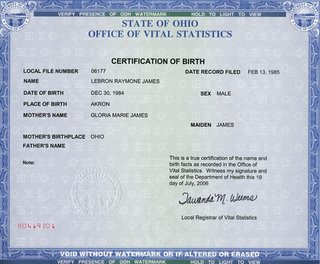
2) Brian Windhorst of the Akron Beacon-Journal confirms that LeBron really is just 21 years old:

Signed, sealed and delivered, LeBron is 21
.
A sweaty Team USA practice has ended inside UNLV's Cox Pavilion, and players are plopping down on chairs, untying laces and toweling off.
LeBron James slips off his signature Nikes and yells, to no one in particular, "I need five bags of ice!" Three chairs over, Dwyane Wade shoots LeBron a sly look and retorts: "That's because you're 30 years old!" It's not the first time LeBron's pal Wade has used the joke. Just a month ago, he made similar comments during the NBA Finals when the topic of James' frequent text messages came up. It seems Wade isn't entirely persuaded that James could be three years his junior. "No way I buy he's 21," Wade said. "Show me that birth certificate, that's what I want." Well, Dwyane, you're in luck. ESPN.com has obtained a copy of James' official birth certificate from the State of Ohio Office of Vital Statistics and compared it with records from the City of Akron Department of Public Health. Sure enough, sealed and certified, LeBron Raymone James was born to Gloria Marie James on Dec. 30, 1984. He's 21 now and was 18 when he played his first NBA game. When James debuted in the NBA in 2003, many wondered how his chiseled, highly developed physique could belong to a teenager. Many besides Wade have voiced their suspicions.
For instance: Tracy McGrady: "Damn, man. You sure he is 21? We've got to check his birth certificate." Sekou Smith, Atlanta Journal-Constitution: "Um, can I see LeBron James' birth certificate please?" Stephen A. Smith, Philadelphia Inquirer: "Just looking at him makes you want to check his birth certificate." Bomani Jones, ESPN.com's Page 2: "I still wonder if there's a little Almonte on his birth certificate." That would be Danny Almonte, the star pitcher whose parents insisted he was 12 when he pitched his Bronx team into the Little League World Series. When official documents and records showed Almonte was actually 14, his pitching records were removed and his team forfeited its third-place finish.
Besides the Almonte affair, other age scandals in baseball also have helped create the climate of suspicion about other precocious athletes, such as James. When a player like Rafael Furcal turns out to be 22 when he debuted in the big leagues, instead of 19 as originally believed, we might start to wonder what to believe when LeBron does the unbelievable. On the other hand, it's not clear what opportunity or incentive LeBron James would have to lie about his age. For one thing, his birth is a matter of public record in Ohio. And it seems unlikely that James would need to appear younger than he is, especially when such a maneuver actually would have delayed his entry into the NBA, considering James was ready to make the jump even earlier than he did. Still, the questions are there, mainly because James simply looks older than he is. "Everyone knows how old I am, y'all been following me around since I was 15," James said, noting he didn't get carded once while enjoying Vegas' adult offerings. "Some people age and grow differently than others." As a high school freshman, James was shaving, and he was always tall for his age -- standing nearly 6 feet, 4 inches at age 14. But he didn't look older than his classmates at that stage, and in some ways he was a late bloomer, considering his development now. "There were several players on our team [for whom] we had to carry their birth certificates around because other teams would want to see them, but LeBron wasn't one of them," said Dru Joyce, who coached James in AAU and in high school. "But you could always tell he was going to grow more because of his long legs and big feet." When James was a pimple-faced 16-year-old, he started showing muscle definition, and he arrived taller and stronger at his first ABCD Camp in New Jersey and won its Most Valuable Player Award. But it was later, when James became a regular on local and national television, that questions about his age began to be whispered. When he reported for his first NBA training camp, his squared jaw, broad shoulders and refined muscles further opened eyes. "It's because he's a once-in-50-year athlete," said Eric Lichter, the well-known personal trainer James worked with starting when he was 17. Lichter, who is now the strength and conditioning coach for the Ohio State football team, used to operate a private practice in Cleveland where he trained numerous pro athletes, including Nene, Leandro Barbosa and Antonio Gates. Although he didn't usually work with high school athletes, he took on James as a special case after the player's junior year of high school. At the time, James had done almost no weight training but realized he needed to become stronger, knowing he would be facing a highly competitive senior year at St. Vincent-St. Mary and a jump to the NBA shortly thereafter. "LeBron did sit-ups and push-ups, and he was very faithful to it," Joyce said. "But once he started working with weights, you could just see his body take to the training." Lichter said he weighed James in at 228 pounds at the start of a 16-week program. By the time they were done, James was 10 pounds heavier, jumping higher and running faster as his arms and legs became stronger and thicker. He has maintained roughly the same weight since, along with his muscle mass in working with the Cavs trainers. He is listed at 6-8, 240 pounds. "When I first met him, I was amazed at his bone structure and I looked to improve his wing muscle tissue," Lichter said. "He liked to train, and he took an intense approach to it. He didn't just take his talent for granted."
But will the word of his AAU coach and his trainer, combined with legal documents, end the debate? "No comment," said Wizards star and Team USA teammate Gilbert Arenas when told James' age had been confirmed as 21. "LeBron's my older brother -- he's not a day younger than 30."

Wednesday, July 26, 2006


Hi Samson? yeah, meet Delilah...and watch out for the scissors...

Ouch: Former NBA forward Jamal Mashburn is being sued by a man who claims he was blinded by a golf ball hit by Mashburn in 2004…

Interesting: NBA Hall of Famer Dr. J will introduce Dominique Wilkins at his induction into the Hall in September…

Lots of buzz coming out of Storrs these days as Connecticut's 7-foot-3 Tanzanian signee, Hasheem Thabeet begins to play in pickup games…Thabeet is already drawing comparisons to NBA centre Dikembe Mutombo…but more athetic…

I watched a replay (yes I’m pathetic I know, but watching summer league on Raptors TV is something that seems to calm both me and my 3 week old daughter) of a Hawks vs. Jazz summer league game last night and as advertised Hawks PF Marvin Williams was as improved as advertised…however, one play from the 2nd half caught my eye…on a fast break, Jazz PG Deron Williams made a terrific one handed pass that was caught be a streaking Rafael Araujo (yes you read that right, not only was he running with that funny “my hips don’t work” duck run of his but he did indeed catch the pass) and as Araujo rose to dunk (stop laughing) he was clobbered by Marvin Williams with a one handed hack across the face that left Hoffa with a bloody nose…as Hoffa started to fall after the hit he grabbed Williams by the jersey and tossed him like a throw pillow about 8 feet into the stands under the basket…Williams, incensed by Hoffa’s reaction jumped up and had to be restrained by refs and players as he tried in vain to get at Hoffa and fight him…to his credit Hoffa backed off and was laughing…the refs threw Hoffa out of the game and T’d up Williams and that was that…but the best part was the camera showing Jerry Sloan in the crow talking to Jazz owner Larry Miller…you can clearly see Miller say to Sloan: ” They should have let them go…(at it I presume)” top which Sloan replies: “Hoffa would have killed him.”…I agree…

Mike Kahn of Foxsports.com with his terrific “10 things” column:

1) 10 things we learned this week in the NBA

A week later, the stunning sting that came with the ownership group led by Starbucks chairman Howard Schultz sold the Sonics to Clay Bennett and a group of Oklahoma City businessmen for $350 million hasn't lessened in the market. It's just been replaced by the obvious ... what happens next?

1. Item: Essentially, we're sitting here with the Sonics guaranteed to be in Seattle only for the 2006-07 season, while the Hornets will be playing in Oklahoma City, and then returning to New Orleans for the 2007-08 season along with the 2008 NBA All-Star game. What this really means: We've got two NBA franchises and three cities, with the NBA sitting back in earnest watching the machinations unfold. The new Sonics owners, led by Clay Bennett, almost too honestly said there are 12 months to get the arena problems resolved, otherwise ... they're headed for Oklahoma City. Actually, he didn't say the last part, but it won't be 12 months either, since the state legislature that will have to get on board for a new arena, convenes in January. Meanwhile, Hornets owner George Shinn has serious concerns about the long-range market in New Orleans, which was a bad market before Hurricane Katrina's devastation, and isn't going to improve as a NBA city now. That translates into the Seattle market being a strong viability for a franchise swap of sorts, between Shinn and Bennett, who obviously would prefer to have his team in Oklahoma City. To appease the NBA and escape the rigors of a ludicrous lease in Seattle's KeyArena and the intractable city council, there needs to be an immediate grass roots campaign to put a new building on the East Side of Lake Washington across from Seattle. Already, Bellevue developer Kemper Freeman is involved, as are Washington State Ways and Means Committee chair Marguerite Prentice and mayor Kathy Koehlker (both from Renton) in an attempt to get the ball rolling. One other possibility to keep an eye on is whether or not Trail Blazers owners Paul Allen sells his team or just re-purchases the Rose Garden. If he sells, he could become a player on the building in Renton, which would be close to the brand new headquarters of his NFL Seahawks, opening in 2008. The Sonics are, after all, the flagship franchise of professional sports in the Pacific Northwest, entering their 40th season, and 70 percent of their season ticketholders have been from the East Side anyway.

2. Item: Sacramento Kings owners Gavin and Joe Maloof apparently will get their new $500 million downtown arena based on a .025 sales tax initiative — ending all sorts of ruminations that this nomadic franchise would be on the move again. What this really means: From Rochester to Cincinnati to Kansas City, Omaha and now Sacramento, finally this franchise appears to have found a permanent home. Contingent on approval of the proposal — which now seems a slamdunk on the November ballot — the Maloofs will pay $122 million over the life of the deal to the project, along with $72 million to settle the debt on Arco Arena. And that puts an end to the rumblings of moving the Kings to Orange County or even more attractive, Las Vegas, where the Maloofs own the Palms Hotel and Casino. It's imperative that situations like this continue in the NBA to prove that the financial system isn't broken, and teams will continue to be sold and moved. Nothing happened from 1985 — when the Kings moved from Kansas City — until 2001 when Michael Heisley, who bought the Grizzlies, moved them from Vancouver to Memphis. Since then, Shinn moved the Hornets from Charlotte to Memphis, and Charlotte got a new franchise because of the ill will caused by Shinn. Now we've got franchises in Seattle, Portland, Milwaukee, Orlando, and Atlanta all in unsettling circumstances (not to mention the Hornets again). Or maybe what we are finding out is in today's economics, stability among NBA franchises will be the exception rather than the rule.

3. Item: While virtually all of the veteran players have committed to return to the NBA champion Miami Heat, still no word from the African safari that has taken coach Pat Riley and his internal warfare over to continue coaching or just continue in the front office as president. What this really means: At 61, Riley finally validated what he began in 1995, by building the Heat into a championship franchise, 18 years after he last won a title as coach of the Los Angeles Lakers. Perhaps had Riley and the New York Knicks won the 1994 title over the Houston Rockets instead of blowing a 3-2 lead, he wouldn't have been so haunted by it all. Instead of deciding to retire, he opted to — in Neil Young's words — retread by leaving the Knicks to reconstruct and coach the Heat. He bowed out from coaching three years ago, leaving it to Stan Van Gundy until sketchy problems followed last season's conference finals. This season, although erratic, ended in spectacular fashion — with a stunning turnaround. After looking dead in the water — two games and 3 1/2 quarters into the finals against the Dallas Mavericks — Riley's mental toughness and the spectacular talent of Dwyane Wade took over. They pulled out Game 3 and stole the next three games from the Mavs for the title. Did it energize Riley or cap his career? We'll know soon enough, but the guys love him and he further proved he is one of the great coaches of any era. Now we'll see if he's got any juice left for an encore performance, or opts to take a run at one of the few great college coaches who really could make it in the NBA — Florida icon Billy Donovan.

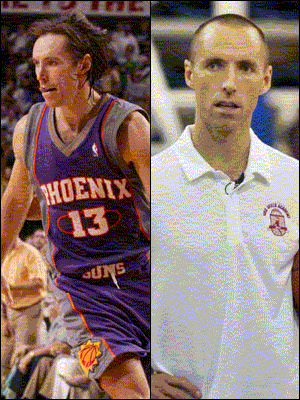
4. Item: It was a stunning blow to the Nike select team that showed up in Vancouver last week to hang out with national team coach Jay Triano and two-time NBA Most Valuable Player Steve Nash. Nash cut his hair. Not just a little, his head was buzzed. What this really means: Nash, unlike Samson, laughed it off. More than anything else, it shocked the 20 players who showed up to play and learn from the Canadian hero. It just further emphasizes what we've sensed all along — Nash is dancing to the beat of his own drum at all times. As he remains humble and incredibly committed to community service in Phoenix with the Suns and all over his Canadian homeland — from British Columbia to Ontario — he will do it his way and in his time. At 32, it's hard to fathom how long he can maintain the incredible pace with which he plays and at such a high level. The hope is that the return of Amare Stoudemire from a year off after microfracture knee surgery will relieve a lot of his offensive pressure. But it will be interesting how close Stoudemire actually will be to his budding superstar form of two years ago. Maybe the signing of Marcus Banks to a five-year, $21 million contract to backup Nash and help Leandro Barbosa will help as well. With clear orders from Robert Sarver to avoid a luxury tax, it will again test the highly-underrated coaching ability of Mike D'Antoni after consecutive trips to the conference finals. You wouldn't think the magic would be lost in Nash's swept away locks, would you?

5. Item: The Detroit Pistons introduced new acquisitions Nazr Mohammed and Flip Murray to the media last week, plus they resigned Lindsey Hunter and Ronald Dupree. What this really means: Before everyone throws up their hands in disbelieve — present company included — over the huge loss of Ben Wallace via free agency, let's consider the comparison of last year's team to this one. Mohammed will in no way bring the energy to the table that Wallace does. But his numbers may not be that significantly different if the team diversifies as much as it appears president Joe Dumars would like to see. Wallace, Rasheed Wallace, Tayshaun Prince, Rip Hamilton and Chauncey Billups were the top five in the NBA in minutes played the past three years and that caught up with them as they nearly failed to get even to the conference finals. With the additions of Mohammed and Murray, plus Flip Saunders committing to utilizing the bench more with Murray, Antonio McDyess, Hunter and Carlos Delfino, it should give them a more diverse look and feel. And the real hope is it will give them consistent bench scoring and strong legs at the end of the season. To be sure, the Pistons proved they are not one of the teams to be considered with greatness over the past 20 years, butt hey were in the NBA finals two years in a row and had the best record of all during the 2005-06 regular season. That should mean they will be one of the top four teams in the East again, but how good they really are may ultimately be decided by whether the intangibles of Ben Wallace can be replaced.

6. Item: With the signing of big men Jackie Butler and Francisco Elson, restricted free agents from the Knicks and Nuggets respectively whose offer sheets were not matched, the San Antonio Spurs now have completed the transformation of their frontcourt. What this really means: Just like how so many went bananas over the failure of the Pistons to return to the NBA finals, the death of the Spurs was greatly overestimated. Unloading Rasho Nesterovic for Matt Bonner and Eric Williams, plus letting Mohammed go, gives the Spurs much more depth and versatility up front than what they had around Tim Duncan last season. Besides, with Bruce Bowen's defensive proficiency on the wing — plus the backcourt of Tony Parker, Manu Ginobili, Michael Finley, Beno Udrih, Brent Barry and newly-signed point guard Jacque Vaughn — they have the deepest roster in the NBA. They can go very big or very small — with championship experience on the floor, the bench and the coaching staff. The only real questions would be the stamina of Parker and Ginobili.

7. Item: After looking so good in summer league, Nets rookie big man Josh Boone tore the labrum in his left shoulder, had surgery last week and will be out 4-6 months. What this really means: After feeling so good about stealing Connecticut stars Boone and Marcus Williams with the 22nd and 23rd picks of the first round, the Nets now are one short up front. Boone had looked superb earlier in the week putting up great Summer League numbers, then obviously hurt himself at some point during one of the later games last week. Has anybody else noticed how much Boone facially and physically looks like noted 7-footer Sam Bowie, who was the infamous No. 2 draft pick of the 1984 draft by the Trail Blazers instead of Michael Jordan. Bowie had missed two seasons with a broken leg at Kentucky and struggled throughout his NBA career, never attaining the greatness expected. But the irony and good news is the best portion of his career happened to be the four years he played with the Nets — averaging 12.8 points and 8.2 rebounds per game. If the Nets can get that out of Boone, they'll be thrilled. Let's just see him get back for the second half of this season first.

8. Item: With expectations of a deal for Al Harrington continuing to mount, the Indiana Pacers instead made their second trade of the summer with the Dallas Mavericks — sending backup guard Anthony Johnson to the Mavs in exchange for 38-year-old point guard Darrell Armstrong, along with throw-in youngsters Josh Powell and Rawle Marshall. What this really means: Obviously, the front office feels that Jamaal Tinsley, Sarunas Jasikevicius and Marquis Daniels — plus Armstrong — give them plenty at point guard. It also will help keep contracts away from luxury tax with what appears to be an inevitable deal for Harrington. The latest conversations with the Atlanta Hawks now reportedly have found the Hawks to be appeased by taking the $7.5 million trade exception in exchange for a sign-and-trade for Harrington at that number over six years. Maybe there will be a throw-in, but with the Hawks ownership still in a state of disarray, they don't want any more big contracts. It also means Harrington may be taking less from the Pacers than a sign-and-trade may have brought from Golden State. But he prefers to go back to Indiana, where his parents now live and where his career started with best friend Jermaine O'Neal. Over six seasons, the deal would be worth approximately $56.8 million — an average of just less than $9.5 million.

9. Item: The Pacers also rescinded the rights to guard Fred Jones, who turned around and signed a three-year, $11 million deal with the continuously changing Toronto Raptors. What this really means: Raptors president Bryan Colangelo wasted no time responding to John Salmons changing his mind. Salmons had originally agreed to a $23 million, five-year deal with the Sixers and a trade to the Raptors. Uncertain of his role after the signing of Anthony Parker and Mo Peterson's status, Salmons pulled out. That opened the door for Jones, who is two inches shorter at 6-4 and not as versatile as Salmons with the ball, but has shown far more flashes of an exceptional player. Consider now how much Colangelo changed the landscape from last year's 27-55 team. Beginning with the huge deal that brought point guard T.J. Ford for Charlie Villanueva, the Raptors have added Jones, Parker, Nesterovic, Darrick Martin, Kris Humphries, and rookies Andre Bargnani and P.J. Tucker. That's eight new players to go along with the burgeoning stardom of forward Chris Bosh. This isn't to say they will be in the playoffs, but, injuries aside, they should be one of the teams battling on the bubble for the final spot.

10. Item: The first week of coach Mike Krzyzewski as coach of the U.S. Senior National Team was spent getting to know the players and emphasizing team chemistry. Along with assistants Mike D'Antoni from the Suns, the Blazers' Nate McMillan, and Syracuse coach Jim Boeheim, there appears to be none of the unrest that was so apparent with Larry Brown and his staff the last time around. What this really means: The staff has the right idea, as do the players. Carmelo Anthony, no doubt buffeted by having his college coach Boeheim around, has been the standout along with Chris Paul. But, obviously, this is a star-studded cast and there might be some major surprises left home. Keep in mind, we're talking about LeBron James, Dwyane Wade, Chris Bosh, Gilbert Arenas, Amare Stoudemire, Elton Brand, Shawn Marion, Dwight Howard and versatile Joe Johnson, too. That's 11. Add role players with a defensive edge such as Bruce Bowen and Shane Battier, you've got 13. Add on Brad Miller, Antawn Jamison, and rookie Adam Morrison, and then consider point guards Luke Ridnour and Kirk Hinrich. They're off this week, and return to Las Vegas for another week, capped off with an exhibition game against Puerto Rico on Aug. 3. They then head to Asia with 15 players to play China and Korea in exhibition games for two weeks before going to Sapporo, Japan with the final 12 for the World Championships from Aug. 19-Sept. 3. The biggest concern appears to be redundant skills, so there could be some surprise cuts just to enhance the chemistry with role players. On the other hand, Colangelo and company have to be careful not to damage egos in this process. Otherwise, what appeared to be a well-conceived, and comfortable process for many, could be a problem. It's imperative for the perception of both USA Basketball and the NBA that the whining and lack of success that has permeated the process the past half dozen years or so is gone at least through the 2008 Olympics.

2) Marc Stein of ESPN.com thinks the Pacers are close to getting Harrington:

Pacers close to acquiring Harrington from Hawks

The biggest name still available on the NBA free-agent market is Al Harrington. Except that you'd struggle to find a team out there that considers Harrington available. Harrington's return to the Indiana Pacers via sign-and-trade with the Atlanta Hawks, according to various NBA front-office sources, is widely seen as a done deal. Perhaps the strongest indication that a formal announcement is forthcoming from Indianapolis is the fact that the Pacers' main competition for Harrington is no longer courting the versatile forward. The Golden State Warriors, sources said, have conceded defeat in the Harrington chase, fully expecting the 26-year-old to join the Pacers in a swap with Atlanta that would net Harrington a six-year contract worth a tad less than $57 million. It remains unclear who or what Atlanta would receive in the sign-and-trade arrangement, but the deal can be completed with the Hawks taking back recent or future draft picks -- or perhaps a moderately priced youngster, such as center David Harrison -- as opposed to significant salary. That's because of a $7.5 million trade exception Indiana created earlier this month by striking a sign-and-trade deal with the New Orleans/Oklahoma City Hornets involving Peja Stojakovic … after Stojakovic already had committed to sign a five-year, $60-plus million free-agent contract with the Hornets. With a modest cash payment believed to be in the $250,000 range, Indiana persuaded the Hornets to participate in a sign-and-trade swap for Stojakovic instead of signing him outright. The Pacers signed Stojakovic to the terms he and the Hornets negotiated and shipped the sharpshooter (plus cash) to New Orleans/Oklahoma City for the rights to 1998 second-round draft pick Andy Betts, who likely will never play for Indiana. Without the $7.5 million trade exception resulting from that maneuver, Indiana wouldn't be able to complete a sign-and-trade for Harrington unless the Hawks were willing to take back contracts in the same monetary range as Harrington's new first-year salary. Harrington's apparent willingness to start that new contract in the $7.5 million range, meanwhile, is expected to return him to the team that drafted the 6-9, 245-pounder in 1998 -- and has turned that trade exception into one of the most valuable assets of this NBA offseason. Harrington, sources said, initially told interested suitors he was expecting a six-year deal worth at least $66 million. For the Pacers to pay that much, Atlanta almost certainly would have to be willing to accept a package built around Indiana center Jeff Foster. But Foster, by all indications, is not part of the forthcoming trade. Indy's unforeseen trade exception gets Harrington fairly close to his financial target and the team he likes best. Better yet for the Pacers, their new Ron Artest replacement is regarded as a topflight athlete capable of playing small forward and power forward. When the free-agent period commenced July 1 and the Hornets secured a verbal commitment from Stojakovic within hours, it looked as though Indiana would lose its original Artest successor without compensation. The Pacers have been busy on other fronts, as well, according to sources, in hopes of reducing future salary obligations wherever possible as they prepare to absorb Harrington's big contract. They first rescinded a qualifying offer to shooting guard Fred Jones, suddenly making Jones an unrestricted free agent, and he quickly reached an agreement to sign with Toronto Raptors. Indiana also agreed this past weekend to trade point guard Anthony Johnson, who has two seasons left on his contract worth a little more than $5 million, for a package of three Dallas Mavericks that likely will be whittled to one. Veteran point guard Darrell Armstrong is the only Mav expected to stick with the Pacers after the deal goes through. Young forwards Josh Powell and Rawle Marshall are prime candidates to be waived. The Pacers also have shopped Foster (who earns $5.5 million next season) and guard Sarunas Jasikevicius ($4 million) this summer and might proceed with plans to move one or both to gain additional distance from the luxury-tax threshold. "Obviously, Indiana, I'm more comfortable there because I've been there, I've been in the East," Harrington told ESPN.com earlier this month at the Vegas Summer League, making it clear then that he expected to wind up with either the Pacers or the Warriors. "Going into free agency, obviously you think, 'I'm going to be at the bottom of the screen [on ESPN's Bottom Line ticker] like Ben Wallace and the rest of the guys.' But everyone's telling me to be patient, so that's what I'm trying to do."

Tuesday, July 25, 2006

Yikes…here’s a quote from Jean Strahan, who became the ex-wife of Giants defensive end Michael Strahan last week at a family court in Newark, N.J., commenting on why she needed to spend $27,000 on clothing for her twin daughters: "My daughters like to be accessorized. Isabella doesn't like to leave the house without a purse.'' By the way…her daughters have not yet turned two years old…

I you drink coffee, Jackie Robinson’s son has established a coffee company in eastern Tanzania…I can vouch for this fantastic coffee, and you’d be helping some folks out who really need it… http://www.sweetunityfarmscoffee.com/

The Raptors on Monday signed forward Jorge Garbajosa, the MVP of the last two Spanish Cup Finals, to a multiyear contract. Financial terms were not disclosed. Garbajosa, 6-foot-9, 245-pounds, spent the past two seasons with Unicaja Malaga, helping the team win the 2005-06 ACB League championship and the Spanish National Cup. This past season, he averaged 14.9 points and 6.9 rebounds and 35 minutes for Unicaja in the Euroleague this past year.

John Salmons signed a multi-year deal with the Kings…The 76ers' unrestricted free agent signed a 5-year, $25.5 million contract yesterday…Having completed four seasons on his rookie contract with the Sixers, the 6-6 Salmons was a restricted free agent when Phoenix offered a 5-year sign-and-trade deal that would have paid him $22 million; at one point, the Suns were convinced he was coming to them…Instead, he agreed to a sign-and-trade arrangement with Toronto that would have paid him $23 million. In both scenarios, the Sixers were to receive a second-round draft choice; the Suns' deal would have created a trade exception for the Sixers worth $1.8 million, the Toronto version would have created a trade exception of $2 million…weird…the dude gave up the chance to play for a free-flowing, running team in the best city in North America for a chance to play for a serious hard-ass control freak, in new Kings coach Eric Musselman in what’s commonly known as Cow-Town…oh well, enjoy the 3 hour practices, the strict play-calling in the half court, and the smell of fresh manure…and, of course, the yelling…

Yawn…Devean George about to sign with Dallas for the minimum…

I’ve been watching the Vegas summer league on Raptors TV…Some observations:

The Hawks continue to demonstrate why they suck…last year they drafted SF/ PF Marvin Williams thereby leading the league in SF’s…in doing so they passed on the Rookie of the Year at the PG position, one Chris Paul (who may be the US Natinoal team starting PG)…this year they drafted overrated Antonio Davis clone Shelden Williams at the PF spot, passing on possible Rookie of the Year candidate Randy Foye at the PG position…sound familiar? Foye averaged about 26 PPG in Vegas and was basically the best player in summer ball…Imagine he and Joe Johnson playing together in the backcourt…sounds perfect…except the Hawks screwed it up yet again…

Raptors top wop Andrea Bargnani is very skilled…he shoots well, especially spoting up and has a nice Dirk-esque fadeaway…terrific handle for a 7 footer, and great first step, especially going left…he has a decent post game and is aggressive down low…he has great hands and feet…however, he needs to keep his hands off…he led the world in fouls this summer…give him at least 20 games in the bigs before he and the refs figure each other out…however, the Dirk comparisons are not fair, as Bargnani has not developed the pull up off the dribble that makes Dirk so dangerous…

PJ Tucker is a player…he’s not a 2, or a 3 or a 4, but he is a player…tough as nails, posts up and just creates shots with his toughness and athleticism…he’s the kind of physical guy who beats you to death with that off arm…you love him on your team, but guarding him makes your dentist nervous…now if we could transplant his desire into Joey Graham’s body we’d have an All-Star…

LaMarcus Aldridge is La-young, La-weak and La-2 years away from contributing anything based on his play in the summer league…

However in Blazer-land, Brandon Roy looks fantastic…the game I watched he played the point flawlessly and they seamlessly switched to the 2 for the 2nd half…it’s like he’s been in the league for 10 years…

Chad Ford of ESPN.com reports on his Summer League oberservations:

The good, the bad and the murky of summer league

Grading picks on draft night is a shaky proposition. Just an hour or two after the draft is way too early to give a full assessment of how a team selected. We learn a little more in the NBA summer leagues, but summer success isn't a very accurate predictor of stardom, not when players like Loren Woods, Shammond Williams and Nikoloz Tskitishvili have made the honor roll in previous summers. A more accurate gauge of a player's future performance is an inability to thrive in a summer league. If a player can't produce against the watered-down competition in the summer, he'll struggle mightily to get it done against real NBA players during the season. This year the NBA held four summer leagues across the country -- the Reebok Vegas Summer League, the Orlando Summer League, the Southern California Summer Pro League in Los Angeles and the Rocky Mountain Revue in Salt Lake City. To get the skinny, Insider queried a number of NBA scouts and executives who attended the four leagues: Who played well? Who bombed out? How does the performance of rookies and sophomores affect team draft grades for the past two years?
Here's what the NBA Boys of Summer were up to in July:

THE GOOD

Charlotte Bobcats: We've been lukewarm toward Charlotte's last two drafts. But after the Bobcats' play in the Orlando league, we might have to adjust our draft grades a bit. This year's first-round pick, Adam Morrison, earned rave reviews. He showed he could score in summer league, averaging 24 points in 31 minutes. But he shot less than 40 percent from the field (less than 30 percent from 3-point country), averaged only 2.6 rebounds and struggled defensively, so it might be premature to put him in the All-Star Game just yet. Last year's second lottery pick, Sean May, was better. He averaged 18 points, shot 50 percent from the field and played strong defense. Raymond Felton played just one game before pulling out with a small injury. But that doesn't matter. Felton's strong play toward the end of last season proved he belonged in the league.

Boston Celtics: It's sometimes hard to decipher what Danny Ainge is doing with his roster, but when it comes to the draft, you have to like the results for the Celtics. One of the Celtics' second-round picks last year, Ryan Gomes, was one of the three or four best players in Vegas, continuing his strong play from last season. This year's first-round pick by the Celtics, Rajon Rondo, earned rave reviews from scouts (including some who mocked me when I kept Rondo in the top 10 on my prospects list on draft night). They are calling Rondo the steal of the draft. Rondo was second in the league in assists, showed his open-court skills, played excellent defense, kept mistakes to a minimum and shot the ball well (albeit by avoiding long-range jumpers). Last year's first-round pick, Gerald Green, was up and down. He's got NBA athleticism and size plus a beautiful 3-point shot (he shot 55 percent on 3s in Vegas). While he makes a lot of mistakes, he's still young and the talent is undeniable. Celtics fans are just going to have to be patient. Another steal was the undrafted Allan Ray, whose performance was among the best in Vegas, earning him a contract with the Celtics. Given the number of young players already on the roster, that's pretty impressive. Al Jefferson wasn't as bad as some have said, but compared to the kid who dominated the summer league two years ago, he does seem to have regressed. Still, Jefferson can rebound and he can score in the paint. His lack of aggression has some scratching their heads, but the scouts I talked to were all still generally positive about Jefferson's long-term future. It's just going to take him a little longer than the Celtics first thought. Sebastian Telfair, whom Boston acquired with a lottery pick, was solid. He ran the team well and in flashes was the pure point guard the Celtics need. But he didn't shoot the ball well and led the team in turnovers. Considering whom the Celtics could have drafted at No. 7 (either Brandon Roy or Randy Foye), it looks like Boston might have gotten the short end of the stick. Roy, Foye and Rondo all look like they have more NBA potential than Telfair. On the other hand, the Celtics did save some money in the trade by swapping Raef LaFrentz for Theo Ratliff.

Chicago Bulls: Thabo Sefalosha showed he's going to be able to step in right away and contribute to the Bulls. Sefalosha played only two games, but he excelled at just about everything -- he shot the ball well, played great defense, handled the ball a little and rebounded. Chicago's higher pick, Tyrus Thomas, was more of a mixed bag. When Thomas stuck to what he does well -- rebounding, shot-blocking and playing around the basket -- he looked very good. When he tried to be a wing player, the results weren't so hot. Thomas, a natural power forward, took six 3-pointers in Orlando and made just one. While there is talk that he might be able to play small forward someday, it's going to take a while before he can contribute there -- especially since the Bulls upped the stakes by adding Ben Wallace to the mix. If Thomas sticks to what he does well, he has a shot at breaking into the rotation this year.

Utah Jazz: Utah GM Kevin O'Connor has taken a beating for his draft performance the past decade. Before the 2005 draft, the Jazz had drafted DeShawn Stevenson, Raul Lopez, Curtis Borchardt, Sasha Pavlovic, Kris Humphries and Kirk Snyder in the first round. They are no longer in Utah, and only Stevenson has shown signs of being a legit NBA player. O'Connor's fortunes changed last year. While he's been derided for selecting Deron Williams over Chris Paul, Williams continues to show that he's got a bright future in the NBA. His play the last month of his rookie season for Utah was strong, and in the two games he played at the Revue, he looked great. Williams probably won't have as stellar a career as Paul, but he's a good fit in Utah and should be their lead guard for the next decade. Ronnie Brewer has the Jazz singing his praises. This year's first-round pick, Ronnie Brewer, has Jazz fans salivating. Brewer was dynamite in Utah, averaging 16 points on 56 percent shooting. He played excellent defense, filled multiple positions and showed he'll fit a serious need for the Jazz with his ability to drive and get to the rim and the foul line. Brewer probably will begin the season coming off the bench, but it's not out of the question that he'll be in Jerry Sloan's starting lineup before the season ends. A couple of second-round picks, C. J. Miles and Paul Millsap, also were solid. Miles showed the ability to score, and Millsap proved that he's going to be able to rebound at the next level.

Minnesota Timberwolves: The Wolves had only one rookie to speak of, Randy Foye, but he was awesome. Foye was a scoring machine in Vegas, averaging a summer league-high 24.8 points while shooting an impressive 53 percent from the floor. Foye was impossible for defenders to stay in front of and he got to the basket at will. Given the recent rule changes, he should have the same sort of success at the next level. He looks like a real steal for the Wolves, though the arrival of Mike James in the backcourt might mean that there won't be enough basketballs to go around in Minnesota.

Indiana Pacers: The Pacers quietly have been exploring ways of rebuilding their team this summer without tearing things apart. In part that's because they are bullish on four young players on their roster. Danny Granger was the steal of the draft last year and he continued to show maturity and poise beyond his years at Orlando. Granger didn't go out to dominate, but still averaged 17.3 points and 5.0 boards for the Pacers. His shot wasn't really falling in Orlando, but his play still gave the Pacers reason to be hopeful that he'll be a major contributor to the team next year. Big man David Harrison continued to show improvement. He played only two games but was dominant when he was on the floor. This year's rookies were more of a mixed bag. Shawne Williams played just one game and struggled shooting the ball. Second-round pick James White had an excellent summer league and drew very positive reviews from several scouts. His defense and poise really stood out, according to scouts, and he shot the ball quite well.

Memphis Grizzlies: After a string of disappointing drafts, it looks like Jerry West is back. Hakim Warrick played very well in the Summer Pro League for the second straight season. This year's lottery pick, Rudy Gay, played in just two games, but was dominant in both. The Grizzlies' other first round pick, Kyle Lowry, was up and down. Based on what scouts saw in Los Angeles, it looks like Lowry might be another year away before he gets much burn. Everyone was much more excited about second-round pick Alexander Johnson, who dominated in Los Angeles with his strength and athleticism. But Johnson is older and more physically mature than most of the players he was up against. Will he be able to use his raw power as effectively in the regular season?

Philadelphia 76ers: The Sixers didn't get to see much of this year's picks, Rodney Carney and Bobby Jones, as injuries limited both to three games. Carney was very solid in all three games. Jones didn't make a shot. The good news is that two second-round picks from 2005 shined for the Sixers. Louis Williams showed he could fill the void of an undersized 2-guard who shoots too much if Allen Iverson gets traded. Williams took a whopping 97 field-goal attempts and another 42 free throws in six games for Philly. He averaged 22 points and shot 47 percent from the field. Shavlik Randolph had 25 points and 13 rebounds in his only appearance for the Sixers.

New Jersey Nets: Some believe the Nets got the steal of the draft in Marcus Williams, and he didn't disappoint in Orlando. He slimmed down to a svelte 204 pounds and ended up averaging 16.6 points and eight assists with 46 percent shooting, including 55 percent shooting from the 3-point line. He did have some problems with turnovers and defense, but looked like he was well on his way toward solving the Nets' problem backing up Jason Kidd. Last year's first-round pick, Antoine Wright, had a miserable season, but picked things up in the summer league, averaging a team high 17.2 points on 47 percent shooting and 50 percent shooting from 3-point territory. While scouts still have some questions about his defense, athleticism and ability to create his own shot at the next level, they thought his performance was solid. We gave the Nets a hard time for drafting Josh Boone, but he was good in Orlando before a shoulder injury hurt him in the last game. Boone has to have shoulder surgery and will miss much of the first half of the season.

THE BAD

Phoenix Suns: The Suns do so many things right that it's tough to criticize them. They remain my favorite team in the league to watch, and with Amare Stoudemire returning, they have a great shot at winning it all next season. But after years of being one of the best teams at drafting, I think the Suns screwed up their last three drafts, badly. In 2004, the Suns traded their pick to the Bulls for Chicago's 2005 first-round pick. It turns out they could've had their choice of Luol Deng or Andre Iguodala. The rationale was that the team needed to save money to make a run at a free agent. They used the said saved money to sign Quentin Richardson. Richardson was solid, but the Suns almost immediately regretted overpaying him to the tune of $45 million and traded him to the Knicks the next summer. The Suns used that Bulls 2005 pick (which was much lower than they had originally expected, thanks in part to the Bulls grabbing Deng) to draft Nate Robinson. They then traded Robinson and Richardson to New York for Kurt Thomas. The rationale was that the Suns needed toughness and they needed to save money. Thomas was solid, but ran out of gas in February and spent the rest of the season on the injured list. This year, the Suns traded both of their first-round picks (Rajon Rondo and Sergio Rodriguez) for a future first-round pick, and cash. Again the rationale was that the team wanted to save the cap room so that they could spend in free agency. Their primary target, John Salmons, spurned them, and they ended up throwing way too much money at Marcus Banks when Salmons went another way. So after three drafts, what do the Suns have to show for it all? A broken down Kurt Thomas (with $16 million left on his contract), an overpaid/undersized back-up guard in Banks and the Cavs' first-round pick next season. Would you trade those assets for a combination of Deng (or Iguodala), Robinson and Rondo? On talent, there's no way. And when you factor in how cheap rookies are compared to free-agent vets, you wouldn't do it for the money, either. The bottom line is: Part of the reason the Suns are having cap problems is that they aren't totally taking advantage of cheaper rookie contracts. When Leandro Barbosa and Boris Diaw sign their extensions (Barbosa is closer than Diaw right now to inking a deal), the team won't have any young players in the pipe earning cheaper contracts. The Suns have three potential first-round picks next year. Let's hope they've learned their lesson. Add Deng or Iguodala to that already stacked Suns roster and I think they'd be the favorite to win the West next season.

Clippers: As most of you know, I'm not one who automatically believes that international players are dubious NBA prospects. I actually go overseas, evaluate them and don't discount them because their names sound funny. But I think Mike Dunleavy went overboard when he drafted Yaroslav Korolev ahead of players like Danny Granger, Sean May, Rashad McCants and Gerald Green. Korolev averaged 10.8 points on 35 percent shooting. He shot 25 percent from 3-point territory, couldn't guard anyone and led the team in turnovers. At this point, it looks like we're going to have to wait another year before we can see if Korolev can play. Combine that with the uneven play of a guy on whom I was high on in the 2004 draft, Shaun Livingston, and it's tough to put the Clippers in any other category. Second-round picks Daniel Ewing and Guillermo Diaz played better, but not well enough to make up for Korolev.

Warriors: The Warriors also have drafted well in the past, but their young guys didn't show much in Vegas. 2004 first rounder Andris Biedrins actually looked like he might have taken a step back. Patrick O'Bryant put the P in project and Ike Diogu missed the summer league with more injuries.

Spurs: The Spurs are famous for either trading their first-round pick or selecting some obscure international player. Two of the said mystery men showed up in Utah at the Rocky Mountain Revue and there wasn't much to like. Ian Mahinimi looks like he has the raw tools but looks to be years away. By the way Sergei Karaulov played, according to scouts, he might never play in the league.

Heat: The Heat didn't have a pick this year so they went with their first rounder from two years ago, Dorell Wright, and a slew of undrafted players from this year's draft -- Mike Gansey, Kevin Pittsnogle, Eric Hicks, and Daniel Horton. Wright was a disappointment, according to scouts. He had a couple of solid games for the Heat, but was plagued with inconsistency. He's still young and has a lot of talent, but for a third-year player in the summer league, scouts expected more. Gansey, Pittsnogle, Hicks and, to a lesser extent, Horton all justified the 30 teams that passed on them on draft night. None of them stood out. The good news is that an undrafted center out of Memphis, Earl Barron, was one of the dominant players in the camp. He probably won't get much blow behind Shaq and Alonzo Mourning, but if one of them goes down, he could see some minutes. If he plays the way he did in Orlando, he could be a sleeper.

Magic: The Magic's first-round pick, J. J. Redick, sat on the sidelines and cheered. His back injury forced him to miss the summer league and the USA basketball tryouts -- not the start you want from your lottery pick. Combine that with last year's lottery pick, Fran Vazquez, hanging out in Spain and the Magic's draft gurus are not looking so hot right now. Their second-round picks were a mixed bag. Second-year point guard Travis Diener was great by all accounts, though scouts weren't sure whether anything he did in the summer league would translate in the NBA. Diener didn't have much talent on his team and ended up dominating the ball. 2006 second-round pick James Augustine was his usual low-key self. Not sure if that's a good or bad thing.

MUDDY WATERS

Hawks: On the bright side, last year's No. 2 pick, Marvin Williams, tried to shut all of us up for criticizing the Hawks for passing on Chris Paul to draft him last year. Williams was awesome at the Rocky Mountain Revue, averaging 23.2 points, 7.5 rebounds and 4.8 assists while shooting a red hot 55 percent from the field. Williams did a little of everything, but most importantly, he was aggressive putting the ball on the floor and getting to the basket. No one could defend him here. If he shows up playing like that next season, the Chris Paul criticism will hush. I am still holding true to two seemingly inconsistent propositions. I still believe that in five years Williams will be remembered as the best player in the 2005 draft. And I still think the Hawks made a mistake by passing on Paul. Had they drafted Paul, they could keep Al Harrington this summer and have a team that could approach 35 to 40 wins next year. As it stands now, Speedy Claxton is now Chris Paul and makes a lot more money. Williams is a better prospect than Harrington, but it looks like the Hawks are in for another long season. Second-round pick Salim Stoudamire also played well, shooting an impressive 55 percent from the field and 50 percent from 3-point territory. This year's picks didn't fare so well. The general consensus was that Shelden Williams was the most disappointing lottery pick in the summer league. For a guy that was drafted this high because he was supposed to be NBA ready, Williams averaged just 8.0 points and shot a miserable 33 percent from the field. "I was high on Shelden before the draft," one NBA executive at the Rocky Mountain Revue told Insider. "But after watching him here I have to say that I think I was wrong. I never want to read too much into the summer league, but every one of Shelden's weaknesses looked glaring here. I'm not sure he'll overcome them. That's not fair, but he's not going to grow or get more athletic and that was what was holding him back. I don't think he has the craftiness in his game to overcome those shortcomings." With the two guys drafted right behind Williams -- Brandon Roy and Randy Foye -- looking awesome, this could be the last nail in the coffin for Billy Knight.

Blazers: On the positive side, Brandon Roy looks like the potential Rookie of the Year candidate we touted him to be the night of the draft. The Blazers played him out of position at point guard and he handled himself surprisingly well. When they switched him to shooting guard the last day, he went off for 35 ppg on 13-for-22 shooting. He ended up averaging 19 points, 3.6 rebounds, 3.5 assists while shooting 65 percent from the field and 67 percent from 3-point territory. The Blazers had less luck with their other two first-round draft picks. Last year's first-rounder, Martell Webster, started off the summer league with a bang by scoring 29 points against the Rockets. But after that he struggle with his shooting, finishing with a 1-for-11 performance against the Suns. Shooting is Webster's best asset right now and while you can't quibble with a 40 percent shooting performance from 3-point territory for the summer league, he didn't play as well as his talent suggests he should. LaMarcus Aldridge didn't play like the No. 2 pick in this year's draft until his last game against Phoenix, when he scored 19 points and grabbed nine rebounds. Otherwise, he appeared to lack the strength to play down low and spent too much time hanging around the perimeter. One other former first-rounder, Travis Outlaw, was solid, but didn't have the dominating performance he put up in Vegas last year. A few of the Blazers' second-round picks -- Ha Seung Jin, Nedzad Sinanovic and Joel Freeland -- didn't show much of anything.

Knicks: Last year's Knicks rookies all played well in Vegas. David Lee was the best of the group, hustling up and down the floor, grabbing rebounds and scoring in a multitude of ways. Nate Robinson showed he could run the point a little, at least part time, but continued to have problems shooting the ball. Channing Frye played two games. In the first he looked great, the second he struggled. This year's first-round pick Renaldo Balkman was disappointing & for Knicks haters. Everyone was ready to blast Isiah Thomas for making the biggest draft blunder of the century but Balkman actually played well. Not well enough to justify being drafted ahead of Rajon Rondo or Marcus Williams, but he hustled, grabbed rebounds and showed a lot of energy. I'm not sure how he makes it into the rotation in New York, but given all the pressure on this guy to perform, he did well. Meanwhile, Mardy Collins looked like he won't see the light of day in New York for the next decade.

Raptors: Raptors GM Bryan Colangelo can breathe a sigh of relief. He stuck his neck out drafting Andrea Bargnani with the No. 1 pick and, by all accounts, scouts were impressed with Bargnani's scoring mentality, outside shooting and his ability to put the ball on the floor and get to the rim. Scouts said he still needs a lot of work in the weight room, at the defensive end and on the boards, but felt that he was more advanced than they had thought. Last year's first-rounder, Joey Graham, was up and down. Ditto for this year's second-rounder, P.J. Tucker.

Hornets: Last year's first-round pick, Chris Paul, won the Rookie of the Year and is playing for Team USA so he was exempt. This year's top two picks were OK. Hilton Armstrong played well in two of the three games he played. He hustled up and down the floor, shot a high percentage from the field and played solid defense. Cedric Simmons really struggled on the offensive end, shooting just 37 percent from the field. But he was solid on the boards and played good defense. If you could combine him with Armstrong, you might have a complete big man. Last year's second-round pick, Brandon Bass, was disappointing.

Lakers: The Lakers got exactly what they expected from big man Andrew Bynum. One night he looked great. The next, ugh. He's a young big man who is still at least another year away from doing anything for the Lakers. He's got lots of talent, let's just hope he doesn't suffer sitting at the end of the bench. Jordan Farmar played pretty well, according to scouts, but no one sees him getting major minutes in L.A. this season.

Sonics: Everyone in Utah was pleasantly surprised to see how well Mouhamed Saer Sene played. Sene was billed as a player that was three-to-four years away from playing in the league. But his shot-blocking, defense and a few surprising offensive moves have everyone reassessing that. The leap from summer league to the NBA is huge, but Sene does things that should be able to translate. He ended up averaging 3.75 blocks in just 22 minutes. On the downside, the Sonics' other two young players, Robert Swift and Yotam Halperin, really struggled. Swift shot a miserable 30 percent from the field and Halperin seemed to struggle with the speed of the league.

Wizards: The Wizards appear to have an interesting prospect in Andray Blatche. He's a 6-foot-11 athlete who likes to spend most of his time facing the basket. He's very active and can do a little of everything. Some scouts compared him to a poor man's Rasheed Wallace. This year's first-round pick, Oleksiy Pecherov, was up and down but had a few stellar games against the Raptors and Knicks. However, based on the Wizards' signing of Darius Songalia, Pecherov probably is heading back to France or the Ukraine.

Kings: Kevin Martin continued to show that he knows how to put the ball in the basket, though he shot just 37 percent from the field in the Vegas Summer League. Francisco Garcia continues to appear to be a mistake. He shot 33 percent from the field and 14 percent from 3-point territory. The Kings drafted him for his shooting. Ouch. This year's rookies were better. Quincy Douby was solid. He scored, played some point guard and shot 40 percent from 3-point territory. Undrafted rookie Louis Amundson was a crowd favorite in Vegas with his athleticism and hustle. His 10.4 points, 7.4 rebounds and 69 percent shooting from the field might earn him a roster spot with the Kings.

Cavs: The Cavs were pleased with the play of Shannon Brown, who showed he's going to be a handful to defend at the next level. Daniel Gibson was a mild disappointment. He was a highly regarded second-round pick who played like an average second-round pick. Martynas Andriuskevicius still looks like he's a few years away, but you can't teach height: He's 7-foot-3. Let's just hope the Cavs figure out how to teach him to play.

Pistons: The Pistons got a pleasant surprise from last year's second-rounder Amir Johnson. His length and athleticism had several scouts saying he's another year away from being a big-time prospect. Last year's first-rounder, Jason Maxiell, was solid though his shooting and free-throw percentages were eerily reminiscent of Ben Wallace. Last year's second-round pick, Alex Acker, had a few good games scoring. But he didn't shoot the ball particularly well. This year's second-round picks, Will Blalock and Cheik Samb, were a mixed bag. Samb was surprisingly solid rebounding the ball and blocking shots. He has to get stronger, but he could be a sleeper. Blalock led the team in assists but didn't shoot the ball well.

Mavs: The Mavs appeared to have picked up a keeper in Maurice Ager. He shot the ball really well in Vegas, averaging 20 points and shooting 47 percent from 3-point territory. His averages dipped by the time he hit the Rocky Mountain Revue, but considering how many games he played, you expect the legs to go a little. The same could be said for Pavel Podkolzine. He looked solid in Vegas averaging 11.6 points and 7.2 rebounds in 21 minutes. He shot 60 percent from the field and even had a 20-point, 10-rebound game against the Kings. His legs were completely gone by the time he hit Utah, however, and he struggled mightily in the Rocky Mountain Revue. Still, for a 21-year-old, 7-5 kid, he showed enough promise to keep the experiment going.

Monday, July 24, 2006


Probably one of the funnier pictures that have come out of the USA National team training camp...I can just imagine the caption: "No you stop it...No you stop it...stop tickling Bron-Bron...No you stop ticking Dwyaney Wadey..."

I saw a kid with a crazy spin move on the playground a few days ago. This kid had the move down pat, gpoing left or right and did the spin very instinctly…never hurried or out of control, but using his body to shield the ball, making the contact and then using the defenders momentum to support the spin and slip past with full control over his dribble. Just a tremendous spin move. I told him: “You know, you’re going to have that move for as long as you play basketball…seriously, when you’re 40 years old, you’ll still school 20 year olds with that move…” That got me to thinking, who had the best spin move ever…the answer is obvious…it was “Black Jesus”…or as he was otherwise know Earl “The Pearl” Monroe…how good was Monroe? This good:

College:

As a college senior at Winston-Salem State in 1966-67, Monroe led his collegiate squad to an NCAA Division II title while averaging 41.5 points
The Sporting News First-Team All-America (1966)
All-America (1966, 1967)
Holds Division II single season record for most points in a season (1,326, 41.5 ppg) in 1967
NCAA College Division and NAIA Leading scorer (1967)
Led Winston-Salem to NCAA College Division championship (1967)
Outstanding player in NCAA College Division Tournament (MVP)
NCAA College Division All-Tournament Team (1967)
Scored 2,935 points (26.7 ppg) in 110 games
Enshrined in NAIA Hall of Fame (1975)
NAIA Golden Anniversary Team (1986)

Pro:

NBA Rookie of the Year (1968)
All-NBA First Team (1969)
Four-time NBA All-Star (1969, 1971, 1975, 1977)
Scored 17,454 points (18.8 ppg) in 926 professional games, 21st best in history upon retirement
Scored over 1,000 points in nine professional seasons (1968-71, 1973, 1975-78), including a career high (2,065, 25.8 ppg) in 1968-69
As a rookie, scored a career-high 56 points against the Los Angeles Lakers (Feb. 13, 1968) in overtime, third highest rookie total in history
Dished out 3,594 (3.9 apg) assists
NBA championship with New York Knicks (1973)
NBA finalists with Baltimore Bullets (1971)
On Feb. 6, 1970, set an NBA record with 13 points in one overtime in a double overtime victory over Detroit; now second best
NBA 50th Anniversary All-Time Team (1996)
Knicks retired his jersey

Good Trade for the Mavs: The Pacers send PG Anthony Johnson to the Dallas Mavericks for PG Darrell Armstrong and SF Josh Powell and SG Rawle Marshal

With no Salmon(s) in the water, the Raptors go fishing for Jones: Free agent guard Fred Jones will sign with the Toronto Raptors, his agent said Sunday. Jones, a former slam-dunk champion, spent the first four years of his NBA career with the Indiana Pacers and played a key role while the team fought through injuries and suspensions the last two seasons. The 6-foot-2 leaper from Oregon averaged 9.6 points a game as a backup last season, and 10.6 points and 3.1 rebounds two seasons ago.

1) From Mike White of the Pittsburgh Post-Gazette, an interesting article about Vince Carter speaking at the prestigious Five-Star summer camp:

NBA star 'on stage' at Five-Star Camp

Did you know Vince Carter and Shaquille O'Neal have a secret gentlemen's agreement that when one goes into the lane for a dunk, the other will get out of the way? Did you know one of Carter's goals is to dunk on Yao Ming? And did you know one of the deciding factors in Carter choosing the University of North Carolina years ago was Coach Dean Smith coming to the Carter family home in Florida and talking about academics before basketball? About 250 high school boys learned all of the above -- and a lot more -- about Carter yesterday. They seemed to be happy campers, sitting on the basketball court inside the Sewall Center at Robert Morris University, getting up close and personal with an NBA star. Carter, who plays for the New Jersey Nets, was the guest speaker at the Five-Star Basketball Camp, which is in its 41st year of operation. He gave a speech for about 15 minutes and then answered question after question for the next 45. "What did he answer 80 questions?" said Five-Star director and founder Howie Garfinkel. "We've brought NBA guys in here before and they're done in about 20 minutes. Vince was like a guy on stage here."
The campers, coaches and counselors saw a side of Carter that can't be viewed on the court or on "SportsCenter" highlights. He's well-spoken and has a sense of humor that had the campers laughing numerous times. This is a guy who used to be the drum major at his high school.
Carter, 29, was once in the same place as the Five-Star campers. He attended Five-Star in the early 1990s and North Carolina discovered him there. When Garfinkel asked him to speak to the camp, Carter gladly accepted. He flew in from his home in Orlando on his private jet, spoke and then headed back to Florida to speak to more kids at a gathering last night. Carter yesterday became the 15th former camper inducted into the Five-Star Hall of Fame, which also includes Michael Jordan, Patrick Ewing, Alonzo Mourning, Isaiah Thomas and Moses Malone. "I enjoy speaking to kids and shedding light on the reality of life and basketball," Carter said after his talk. "Parents and coaches talk to kids about education and other things, and sometimes it goes right over their head. But when they hear from an athlete in the NBA, maybe they pay attention a little more. It's nice to see how attentive they can be and the questions they ask are good. They don't ask things like, 'How many girls did you see on All-Star weekend?' " Garfinkel told the campers how Carter donated $2.5 million to his alma mater, Mainland High School in Daytona Beach, Fla. The campers heard about Carter's Embassy of Hope Foundation that raises money for the needs of children and their parents. Although Carter left college for the NBA after his junior season, he told how he went back and got a degree in African-American studies from North Carolina. On the morning of an NBA playoff game, he attended graduation ceremonies at North Carolina, a move that caused some criticism from the media and fans. "If I had to do it all over again, I'd do the same," Carter said. "It was one of my goals to walk across that stage and get my degree." Carter was asked about one of his famous dunks in the Olympics years ago. "The guy was 7 feet 2," he said. A Five-Star coach then informed Carter there was a 7-3 camper in the audience. When the camper stood up, Carter said, "Yeah, he looked like him." Carter was asked about particular NBA players, such as Kobe Bryant, LeBron James and Dwyane Wade. "Kobe gets away with murder and they let LeBron and Dwyane travel with the ball," he said. Then one camper yelled, "What about T Mac [Tracy McGrady]?" McGrady and Carter are cousins…"Ahhh, T Mac stinks," Carter said before he and the campers burst into laughter.

2) A fascinating article from Bob Hohler about summer AAU ball and the sneaker companies:

Wading in cesspool - Officials for amateur teams admit doling out cash to players

It's a sleepy Saturday afternoon in the foothills of the Ozark Mountains, and Rakim Sanders, a 16-year-old hotshot from a Rhode Island housing project, has created a buzz at a Boys and Girls Club on the edge of town. Recruiters from major colleges across the country have trekked in April to the gym on a dead end street in northwest Arkansas to pay respect to Sanders, a sleek, 6-foot-5-inch shooting guard. Assistant coaches from Boston College and the University of Connecticut anchor a group watching Sanders from one end of the basketball court while rivals from Providence, Syracuse, and other Division 1 powers stand vigil at the opposite end. As New England's top college basketball prospect in the high school class of 2007, Sanders -- a high-scoring junior at St. Andrew's School in Rhode Island -- has received scholarship offers from BC and Providence and has been projected by a basketball trade publication as a 2010 selection in the NBA draft. (Two weeks later, on May 1, he verbally commits to BC.) Sanders also is the jewel of the Adidas-backed New England Playaz, an elite travel team based in Springfield. And he will receive a special benefit from the Playaz after he performs at the Real Deal on the Hill Tournament in Fayetteville, a major weekend showcase that attracts the nation's top college recruiters and scouting services. Playaz president Thomas J. ``TJ" Gassnola has paid for Sanders to travel not only from New England to Fayetteville, as Gassnola has done for the entire team, but also to fly after the tournament from Arkansas to Orlando to vacation with his brothers and sisters at Disney World. Gassnola then will pay for Sanders to fly home from Disney World. Never mind that NCAA rules bar amateur teams such as the Playaz from paying for anything but ``actual and necessary travel, room and board, and apparel and equipment for competition and practice." Gassnola, who has a lengthy criminal record and rich history of financial delinquency, says he also will slip his star player $100 to spend during his Disney vacation. ``The kid has no money, so I'm helping him out," Gassnola says. ``You want to throw me in jail for that? Go ahead." Since Sanders will not be subject to NCAA rules until he enrolls in college -- and since no other agency closely regulates such activity -- the chances of anyone facing sanctions for Gassnola's special gift to Sanders are remote. ``It's all loosely regulated, at best," says Robert Kanaby, executive director of the National Federation of State High School Associations. ``We may just have to hope for some sense of voluntary compliance by the individuals who are making [the system] so lucrative and rewarding." So it goes in the shadowy corners of the high-stakes scramble by multibillion-dollar sneaker conglomerates to adorn America's basketball stars of tomorrow in their brands. Each of the three major companies -- Nike, Adidas, and Reebok -- spends millions of dollars sponsoring ``grassroots" teams like the Playaz and other youth programs, hoping their teen sensations one day will become endorsement giants, a la Michael Jordan (Nike), Tracy McGrady (Adidas), and Allen Iverson (Reebok). ``The theory remains the same: We're all looking for the next Michael," says Sonny Vaccaro, who revolutionized the market by signing Jordan for Nike in 1984 and now serves as Reebok's senior director of grassroots basketball. Dreams are made and dashed at national camps and tournaments like the Real Deal, where big-monied sneaker companies and college coaches often determine the future of the nation's most promising amateur athletes. It's a basketball meat market, and the stakes are enormous for everyone: Company-sponsored recruiters like Gassnola who have scoured gyms and playgrounds to deliver the best players they can enlist for the showcase; players like Sanders, whose futures can hinge on their brief auditions before the nation's top college coaches; colleges like BC, whose fortunes can rise or fall on the players in whom they decide to invest lucrative scholarships; companies like Adidas, whose bottom lines can be determined by how many of the players they sponsor make it big. If the companies or their representatives play fast and loose in the process, they rarely answer for it, as team officials such as Gassnola operate in a subculture in which pioneers like Vaccaro and Nike executive George Raveling set the standards, for better or worse. Raveling, who followed Vaccaro as head of Nike's grassroots program, has acknowledged giving $100 to Amare Stoudemire's mother, Carrie, in 2000 while she was jailed on theft charges (Nike was wooing Amare before he turned pro). Stoudemire has since signed endorsement deals with Nike worth an estimated $33 million. Vaccaro acknowledges that as an Adidas executive in the 1990s he bought street clothes for NBA player Lamar Odom when Odom played for an Adidas-funded youth team (Odom later signed with Nike). Vaccaro also says in an interview near his multimillion-dollar home in Calabasas, Calif., that he has provided players money for expenses not directly related to basketball, which critics decry as improper preferential treatment and the NCAA could consider a violation of its rules on amateurism. ``I would do that, absolutely," Vaccaro says of regularly giving players money for food and other expenses unrelated to basketball. ``There's no hard-line rule against it and it would be asinine to put one in because you couldn't monitor it." Vaccaro acknowledges the sneaker companies participate in a system that exploits amateur youths for financial gain. ``It's a cesspool," he said, ``but everybody's involved in it: the sneaker companies, the NBA, the colleges, and the high schools." Vaccaro, Gassnola and others justify the practice in part by citing the profits that sneaker companies, colleges, professional teams, television networks, agents and others make on teenagers, many of whom are poor. ``I live in a beautiful place and I'm pretty damn successful," Vaccaro says. "For a lot of these kids, it's a rough life." A number of coaches whose players Gassnola tried to lure away see it differently. ``We don't want to be associated with street agents, and that's the best way I can think of to describe him," says Mike Crotty, director of the Belmont-based Middlesex Magic, whose players pay to participate. Sanders says he just wants to survive financially. He was 11 when his mother died in 2000. His sister, Nyisha, who was 18 at the time, has since raised him and four other siblings at a low-income project in Pawtucket, R.I. Sanders's basketball ability helped land him at St. Andrew's, a small private school with a strong basketball program, and he hopes his athletic skills carry him further. ``I just want to get into college and not have my sister have to pay for it," Sanders says after leading the Playaz to victory in their first two games of the Real Deal's 17-and-under division. ``Making it through school for free, that would be the best thing for me." Gassnola, who has lured away numerous players from summer teams in Greater Boston, including the Nike-backed Boston Amateur Basketball Club, has reached into Rhode Island for Sanders and a point guard, Andrew Hanson, one of 12 children from a Narragansett family who also attends St. Andrew's. The Playaz have picked up a pair of 6-8 forwards from Springfield: Garrett Kissel, whom Gassnola helped enroll at St. Andrew's, and Travon Wilcher , whom Gassnola steered to Lee Academy in Maine. The team features two other talented guards: Sedale Jones, a prolific scorer from Pittsfield High School, and Dominique Price, a star for Holy Name in Worcester. Gassnola's second-leading scorer is 6-3 Corey Bingham, a 2005 Globe All-Scholastic at Lynn Tech who joined Wilcher at Lee Academy. Gassnola also helps some of his players choose colleges, as he did last year with former Lynn Tech star Antonio Anderson. With several top Division 1 teams pursuing him, Anderson selected Memphis, whose coach, John Calipari, Gassnola considers a close friend. ``I'd take a bullet for the guy," Gassnola says. Calipari's assistant, Derek Kellogg, has been Gassnola's best friend since they attended Cathedral High School together in Springfield. ``I told Antonio, `You need to go to a place where you're comfortable, with people I know, because I can't call [North Carolina coach] Roy Williams, but I can call Cal,' " Gassnola says. Calipari and Kellogg did not respond to interview requests. So far this year, the 10-member Playaz squad has competed in New Jersey, Rhode Island, and Arkansas. Before the summer ends, they will play in Washington, D.C., Georgia, North Carolina, New York, Nevada, and California, with all their expenses paid. Sign up for: Globe Headlines e-mail Breaking News Alerts Nearly every member of the Playaz appears poised to secure a Division 1 basketball scholarship, and most say they have joined the team to try to enhance their recruiting positions.
``TJ gets us out to the bigger tournaments," says Sanders, who joined Gassnola last year after playing for the Rhode Island Breakers since he was 12. "He gives me a better chance to showcase my talents." Bingham, who will spend two post-grad years at Lee Academy, credits Gassnola with helping him attract interest from his top choices: the University of Nevada-Las Vegas, St. John's, and Miami. ``You get way more exposure with the Playaz," Bingham says. Wilcher, an athletic shot-blocker, already has generated interest from UMass, URI, and Wyoming. But his stock appears to climb during the Real Deal tournament as several recruiters, including one from UConn, ask Gassnola about him. (He verbally committed last week to UMass). Wilcher says he might not have made it out of Springfield if Gassnola had not helped him academically by guiding him from Central High School there toward Lee Academy. ``I probably wouldn't be qualified to play right now if it wasn't for TJ," Wilcher says. "Now I'm in the correct classes." A new member of the Playaz, 6-7 Josh Herritt, commutes from Stamford, Conn., in the hope of gaining more recognition. Herritt plays for King & Low-Heywood Thomas, a small private school little noticed by college recruiters. He hopes to play for a Division 1 program, perhaps in the Ivy League. ``Unfortunately, in today's environment, it's all about exposure and Josh needed to get some," says his father, Dave Herritt. ``TJ came to watch him play and it has worked out for all of us." Since NCAA rules bar individuals who have been charged with a felony from coaching in tournaments it certifies, Gassnola has not coached the Playaz since he formed them in 2004 (a jury found him not guilty in 1997 of felony assault and battery and unarmed burglary). He has left the coaching first to Mike Jarvis II, now the head team manager at Duke, and since then to Shawn Bloom, who played at Salem State after starring at Minnechaug Regional High School in Wilbraham, Mass. While Bloom directs the team, Gassnola stands amid the college recruiters at one end of the court, alternately cheering and chastising his players. After the Playaz win their opening game in the tournament, Gassnola peels a $100 bill off a roll he pulls from his pocket and hands it to Hanson, instructing him to buy food for the team. “Anything we need, TJ gets it for us," Bingham says. The Playaz dine at local restaurants between games, sleep at the Quality Inn, and travel about town in a rented van. Before the summer ends, Gassnola will have spent several thousand dollars per player, each of whom is outfitted with a full line of Adidas gear, including two game uniforms, warmups, and sneakers. Gassnola, who describes himself as a real estate entrepreneur, also supports a 15-and-under travel team, which has not traveled to Fayetteville. He says he funds the program with his own money as well as contributions from Springfield-area businessmen and three NBA players he declines to identify. He says the program costs about $100,000 a year. ``TJ does everything," Hanson says. "All he wants me to do is run the team [on the court], and he said he'll take care of me." Adidas is pleased with Gassnola because the Playaz are wearing its brand in a national showcase, where more than 175 colleges and 40 recruiting services are represented, with television cameras recording much of the action. Gassnola's goodwill ebbs, however, when the Playaz fail to overcome a lackluster start in their third game of the tournament and suffer a 1-point loss to a team from Memphis. ``That's it," he says, fuming, to Bloom. ``Take away their cellphones, their iPods, everything. I'm kicking [butt]." Despite the sullen interlude, Gassnola gets plenty of attention from college recruiters, who recognize the influence he wields. When he first walks into the Boys and Girls Club, he exchanges a hug and handshake with Tennessee coach Bruce Pearl, who quickly hands his cellphone to Gassnola. One of Pearl's assistants is curious about Kiwan Smith, a 6-8 star Gassnola brought to the tournament the previous year. Gassnola had pushed the 17-and-under age limit with Smith, who is 21 and was barred from another tournament last year because of his age. (Tournaments often permit limited age exceptions, which is how the BABC's 15-and-under team recently won AAU national, regional, and state championships with four players who are 16.) As for Smith, questions also arose about his character: He pleaded guilty in 2004 in Schenectady (N.Y.) County to a Class D felony of third-degree criminal possession of stolen property (an SUV) and was sentenced to five years probation. But the more pressing matter seems to be that Smith, who attends Laurinburg Institute in North Carolina, has yet to meet NCAA academic eligibility requirements, diminishing Tennessee's interest. Still, one coach after another, including Kansas State's Bob Huggins, makes a point of schmoozing with Gassnola. With dozens of major college prospects participating, organizers charge the coaches $250 each for team rosters (178 colleges are registered). And even though the NCAA bars the coaches from speaking with players -- coaches may only observe the players but are allowed to speak with organizers like Gassnola -- Huggins has turned out with many of his contemporaries, including Pearl, Williams, Calipari, Kentucky's Tubby Smith, and Michigan State's Tom Izzo. In the past, Gassnola has helped at least one college recruiter break the rule barring communication with players. The Record of Bergen County, N.J., reported in 2002 that Gassnola, then an associate of the Playaz Basketball Club of Paterson, N.J., handed his cellphone to Demetris Nichols, of Dorchester, whom Gassnola had enlisted with the Playaz, so Nichols could speak with a Syracuse recruiter who was standing in the same gym during a tournament. When a Record reporter asked Gassnola whether the NCAA would ever be able to stop such prohibited communication, he replied, ``They can't do a [expletive] thing about it." In Fayetteville, the Reebok-sponsored tournament has drawn 156 teams from coast to coast, despite Nike advising its teams to boycott the event because of its rival's sponsorship. Several Nike-sponsored teams, including the Illinois Warriors, who win the tournament, have ignored the company's ban, a measure of the event's significance on the recruiting calendar. An additional 83 teams that sought to pay the $450 entry fee were wait-listed. Izzo said it's ``imperative" for recruiters to attend such talent shows. One problem, he said, is the outsized influence many sneaker-company operatives have gained, sometimes for the worse. ``Some of the coaches are real good, like in high school," Izzo said, ``but some of them are shady." For Gassnola, it's just another stop on the road. His team travels more than nearly any in New England, including the BABC, Nike's premier program in the region. The Playaz and BABC rarely face each other for several reasons, including their rival sponsorships and Gassnola being barred from AAU tournaments for failing to pay an estimated $2,500 in entry fees. Their premier teams also compete at different levels, Gassnola's in the 17-and-under division, Papile's at 15- or 16-and-under. At the Providence Jam Fest, for example, which drew teams in April from as far as North Carolina, the New England Playaz won the 17-and-under title, with Sanders named the division's most valuable player, while the BABC captured the 15-and-under championship behind division MVP Erik Murphy. The only team in New England that travels more than the Playaz is the Boston-based Junior Celtics, which receives sneakers, gym bags, and warmups from New Balance (the company does not provide cash grants to youth basketball teams). The Junior Celtics, the only other New England team to compete in the Real Deal tournament, are funded mostly by their coach, Craig Stockmal, and the players' parents, several of whom will donate frequent flyer and hotel points to help underwrite trips this year to New York, Rhode Island, Arkansas, Texas, Washington, D.C., Georgia, North Carolina, New Jersey, and Nevada. Stockmal says Gassnola and the BABC's Leo Papile have tried to lure away a couple of his players, who include major college prospects such as 6-7 Andrew McCarthy of Buckingham Browne and Nichols and 6-3 Jamal Turner of Thayer Academy. But Stockmal says the players and their parents are pleased both with the national exposure the Junior Celtics provide and the program's emphasis on team play, which sometimes is lost on star-studded summer squads. Stockmal says he also values his freedom from the sneaker wars. ``The more you see it," he says, ``the happier you are that you're a small, independent program." The Junior Celtics, like the New England Playaz, win two of three games in their tournament pools before they are eliminated from the Real Deal. Soon, Stockmal will return to his sales job for a national printing firm. Sanders will be vacationing at Disney World. And Gassnola will be back prowling for the region's best young players, trying to deliver for Adidas.

Wednesday, July 19, 2006


I’m reading a John Feinstein’s book “Let me tell you a story” about Red Auerbach…in the book Auerbach thinks Reggie Lewis was on the cuspt of being a top 5 NBA player when he died…I don’t know about that, but Lewis averaged 20 PPG on 50% shooting and 85% from the line his last 4 years while carrying an ailing Bird, McHale and Parish…imagine the numbers once they were gone…

So I’ve had some time to think about it, and I think the Villanueva for Ford trade is actually one of the few win-win trades in recent memory…here’s why:

The Bucks win because…they now longer have to start Joe Smith. Ok, but seriously, the Bucks now feature one of the most offensively potent line-ups in the league. With Mo Williams at PG, they upgrade their size at this position, plus get better shooting from three and some more scoring, especially clutch scoring late in games...which Williams showed a knack for last year on several occasions. Some will argue that they gave up some speed and quickness at the PG, but they Bucks entire starting line-up screams half-court with Bogut being the classic high post centre à la Vlade Divac, Redd being the potent scorer off screens, Simmons being the baseline/post-up 3 man and now Villanueva operating as the roaming/inside-outside 4 man. Others will argue that they will miss Ford’s passing, but with more playing time Bogut and Villanueva, both unselfish players and great passers (especially Bogut) will both make up for the few assists that Ford takes with him. As for Charlie V, he’s a huge upgrade over Joe Smith as the starting 4-man. His versatility, handle and range will make him a match-up nightmare for opposing 4’s. Actually, this starting line-up reminds me of the Kings team of 2000-2001. A very good passing team, with a scoring PG, a terrific long-range shooter, a tough defender, a versatile scoring 4 man and a great passing centre. OK, so Simmons in the role of Doug Christie is a stretch, but it’s a decent comparison.

The Raptors win because…they get to run, run, run. Colangelo wants an up-tempo that can score. He needs a PG with wheels, who likes to/can pass. He’s got an extra 4 man, (extra because he happens to also have the premiere young 4 man in the league in Chris Bosh) and his only PG is crazy. (that would me Mike James) Throw in Anthony Parker, the next Bobby Phills/Raja Bell, John Salmons who has Josh Howard like potential and you’ve all of a sudden got a team that can play the run and shoot style. Of course, the big if is that Ford I not a shooter and does not have 3 point range, which is a must to keep defences from sagging on Chris Bosh…

1) David Dupree of USATODAY.com reports on Coach K’s upcoming training camp with team USA

Coach K tips off new era for Team USA

When Mike Krzyzewski walks onto the Cox Pavilion floor in Las Vegas today to greet his new team, it might be one small step for him but it's one giant leap for U.S. basketball. "I've gotten chills the last four or five days just thinking about being with the team," Krzyzewski said Tuesday at the opening of training camp for the USA Basketball national team. "I'm amazingly excited. You feel like everyone knows how special it is to be in this position." USA Basketball tore up its playbook and turned to a college coach after an NBA coach led U.S. teams in every major international competition since the 1992 Olympics. Slapped into reality by a sixth-place finish in the 2002 World Championships, followed by a third-place finish at the 2004 Olympics, USA Basketball selected Duke's Krzyzewski to lead the quest to regain international dominance. He has 24 of the best basketball players at his disposal, each making a three-year commitment to win an Olympic gold medal. Although winning the Olympic gold medal is the ultimate goal, the upcoming World Championships are much more than just a tuneup. There are only two byes into the Olympics. One goes to the host team — that means China for the 2008 Beijing Games — and the other to the reigning world champion. If the USA loses in Japan, it must qualify next summer in Venezuela in the Tournament of the Americas. Since NBA players began competing in the World Championships and Olympics, an All-Star team has been picked without regard to almost anything else. Players were not asked to try out, simply handed spots on the team. Those days are over. The 24 players on the national team roster — from which 12 will be chosen for the teams that compete in the World Championships and the Olympics — are a varied collection of young and old stars and role players. Luke Ridnour (11.5 points a game last season), Chris Paul, last season's NBA rookie of the year, Kirk Hinrich and defensive specialists Bruce Bowen (7.5 points) and former Duke star Shane Battier (10.1 points) would never have been considered under the stars-only system. But they are the types of players Krzyzewski said will help make this a real team. Gilbert Arenas of the Washington Wizards, the NBA's fourth-leading scorer last season (29.3 points a game), is thankful for the opportunity to try out. "I told (Krzyzewski), 'You don't have to worry about me. I'm not one of the egotistic players,' " Arenas said. "If you want me to dive on the floor and run into walls, I'll do it. I'm just trying to make the team." Krzyzewski offered a glimpse into what players can expect training camp to be like and how important their roles will be. "It's a 40-minute game, and we may need a guy who is going to play five minutes. And he will play those five minutes like they are the most important five minutes in his life," he said. "We need guys who are going to create an atmosphere that is conducive to success. And you do that by having guys who can contribute in all different ways and still feel a sense of ownership and pride in what they're doing. I feel we have a group that can do that." The problems the USA faced in the last two major international competitions, going a combined 11-6, were obvious. There was no consistent outside shooting, no defensive specialists, no role players and no options when things started going badly. The current national team would seem to have every base covered — twice over. When looking at role players, the lowest NBA average of any player on the 2004 Olympic team the season before the Athens Games was Carlos Boozer's 15.5. On the current roster, four players averaged 15 points or fewer last season — Bowen, Battier, Ridnour and Brad Miller (15.0). With Kobe Bryant's knee surgery and Tim Duncan, Kevin Garnett and Shaquille O'Neal declining invitations for now, LeBron James (No. 3 in the NBA in scoring last season at 31.4 points) and Dwyane Wade (No. 5 at 27.2) are the biggest stars on the team. Both have bought into the new approach after playing minimal roles on the 2004 Olympic team. "I'll do whatever is needed of me, and that's the way we all look at it," James said.
Krzyzewski expects nothing less. "I think it would be good for every player on the team to look at himself as a role player," he said. "We're not the Lakers, the Cavs or the Heat. This is the United States basketball team. Guys have to share the ball and responsibilities with everybody else on the basketball team." With past teams, it seemed players felt they were doing the country a favor by playing. Not this team. "This is bigger than myself," Paul said. "I've watched the Olympics since Barcelona, and to think about that and just be part of it is an honor in itself." Although there are 24 players, only 18 will be considered for the World Championship team because of injury, personal reasons or family commitments. Of those 18, the readiness of Amare Stoudemire is uncertain as he attempts to come back from a knee injury that forced him to miss all but three games last season. Krzyzewski is quick to point out, however, that no matter who is selected to play, everyone on the roster is on the team. "We have never done things this way before," Krzyzewski said. "One of the first adjustments is the terminology, so that someone doesn't think he didn't make it. He's made it. There is a place for everybody or they wouldn't be on the roster. "It's a matter of putting the guys in who are the healthiest, if there are no family issues and who would make up the best team — not necessarily the 12 best players. I want all of these guys to feel like they belong because they all do. It's a fluid roster over a three-year period." Although Krzyzewski has never coached in the NBA, he doesn't see that as a problem. "You always make adjustments in your coaching style," he said. "I make adjustments every year with the team I'm coaching based on experience, talent and personalities. "You have to do the same with this team. The thing is they're professionals. They take care of their bodies, they're ready and they're mature. They'll be able to get things quicker."

2) Here’s a list of players on the roster for Camp:

Name Team Ht. Age Why him?

SF Carmelo Anthony Denver Nuggets 6-8 22 Scoring, offensive versatility
PG Gilbert Arenas Washington Wizards 6-4 24 Creativity, quickness
SF Shane Battier Houston Rockets 6-8 27 Defense, hustle, adaptability
PG Chauncey Billups Detroit Pistons 6-3 29 Leadership, outside shot
PF Chris Bosh Toronto Raptors 6-10 22 Defense, versatility
SF Bruce Bowen San Antonio Spurs 6-7 35 Defense, toughness
PF Elton Brand L.A. Clippers 6-8 27 Inside game, rebounding
SG Kobe Bryant L.A. Lakers 6-6 27 Competitiveness, leadership
PG Kirk Hinrich Chicago Bulls 6-3 25 Dribble penetration, scrappiness
C Dwight Howard Orlando Magic 6-11 20 Rebounding, defense
SF LeBron James Cleveland Cavaliers 6-8 21 Versatility, scoring
SF Antawn Jamison Washington Wizards 6-9 30 Outside shot, adaptability
PG/SG Joe Johnson Atlanta Hawks 6-7 25 Outside shot, defense
SF Shawn Marion Phoenix Suns 6-7 28 Defense, rebounding
C Brad Miller Sacramento Kings 7-0 30 Size, passing skills
SF Adam Morrison Charlotte Bobcats 6-8 22 Outside shot, competitiveness
PF Lamar Odom L.A. Lakers 6-10 26 Versatility, experience
PG Chris Paul New Orleans Hornets 6-0 21 Quickness, dribble penetration
SF Paul Pierce Boston Celtics 6-6 28 Scoring, clutch shooting
SG Michael Redd Milwaukee Bucks 6-6 26 Outside shot, movement without ball
SG J.J. Redick Orlando Magic 6-4 22 Outside shot
PG Luke Ridnour Seattle SuperSonics 6-1 25 Dribble penetration, scrappiness
PF Amare Stoudemire Phoenix Suns 6-10 23 Size, explosiveness
SG Dwyane Wade Miami Heat 6-4 24 Versatility, competitiveness

3) Marc Stein of ESPN.com with the future of the Sonics:

Sonics best bet to land in Oklahoma City

This early in the process, only one thing is clear about the sale of the Seattle SuperSonics: Oklahoma City, rather suddenly, is an NBA promised land. That's because little OKC, as of Tuesday, has two teams that desperately want to play there. Seattle and New Orleans, sadly, might not be able to claim even one team that feels that way. Combined. The Hornets can never admit this publicly, of course, with New Orleans still in the early stages of its complicated, unenviable recovery from the devastation of Hurricane Katrina. But it's not exactly revealing a league secret to say that the Hornets, selfish as it sounds, would prefer to stay in their new city. The Sonics, meanwhile, were just purchased by a group whose front man -- Oklahoma City's own Clay Bennett -- has repeatedly stated that his goal is bringing a major-league franchise to OKC. For keeps. So … For Oklahomans not to wind up with one of these two teams would require an unlikely combination of events: 1) The Hornets' scheduled return to New Orleans for the 2007-08 season, amid considerable and understandable skepticism that the city will be ready for a full-time commitment to NBA basketball that quickly, has to proceed smoothly. And … 2) Seattle city officials and/or voters would have to sanction the arena renovations and/or lease amendments that would make it viable for the Sonics to stay in a city where they were the first pro sports franchise back in 1967. Don't bet on No. 2. When it comes to No. 1, it doesn't really matter what the Hornets want, even though they'd inevitably insist that their reservations about a New Orleans return stem from the financial troubles the team had there before Katrina. Hornets coach Byron Scott said it in March when the Hornets played their first game back at New Orleans Arena: "I don't think we get to make the decision [to stay or go]. It's the commissioner." It's commissioner David Stern, who's so determined to re-establish the NBA in the Bayou that he has already awarded the 2008 All-Star Game to New Orleans. Chances are Stern would only allow the Hornets to stay in Oklahoma City if New Orleans' city leaders come to him say they're not ready to take the team back. In Seattle, by contrast, Stern has complained about the Sonics' working conditions even louder than the Sonics have. On a media conference call before the playoffs began in April, Stern bluntly voiced his frustrations about the Sonics' inability to make progress on a new arena lease or funding for a new building, saying: "They are not interested in having the NBA there." Critics of outgoing Sonics owner Howard Schultz -- and there are scores -- would say that the Starbucks magnate was never interested in spending what it takes to win in the NBA. The Sonics were essentially a .500 team in Schultz's reign -- going 209-201 with just two playoff appearances in his five full seasons in charge -- and have gained a reputation as a non-player in free agency … even when dealing with many of their own free agents. His reputation will be soiled even further if the Sonics do leave for good, in spite of what his coffee exploits have done for the locals, after Schultz's consortium sold the club for $150 million more than they paid. Yet Schultz backers counter with the contention that even he couldn't afford to spend, largely because of a revenue-sharing arrangement he inherited with the city that Stern has termed as the most onerous arena lease in the whole league, worse even than Portland's. I, too, have often questioned Schultz's frugality with the Sonics given his Starbucks riches -- and his attempts to secure a more favorable lease or public funding for a new arena or renovations were met with similar scoffs -- but it has been suggested by impartial observers in Seattle that the Sonics are on a course for bankruptcy without significant changes to their current set-up. No matter how wealthy the boss is. Caught in the middle, of course, are the Sonics' diehards, who stand as the most likely group in the Seattle-Oklahoma City-New Orleans triangle to be left without a team. (The speculation has already started about Paul Allen moving the Trail Blazers from Portland to Seattle, but that might not be any easier than keeping the Sonics.) I can't imagine that Stern, in spite of all the tough talk, wants to abandon them after a 40-year relationship. He'll undoubtedly be hoping that the arrival of out-of-town ownership in Seattle will convince the local government that the threat of relocation is more real than ever, leading to a deal that can keep the Sonics where they were born … and leave the increasingly attractive OKC market open for another team that might need it. But let's face it. It's much easier to imagine the new Sonics moving into the raucous Ford Center when the Hornets leave, a building so loud that it's often referred to as the Arco Arena of the Midwest. You suspect Bennett and Co. will like their OKC options better than anything they hear from Seattle between now and August 2007. The Sonics' lease at KeyArena runs through 2010, but Bennett said Tuesday that his group has the contractual freedom to explore its outside options if a new agreement can't be hatched in a year. The Bennett-led Sonics could try, at that point, to buy their way out of the lease and are bound to find a willing partner or two in the city legislature to avoid a scenario that would surely appeal to no one in Seattle -- playing out two or three seasons as a lame-duck. It's too early, again, to describe any of this as a lock. Bennett, according to league sources, has some Nashville ties, too. You never know. Maybe the Hornets wind up staying in Oklahoma City, if New Orleans isn't ready, and maybe the Sonics head for Tennessee. The lone certainties at work here are that Bennett was very well regarded in San Antonio during a stint on the Spurs' board of directors in the 1990s … and that Oklahoma City, nowhere to be found on anyone's NBA map this time last year, is a certifiable hot spot now. The Hornets want to stay. The Sonics want to go there. Someone else will surely apply to take over the town if given the chance. I'm sure the OKC folks don't want to lose the Hornets now. Not with the irresistible Chris Paul coming off a Rookie of the Year season and not with George Shinn spending money (on Peja Stojakovic and Tyson Chandler) like never before. Yet there are worse fates than having two NBA teams lust over you. I can think of sadder scenarios than Oklahoma City, for so long branded a minor-league town, absorbing Bennett's Sonics and joining forces with a hometown owner who, unlike Shinn, has a sterling reputation.
The sadness is in Seattle.

4) Chad Ford of ESPN.com with an early (yeah no kidding) look at the 2007 draft:

It's been less than three weeks since the NBA draft, and we already have our first stock watch. That's because NBA scouts were out in force in Indianapolis last week checking out the Nike All-America camp. In years past, scouts were there to get a leg up on a number of potential preps-to-pros prospects. Now they're there to watch the Nike counselors do their thing. Each year Nike invites a couple dozen of the top college players in the country to come to the camp to act as counselors. In addition to their roles as assistant coaches during the games, the players go through their own sets of drills and play scrimmages against each other at night. It's a treasure trove for NBA scouts -- the chance to see the best players in college basketball go head-to-head against each other. Insider spoke to several scouts who were in the gym. Based on their evaluations, we've made our first tweaks to our 2007 Top 100. While there was plenty of talent there, here are 10 kids who caught their collective eye:

Al Horford, PF, Florida: Scouts are raving about Horford's combination of size, strength, athleticism and energy. One scout even stuck his toe in holy water by claiming that Horford was the closest thing he's seen to Karl Malone. We've got him ranked as the fifth-best prospect in the country, so there isn't much room to go up.

Julian Wright, F, Kansas: Wright's body looked a little thicker and he showed off his myriad talents (athleticism, shot-blocking, rebounding, ballhandling and passing). But scouts are still troubled by his lack of a reliable jump shot. Everyone we spoke with has him projected as a lottery pick, but his shooting woes could put a lid on how high he can go in the draft.

Jeff Green, SF, Georgetown: Green has been a red-hot name over the last few months. Scouts now see him as a potential Boris Diaw type -- long and athletic, with a powerful body and the ability to score or play point forward in the NBA. He didn't disappoint in Indianapolis, with scouts saying he looked good in just about every drill. His so-so jump shot seems to be the only thing holding him back. Everyone we spoke with had him penciled into the late lottery.

Roy Hibbert, C, Georgetown: Green's teammate generated significant buzz by getting on a diet. Hibbert has apparently lost around 20 pounds. The result was that he looked more mobile and athletic, which should bode really well for him on draft night. No one is ready to say that he's explosive athletically, but he at least showed that when he gets in good shape, he has a chance to keep up. Several scouts mentioned him as a potential lottery candidate. Right now we have him in the mid-first round.

Corey Brewer, SG, Florida: Brewer didn't fare as well as some of the other players here, in part because a camp like this isn't really going to show off his skills. Brewer is a long, active defender who is all over the court and scores in a variety of ways. He wowed people in the NCAA Tournament, but in Indy there was heavy focus on his on-again, off-again jumper, rail-thin body and shaky ballhandling.

Jermareo Davidson, PF, Alabama: While Hibbert got attention for losing weight, Davidson got attention for putting some on. Scouts said he was noticeably thicker in Indianapolis. "His body looks a lot better," one scout said. "He's a four in the pros, and I always worried that he just wasn't going to be strong enough to play down there. From what I've seen so far this summer, he's made huge strides to improve his body. That will pay off big in the draft." While scouts emphasized that Davidson still needs another 10 or so pounds of muscle, they were impressed with what looks like a blossoming perimeter game. We had Davidson ranked in the early second round, but we're moving him up into the late first round based on feedback from scouts.

Glen Davis, PF, LSU: "Big Baby" is another guy who's benefited from a combination of diet and training. Davis weighed as much as 330 or 340 pounds during the Final Four. But his gut is disappearing rapidly -- he was down to 290 in Indianapolis last week. Scouts were gushing about his trimmed-down frame and the quickness and explosiveness he's exhibiting as a result. One scout said, "He's got all the tools to be a devastating low-post scorer in the NBA. If he can stay in the 280-to-290 range, he's going to get a lot of attention from scouts this year. He's as skilled a big man as you'll find in college basketball. The only thing holding him back was the weight." Davis is vowing to get down to 280 by the start of the season. If he can keep off the weight, his draft stock will shoot through the roof this year.

Sean Williams, PF, Boston College: With Craig Smith ready to bash bodies in the NBA, Williams will take over in the paint for BC. Scouts have always been in love with his size, athleticism and shot-blocking ability, but they commented this week that his offensive game has also taken some important strides. If he blossoms in his bigger role this year, he'll be a hot name.

D.J. White, PF, Indiana: If White can stay healthy, and if he measures anywhere close to the 6-9 he's listed at (scouts believe he's much closer to 6-7), he's going to get major play from NBA scouts. White has hit the weight room and his body is looking stronger than ever. He is a big-time rebounder and excellent defender with the ability to score both inside and out. His long wingspan and added strength should help him make up for his lack of size. If he has a big year and measures out well, he's first-round material.

A.J. Price, PG, Connecticut: Many scouts believe Price might be one of the two or three best point guards in the country. Now all he has to do is prove it. Price suffered a brain hemorrhage as a freshman in October 2004, causing him to miss the entire 2004-05 season. He was suspended for the entire 2005-06 season for trying to sell stolen laptops (teammate Marcus Williams received a one-semester suspension for his role in the attempted laptop sale). At the camp, scouts said his body looked great, but they were split on how well he played in the camp. Some said they were really impressed, others said he looked rusty. Given the weak crop of point guards in next year's draft, if Price can establish himself early, he should soar up the charts.

5) Mike Kahn of FOXSports.com with his 10 things:

10 things we learned this week in the NBA

1. Item: The team continues to take hits to its roster for this summer's World Championships in Japan on Aug. 19-Sept. 3 with the news that Kobe Bryant had surgery on his right knee Saturday, Paul Pierce will have left elbow surgery, J.J. Redick has a disc problem and Lamar Odom has withdrawn in the wake of the horrible crib death of his infant. And now there are reports that Chauncey Billups may pass on the summer due to the birth of his daughter. What this really means: This is symptomatic of why people were up in arms over what happened to the bronze medal-winning 2004 Olympic team, but also reflective of why this team and presumably those in the future will be better prepared. This is inevitably what will happen every year when we are talking about NBA players, who not only go through a far more rigorous season than the college players of the previous generation, but have far more family responsibilities as adults. A lot of the hits the players have taken over the past few years are unfair, particularly those who play more than 100 games — including exhibitions and the playoffs — compared to the 25-35 games played by the collegians. This also explains why Colangelo built a 24-man roster. There remain at least 19 players left with whom head coach Mike Krzyzewski and assistants Mike D'Antoni, Nate McMillan and Jim Boeheim can build a starting lineup and rotation — as Chicago Bulls guard Kirk Hinrich agreed to join the squad this past week. The rest of the roster includes Carmelo Anthony, Gilbert Arenas, Shane Battier, Chauncey Billups, Chris Bosh, Bruce Bowen, Elton Brand, Dwight Howard, LeBron James, Antawn Jamison, Joe Johnson, Shawn Marion, Brad Miller, Adam Morrison, Chris Paul, Michael Redd, Luke Ridnour, Amare Stoudemire and Dwyane Wade. Training camp began Monday at the Cox Pavilion in Las Vegas, they travel to Seoul, South Korea on Aug. 11-16 for exhibition games, and then on to Sapporo for the World Championships.

2. Item: The 10th Annual Summer Groove hosted by Miami Heat center Alonzo Mourning unfolded Saturday night. The 36-year-old Mourning waved off reporters hoping for some answers to whether or not he would return for a 14th season, which was not surprising. And then he stunningly announced he would play another season in his closing statement to the attendees of the charity event. What this really means: Most people were split in wondering whether or not Mourning would return considering his overall health since undergoing a kidney transplant after contracting a life-threatening kidney disease in 2000. Especially after what seemed to be a perfect ending to his career — the five blocks in Game 6 and his general defensive dominance in both Games 5 and 6 that helped the Heat win the 2006 NBA title over the Mavericks. But anyone who has watched him over the years knows the fire within Mourning is all about his personal drive for success time and time again. He's not ready to let it go. He wants to play more than the 65 games and 20 minutes per that he did last season while averaging 7.8 points, 5.5 rebounds and a whopping 2.66 blocks. His offense has deteriorated, but his defense is as ferocious as ever; and he's a much bigger factor on the defensive end than Shaquille O'Neal. So as long as he receives a clean bill of health and he's not merely tempting fate over ego, there doesn't appear to be a reason why he shouldn't play one more year.

3. Item: Philadelphia 76ers guard Allen Iverson spoke to the media Friday afternoon in Washington D.C. after donating $50,000 for two college scholarships to his high school — Bethel in Hampton, Va.— and sounded like a player ready to leave. What this really means: Considering he has spent the off-season living in Atlanta with his wife and children as opposed to their home in Philadelphia, it sounds like A.I. has had enough. He has undoubtedly been one of the five most exciting players and crowd draws of this generation and has loved being adopted by a rough town like Philly, but he's also sick of being the scapegoat and the subject of constant trade rumors. People tend to forget he was traded to Detroit in the summer of 2000, but the trade was rescinded when Sixers center Matt Geiger refused to waive his trade kicker. That's how close he was to being gone then, ironically heading into the one season in which he would lead the Sixers to the NBA Finals. Now they've averaged 38 wins the past three seasons, with only one first-round playoff exit to show for it and with Maurice Cheeks being their fourth coach in those three years. The addition of Chris Webber has afforded them with a defensive liability, another player who has to have the ball and a mouth that too often roars. Maybe the Boston Celtics will facilitate the three- or four-team trade that was all the buzz before the draft, or the Denver Nuggets can coax president Billy King into taking Andre Miller and Marcus Camby or Kenyon Martin for him. Or perhaps a Los Angeles Clippers offer of Corey Maggette, Sam Cassell, a throw-in for salary cap purposes and a first-round draft choice may be enticing. But don't count on it. He's a special player, and to deal him just for the sake of change — like Charles Barkley to Phoenix for Jeff Hornacek, Tim Perry and Andrew Lang in 1992 — doesn't make sense. Keep in mind that the aforementioned deal was followed by six more sub-.500 seasons in a row, and Iverson was the key to pulling them out of it.

4. Item: The Big Four from the 2003 NBA Draft — LeBron James, Carmelo Anthony, Chris Bosh and Dwyane Wade — all signed contract extensions, with James, Bosh and Wade signing three-year deals with a fourth-year option. Anthony signed a five-year agreement. What this really means: If nothing else, this special quartet that went to bad teams is giving their respective organizations a good seven years to prove they've got it together. Financially, the three-year deals also make sense because they will have the opportunity to get 30 percent of the salary cap in the season following the end of the deal because they will have had seven years in the league. What we won't really know is how committed they are beyond those years to their teams, particularly LeBron in Cleveland, where hand-wringing has become a way of life. Wade already has a title in Miami; Bryan Colangelo just turned the Toronto Raptors upside down around Bosh, and Denver won its first division title in 18 years with Anthony. But Cleveland fans have their own special paranoia, with so many blown title opportunities for the Cavaliers, Indians and Browns dating back to the Browns' NFL championship in 1964. Everything appears in order at the moment and they have no reason not to trust James, the wunderkind from down the road in Akron. Maybe he is interested in playing for his buddy Jay-Z, minority owner of the Nets, when this contract is over. But do you really think he'll leave home if the Cavs' winning ways permeate northeastern Ohio? It's his prerogative, but more than anything else, he put the franchise back on the map. Four years ago, that seemed to be impossible.

5. Item: When it comes to the sheer speed of transition, nobody has hit the ground running faster than Bryan Colangelo in Toronto, since he became president on Feb. 28. The Raptors will have a completely different look around Bosh and coach Sam Mitchell this season. What this really means: Maybe he is building them in the image of the Phoenix Suns he reconstructed, maybe not. But in Bosh and Andrea Bargnani, he has two very mobile big men with steady 7-footer Rasho Nesterovic there to occasionally block a shot or stick an open 15-foot jumper. More importantly, they've got lightning quick T.J. Ford to solve their point guard problem, and he'll keep the pace fast and furious — allowing everyone to have more open looks. Adding to their versatility is two-time European MVP Anthony Parker — a 6-6 swingman — and John Salmons, a similarly skilled player, only much younger. Another rookie, P.J. Tucker, fits the same mold as Parker and Salmons, helping provide interchangeable parts as Ford pushes the action. Whether or not the Raptors are playoff-ready remains a huge question mark, but they are a far more exciting team already and will at least make things interesting for fans who have been in shock since Vince Carter lost his mojo and was ultimately given away for scrap pieces. And if this group doesn't show significant progress by this time next season, you can count on Colangelo continuing to spin the wheel — he's nothing if not innovative and aggressive. And with his instincts, the Raptors will inevitably improve. Just how much will be determined by the level of stardom Bosh attains, and at the age of 22, the sleek 6-10 swing forward has only scratched the surface of his potential.

6. Item: Speaking of teams battling back from nowhere, the Washington Wizards just extended coach Eddie Jordan's deal three more years after this one (the final year the team's option) for $12 million. What this really means: It's difficult to figure out where most of the credit should land for the Wizards making the playoffs for the second consecutive season for the first time in 17 years. Certainly president Ernie Grunfeld deserves a lot of the credit for rebuilding the team around Gilbert Arenas and Antawn Jamison and giving Jordan the confidence to do his own thing on the court.
Jordan has been the one to implement the system and even got them to the second round of the 2005 playoffs. But there is a reason why the third year wasn't guaranteed, and that is the team's lack of defense. They have all the offensive tools to win, but defense is all about focus and effort. That's the coach's job through and through. The Wizards are as explosive offensively as any team — courtesy of the vastly underrated Arenas. But if they are to improve at all, it must come on the defensive end. That's what will make or break the anticipated continual improvement of the Wizards.

7. Item: In one of the slicker moves of the official signing period, the Indiana Pacers at least got a one-year, $7.5 million trade exception and the rights to former second-round pick Andrew Betts from the New Orleans/Oklahoma City Hornets for Peja Stojakovic as opposed to letting him walk away for nothing. What this really means: First, it means they didn't lose their best player and most disruptive force — Ron Artest, who was dealt for Stojakovic last winter — for nothing. Second, they now have the ability to package that exception with a player or two in order to be involved with a sign-and-trade for Al Harrington. It now puts the Pacers in a much stronger position than they were prior to the deal, although the contract has to start at $7.5 million. In a sign-and-trade, it can be a six-year, $56.8 million deal or in a flat-out free agent signing, five years for $43.5 million.
This is when we'll find out how badly Harrington wants to return to the Pacers, who drafted him and employ his best friend in Jermaine O'Neal. Harrington's parents still live in Indiana after he bought them a house there years ago. Money seems to be the focus of every agent and just about every player — despite the ridiculous figures that all of them receive. Regardless, the Pacers, who already helped themselves immensely by trading Austin Croshere to Dallas for Marquis Daniels and acquiring athletic Shawne Williams and James White on draft day, now have a chance to creep back into the Central Division and Eastern Conference race.

8. Item: The Boston Celtics signed captain Paul Pierce to a three-year extension reportedly worth $59 million that doesn't begin until the 2008-09 season. What this really means: It's difficult to understand why the Celtics did this unless they perceived this to be a necessary step to keep Pierce, who seemed terminally in a positive mode ... until last season. Even so, it seemed a bit premature for a team that wasn't in the playoffs last season to throw all that money at a player who has yet to prove he can carry them anywhere. Both prior to and immediately after the draft, the Celtics appeared to be the team most likely to go after Allen Iverson. But one of the great mysteries in the NBA is what goes through president Danny Ainge's mind from day to day. When he dealt the seventh pick of the draft to Portland for young point guard Sebastian Telfair, it sent the message that he was going with young players around the 28-year-old Pierce. Oh, they still have washed up veteran shot-blocker Theo Ratliff and terminally overrated Wally Szczerbiak, but everybody else is young and even younger. Consequently, the extension for Pierce was at best unnecessarily premature and at worst setting up a future 30-year-old malcontent making close to $20 million a year. In other words, why bother?

9. Item: The transition and direction of the Chicago Bulls continued all the way through Sunday afternoon when they agreed to terms with free agent swingman Adrian Griffin, luring him away from the Dallas Mavericks with a three-year deal. What this really means: The 6-5, 230-pound Griffin is the fourth player added since Thursday, following the official signing of four-time defensive player of the year Ben Wallace to a four-year deal on Thursday, and the trade of Tyson Chandler that brought post-defender P.J. Brown and athletic J.R. Smith on Friday. However, to make room for Griffin's contract, the Bulls will deal Smith to Denver for future considerations and point guard Howard Eisley, whom they will waive. More to the point, when you take the draft day acquisitions of Tyrus Thomas and Thabo Sefolosha, it's clear this off-season is all about following through on coach Scott Skiles' preference for a defensive-oriented team. Granted, there are those who believe the Bulls vastly overpaid Wallace (four years, $60 million). But his energy and leadership in the defensive end alone will be worth two years of that deal. And if the third and fourth are just about mentoring the extraordinarily talented Thomas to follow in his defensive footsteps, so be it. At first glance, it would seem even greater offensive expectations will fall on young guards Kirk Hinrich and Ben Gordon. But the wild card in all of this is the talented and rapidly improving 6-9 Luol Deng. Between Deng, Andres Nocioni, Gordon and Hinrich, they've got some athletic players capable of putting up numbers quickly on any team.

10. Item: The first full week of summer league play has ended, with some teams competing in Las Vegas, others in Orlando and Long Beach, with the next round of games in Utah. Standouts came and went, starting with Charlotte's Adam Morrison, Minnesota's Randy Foye, Portland's Brandon Roy and New Jersey's Marcus Williams. What this really means: It's tough to get a read on just how significant summer league games are, other than allowing some free agents — such as John Lucas III — to earn a roster spot somewhere. When it comes to first-round draft choices, sometimes exceptional summer league performances can create a false sense of stardom. Considering their background and experience, that isn't likely to affect Morrison, Foye and Roy — clearly the three top candidates for 2007 NBA Rookie of the Year, with Cleveland's Shannon Brown continuing to loom as a sleeper. Williams is a different story. The consensus top point guard in the draft out of Connecticut and an almost-certain lottery pick slid all the way to 22nd in the draft. A lot of it appeared to be fear of his attitude. His role in the theft of some laptop computers was undoubtedly a factor, even though he finished the season strong for Jim Calhoun and showed plenty of contrition to boot. Nonetheless, he slid far — much to the delight of the Nets, who were seeking someone to develop behind aging Jason Kidd. He sank 10 of 18 from 3-point range in five games at Orlando — twice dishing out 12 assists and nine more in a third game. He is a natural point guard, without question — now we'll find out if he is an underachiever or a trend-setter.

Monday, July 10, 2006


Well, I have been absent from the NBA best for good reason and here she is...

Ali delivered a 9 pound and 13 ounce baby girl on Monday July 3rd at 2 pm and we've spent the week not sleeping and figuring out how to be parents...


It's all magic and poopy diapers right now, although in her quieter moments (never between 1 and 5 am mind you) we are bonding in front of Raptors TV...

Back soon...and reat trade for TJ Ford...as much as I love Charlie V, TJ will have us runnin and gunnin...