Tuesday, November 28, 2006

Gone to LA for a vacation, including the Clippers-Grizzlies game tomorrow night...

Be well and see you soon...

Thursday, November 23, 2006


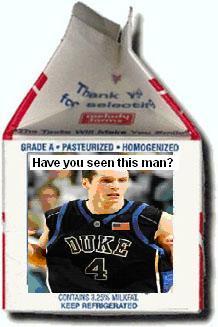
Milk Carton: JJ Redick…11th pick in the draft and dude is just gone…the rook was active for his second game this season, but again did not play.

The Jazz beat the Kings last night 110-101 after Utah was down by as many as 21 points…Carlos Boozer, who is looking like an MVP candidate right now, put up 32 points and 13 boards while 2nd year PG Deron Williams had Kidd-like numbers (20 pts, 7 rebs, 13 asts)…Utah is now 11-1, many of those games without Andrei Kirilenko…

Oh my goodness…the highlight of the game was Sacramento guard Ronnie Price's putting down a left-handed dunk right on Boozers head and 1…dunk of the year so far…

Great game by the Raptors last night, especially their defence in the 4th quarter, as Chris Bosh led the way with 25 points, 14 rebounds, and 6 assists as the Raptors ended a six-game losing streak with a 95-87 victory over the Cavs…Mo Pete was out with a slightly torn tendon in his left elbow, ending the longest consecutive active games streak in the NBA….Mo had played 371 straight games since Feb. 12, 2002…Atlanta's Joe Johnson has the second longest active streak at 365 games….and of course, the record of 1,192 was set by A.C. Green from 1986-2001…and that’s not even the most interesting AC Green record…

Draft note: Boston Colleges had 10 boards and 12 blocks from centre Sean Williams against Providence the other night…

1) Bill Simmons of ESPN.com’s Page 2 thinks KG needs to get out of town:

Kevin Garnett should have flipped out by now. And I'm not talking about a simple tantrum. Why isn't he acting more disruptively than the schoolkids in "The Wire?" He should arrive for home games wearing a sweatshirt that reads I HATE IT HERE. He should give Dwane Casey the nickname Expletive Deleted. He should call Marko Jaric, Ricky Davis and Mark Blount Loser No. 1, Loser No. 2 and Loser No. 3 and refer to Kevin McHale only as the Guy Who Ruined My Life. He should be looking to get whistled for a "flagrant nine" foul and lying on scorers' tables on the road praying for a drunken spectator to lob a beer at him so he can break out his best Artest moves. He should hire Sam Cassell and Latrell Sprewell impersonators to go with him everywhere, just so he can tell anyone who asks that he wants a reminder of the one season when he didn't want to kill somebody. All right, that last idea is a little ridiculous -- no one on the planet could begin to resemble either Cassell or Spree -- but you get the picture. KG's basketball career has become a borderline American tragedy. Here's one of the greatest big men ever, one of the fiercest competitors in any sport, someone who could finish his career with historic scoring and rebounding numbers ... and yet we have absolutely no clue how good he really is. He's played with, by my count, only six quality players in his 12 seasons: Joe Smith, Stephon Marbury, Terrell Brandon, Cassell, Sprewell and Wally Szczerbiak. His only "decent" coach was Flip Saunders, who is currently running the Pistons into the ground. The guy making the player moves has always been the memorably incompetent McHale, and KG's only owner, Glen Taylor, famously squandered four first-rounders by illegally negotiating Smith's ill-conceived, cap-violating contract. How badly has this team been mismanaged? It hasn't drafted a quality starter in seven seasons. It essentially traded Cassell for Jaric and threw in a first-round pick. It has surrounded KG with career losers and bad-attitude guys like Davis, Blount, Troy Hudson and Eddie Griffin. If there's a master plan, it seems to be: "Let's kill our cap space, squander as many picks as possible and see if KG snaps." If you remove Mark Madsen from the current roster, KG has more career playoff minutes than everyone else combined. He isn't a young dude anymore, either. Do you realize he's 30? That this is his 12th season? That he has played more than 900 NBA games (including playoffs)? KG might be 30, but if NBA years were like dog years, he'd be, well, pretty damn old. It's impossible not to feel sorry for him. Always one of the most intense players in the league, Garnett's emotion has morphed into something much more grim, as if he's fighting the urge to pull a Kermit Washington on someone, anyone. Seeing him in person, you can practically hear the clock ticking, like he's an aging single woman with rumbling ovaries. You can see the desperation on his face, the frustration, and almost hear the anguished inner monologue: "My career is wasting away." He's the most tragic figure in the league, a superstar buried on a perpetually impotent team, a loyal player who can't stand losing but is stuck with selfish guys and keeps finding himself walking off in defeat. His saga is the saddest subplot of the 2006-07 season. And few fans seem to give a crap. Well, I give a crap. To be fair, though, I don't care as much about KG as I do about his place in history. I want to know how good he is. Don't we need an answer? After old friend Paul Shirley was released by the Timberwolves before the start of the season, he sent me a gushing e-mail about KG's everyday brilliance that said if KG had played on a contender his entire career, "people would speak of him as a candidate for best player ever." Will that end up being KG's legacy: the coulda-shoulda-woulda star who ended up the Ernie Banks or Barry Sanders of basketball? I can't help thinking that in one sense he deserves some of the blame. Yes, he's one of the best power forwards ever. I rank him fourth, behind Tim Duncan, Charles Barkley and Karl Malone, and just ahead of McHale and D.C. from Fast Break. And we know he can produce in the clutch from that monster 2004 MVP season that culminated in a sublime 32-point, 21-rebound Game 7 against the Kings. We can also agree, his career would have been different if he had somehow switched places with Duncan. But maybe KG is too passionate for his own good. By all accounts, he's so wound up before games, it affects everyone around him; he wouldn't even allow anyone to listen to music in the locker room before Cassell arrived. He's not above punching teammates in practices. And he's famous for yelping ferociously after big plays, clenching his fists and screaming toward the ceiling like a WWE wrestler. He's never learned to adapt his game to the situation; he plays the same in a mid-November blowout and a deciding playoff game, which explains why he seemed spent during the 2004 conference finals against the Lakers. That was his longest season by far -- seven months and exactly 100 games -- and in classic KG fashion, he averaged 24-14-5 in the regular season and an almost identical 24-15-5 in the playoffs. Superstars like Duncan know when to dominate and when to keep something in reserve for big moments. KG plays only in fifth gear. Of course, that nonstop fervor has always been his most admirable quality, right up there with his insistence on passing out of double- and triple-teams (even if he's finding crummy outside shooters and inadvertently hurting his chances). Along with Steve Nash, he's the ultimate team player. Which makes this whole thing such a shame. I watched the Timberwolves lose on consecutive nights recently and realized two things. First, they don't have an above-average player other than KG. And second, KG's body language, especially after Peja Stojakovic's game-winning three, makes him seem almost resigned to his fate, like an unhappy husband who can't stomach the thought of a divorce because he doesn't want to hurt his children. It's depressing to watch. In his shoes, maybe you or I would have sabotaged our situation already, but that's what is great about KG: Instead of quitting on a lost cause to force Minnesota's hand, he just keeps busting his butt and waiting to be saved. And that's why someone needs to save him. For the good of the league, David Stern needs to "nudge" McHale and Taylor to make a move. Trade the man to the Bulls or the Clippers or the Lakers, all of whom have the right combination of young players and picks to make a palatable exchange. Stick Garnett in a big market with quality teammates and see what happens. We need to see what he can really do, and so does he. Whether he wants to admit it or not.

2) Marty Burns of Si.com reports on the players in limbo:

Caught in limbo - These 11 veteran players now face uncertain futures

In the NBA this season, "limbo" is more than just a form of timeout entertainment shown on the overhead video board. It also describes the career status of several notable players. Whether due to injury, poor performance or other factors, these one-time stars/big contributors suddenly find themselves facing an uncertain future. Where will they end up when the music stops?

1. Kenyon Martin, Nuggets - The 6-9 power forward -- and former No. 1 overall pick - recently underwent microfracture surgery on his right knee and will miss the rest of the season. He says he will play in 2007-08, but it's unlikely he will ever be the same. No NBA player has ever come back from microfracture surgery on both knees (Martin had the procedure on his left knee in '05). The Nuggets tried hard last summer to trade Martin, who had clashed with coach George Karl, but no team wanted to take on the remaining five years and $70 million on his contract. Now Denver is stuck with Martin (though insurance will pick up part of the tab). Long-term prognosis: He'll make it back, but Martin will join the real K-Mart as a former blue chip that has seen better days.

2. Darius Miles, Trail Blazers - Like Martin, this 6-9 forward is a former high draft pick (No. 3 overall in 2000) whose career is in jeopardy because of microfracture surgery. Also like Martin, Miles has had previous knee problems (arthroscopic surgery on the same right knee in Dec. '05). The good news for Miles is that he's still relatively young (25). The bad news is that his game is predicated on explosiveness and athleticism. Like Martin, Miles also has a bloated contract (three more years, $26.2 million) that makes him all but untradeable. Long-term prognosis: He'll play again, too, but does he love the game enough to make a successful comeback?

3. Chris Webber, Sixers - The five-time All-Star is getting benched in the fourth quarter, and is not happy about it. He denies he has asked for a trade, but it is clear he would like to find a new team. The Sixers would love to accommodate him, but Webber's large salary ($20.7 million this season) makes matching up salaries difficult. He also has another year (at $22.3 million) on the deal. Webber is still capable of putting up 20 and 10 on a consistent basis, but he hasn't had the same explosiveness since undergoing microfracture surgery on his knee a few years ago. It is possible he could thrive again with a fresh start somewhere, but he's always going to be a defensive liability -- and, at age 33, his best days are clearly behind him. Long-term prognosis: Even if the Sixers can find a sucker to take on his contract (get Isiah Thomas on the phone!) Webber will have to learn to accept a lesser role.

4. Morris Peterson, Raptors - The 6-7 swingman won't make a big issue of it, but he is not happy about losing his spot in the starting lineup to Fred Jones. Though still a part of coach Sam Mitchell's regular rotation, Peterson believes he deserves better after being one of Toronto's most consistent players the past few years. He might be able to wait out this latest storm, but a trade is also a possibility.
In the final year of a deal that pays him $4.5 million, Peterson could be in high demand for a team looking for veteran help down the stretch. The Raptors clearly need help of their own, so it makes sense to try to deal him. Long-term prognosis: Peterson will continue to be a solid player wherever he goes. But after six years in Toronto, he probably could use a change of scenery.

5. Adonal Foyle, Warriors - The 6-10 shotblocker and 10-year veteran is the odd man out in new coach Don Nelson's small-ball scheme. After starting 72 games a year ago, he has appeared in just two games for brief stints so far this season. The Warriors reportedly have discussed a buyout of Foyle, who has three years and $29.2 million guaranteed left on his contract, but so far no deal has been reached. Long-term prognosis: Foyle likely will be bought out, which will allow him to sign with another team. But as one of the game's more intellectual players (he actually reads books!), the Colgate alum will be fine even if he never plays another minute.

6. Jeff McInnis, Nets - The veteran point guard became disgruntled with his role as Jason Kidd's backup a year ago; consequently, his relationship has soured with the Nets, who told him to stay home this season. McInnis and his agent have requested a trade or a buyout of his contract, which has one year and $3.6 million left, but so far New Jersey has not been able to move him. Expect the Nets to eventually cut him free, with McInnis signing with a team for the second half of the season. Long-term prognosis: He'll end up on somebody's bench before the season is over, but he'll never be able to fully shake his reputation as a malcontent.

7. Delonte West, Celtics - The third-year guard out of St. Joe's, who started at the point much of last year, has seen his role drastically changed this season as the Celtics have gone to a more uptempo approach with Sebastian Telfair and Rajon Rondo. West's role now is to supply offense off the bench. But with Tony Allen, Gerald Green and Allen Ray in the rotation, West will have to consistently knock down outside shots or he could find himself somewhere else next season. Long-term prognosis: He seems to have found a niche for now as a scorer off the bench. But with Paul Pierce and Wally Szczerbiak doing the heavy lifting, he's expendable and could be trade bait.

8. Damon Stoudamire, Grizzlies - The 13-year vet is still working his way back into shape after suffering a serious knee injury a year ago. He has played well in spurts, but recently lost his starting spot to Chucky Atkins as the Grizzlies go with a more uptempo approach. The emergence of rookie Kyle Lowry also could cut into Stoudamire's playing time. At 33, with two more years and $9 million left on his contract, Stoudamire might have some value as trade bait if Memphis decides to rebuild at some point. Long-term prognosis: Mighty Mouse isn't ready for the cartoon graveyard just yet, but his better days are probably behind him.

9. Rafael Araujo, Jazz - Considered one of the bigger draft busts in recent memory, the former No. 8 overall selection by the Raptors was hoping to benefit from a fresh start in Utah. It hasn't happened yet. Araujo has shown little to warrant playing time and coach Jerry Sloan has pretty much kept the 6-11 Brazilian confined to the bench. Long-term prognosis: If the former BYU product can't make it in the friendly confines of Utah, where he played his college ball, then he's probably not going to make it anywhere.

10. Bob Sura, Rockets - The 12-year vet contemplated retirement after missing all of last season after undergoing microfracture surgery on his right knee. He decided to give it one more try, and was hoping to make it back for training camp, but a series of setbacks forced him to push back the timetable. Sura has since returned to practice, and now hopes to play by mid January. The Rockets would welcome his hustle and energy, but they know he has a long road back to get where he was before the injury. Long-term prognosis: Sura is too much of a feisty competitor to count out, but at age 33 a full comeback seems unlikely.

11. Keith Van Horn, free agent - The sweet-shooting 6-10 forward, last seen helping the Mavs reach the NBA Finals, remains unsigned. After making $15.7 million last season in the final year of his contract, he apparently didn't want to take a massive pay cut for the chance to come off the bench and hoist a few 3-pointers. Van Horn's agent, David Falk, has said that his client is simply taking a year off, which would seem to leave open the possibility of a return. But if he does come back, it will be for a much smaller paycheck. Long-term prognosis: With a wonderful family and all the money he'll ever need, Van Horn isn't likely to pull up those knee-high socks for an NBA game ever again.

Tuesday, November 21, 2006

Although he did get blocked on a dunk attempt by 5’9” Knick PG Nate Robinson, Yao Ming was all over the Knicks again with 26 points, including 41-16 from the line, 9 rebounds and 3 blocks as the Rockets beat the Knicks 97-90 last night…remember the last time the Knicks tried to stop Yao? Yao had 35 points, 17 rebounds and seven blocked shots in the Rockets' 104-93 victory in Houston on Nov. 10…Eddye Curry was hi usual dominating self getting 7 points and 5 reboudns in the Nov 10th game and 8 points and 4 rebounds in this one…and Yao’s quote after New York Daily News reporter Frank Isola asked him about the block? "I was blocked by a 5-3 guy before, so that's not a record."…too funny…

Funny conversation from Nuggets practice:

Carmelo Anthony: “Got my average up to 31 a game now…” (on his cell phone talking to someone)

Assistant Coach Adrian Dantley overhears and chimes in: “You averaging 31 for about a week now right? Where nobody can touch you in today’s NBA and you’re actually talking about it?” Dantley leaves shaking his head.

Anthony gets off the phone and says to nobody in particular: “What’s he on about?”

Head Coach George Karl overhears the whole thing and wanders over to Anthony and say: “You know AD averaged 30 PPG for four straight years? You know he shot 56% from the floor for those four years? You know he averaged 82% from the line for those four years? And 6 rebounds? And 4 assists? You know he played the 3 and 4 spots right? You know he’s only 6’4”?

And finally: You know he’s the best player not in the Hall right?”

Anthony just stared at Karl, eyes wide…

Steve Nash hit the tiebreaking 3-pointer with 4.1 seconds left to snap the Warriors' five-game winning streak with a 113-110 victory last night.

Raptors suck…no news here…Carlos Boozer scored a season-high 35 points on 14-16 from the floor as Utah pasted the Toronto Raptors 101-96 last night…best player of the night was Jazz rookie Paul Millsap about whom Coahc Sloan said: "I think Millsap has shown us a great deal about what team basketball is. We don't like to talk about it. We just go do it." Millsap, a second-round draft choice, established a career high with 20 points and had five offensive rebounds, four of which led to second-chance points. Millsap is fast becoming the steal of the 2006 NBA Draft. Picked 47th last June, he had 18 and 10 in 22 minutes on Saturday against the Suns and 20 and 7 in 23 minutes last night. "I just wanted to come in and make some impact. If it's just getting one rebound, one steal a game, it's all right with me," Millsap said. "I'm going in there and doing what I've got to do." Chris Bosh on Millsap after the game: "He had a phenomenal game tonight. He just got those key loose balls and then when he got them he scored 'em. Those are the points in the paint. He got the crowd into it with his hustle plays and we should've kept a body on him.” However, it’s not like Toronto didn’t have chances…Jorge Garbajosa, T.J. Ford and Fred Jones all good looks from three to tie the game in the final few seconds, but nobody could make the shot. TJ finished with 16 points and Jones had 15 for Toronto. It was a good game for Number 1 overall pick Andrea Bargnani who scored 15 points on 4-7 from the floor and 6-6 from the line, but he only had 3 rebounds, which for a 7 footer playing 27 minutes is very weak.

Speaking of Utah, EnergySolutions, a nuclear waste services company based in Salt Lake City, has bought the naming rights to the downtown arena that has been known as the Delta Center since it opened 15 years ago.

From Elias: Michael Redd's 57 points against the Jazz last week were the most by a non-first-round draft pick since the NBA/ABA merger in 1976.

1) Joe Juliano of the Philly Inquirer reports that Iverson and Cheeks see things differently:

Iverson and Cheeks see things differently

Whatever beauty the 76ers exhibited during their brief three-game stay in the West appeared to be in the eye of the beholder. Sixers coach Maurice Cheeks chose to look at encouraging signs, such as the fact that his team fought all the way in its overtime loss Saturday night to the Los Angeles Clippers despite the absence of two injured big men - starting forward Chris Webber and backup center Steven Hunter. "I loved our effort," Cheeks said after the game. But when asked whether he liked the Sixers' effort as well, Allen Iverson spit out a "no" as if he had just found something strange in his cheeseburger. "Look, I'm not trying to be an ass, I promise you," Iverson said in the visiting locker room at Staples Center before getting three stitches in his chin courtesy of an accidental elbow by Corey Maggette on Maggette's drive to the hoop. "But I don't care nothing about that. "I don't care who you're playing against, if you're playing a little rec-league team. The effort is supposed to be there every night. So it's not a big thing for me. To say, 'Yeah, we gave effort' or whatever, you're supposed to give effort. But when you go out and play basketball, you're supposed to win the basketball game. "If you're satisfied the effort that you give, then some positive things are supposed to happen, and the most positive thing that can happen is to win... . You don't pay nobody a million dollars, a whole bunch of money, then not give effort." Iverson, who played more than 49 minutes but needed 31 shots to score 29 points, was unhappy the Sixers "switched up what we were doing" after racing out to a 16-point first-quarter lead. When asked specifically what happened, he said he didn't want to start "a whole bunch of bullcrap." "We stopped doing what we were doing," he said. "We stopped playing the way we were playing. We had momentum. We had everything going our way, and we stopped playing like that." The loss concluded a 1-2 road trip and dropped the Sixers (4-5) below the .500 mark for the first time this season. It doesn't get any easier this week with the Sixers playing four games in five days, including games at Milwaukee and Cleveland and home contests with Detroit and Chicago. The Sixers lost the rebounding battle in all three games out West, including a 49-33 pasting Saturday night, while Webber (lower back stiffness and soreness) and Hunter (sprained right knee) watched from the bench. In 36 minutes, 6-foot-11 center Samuel Dalembert managed just three boards. The Sixers held Seattle to 41.7 percent shooting in their 96-90 win there, but Phoenix and the Clippers each shot better than 46 percent. After starting 2 of 15, Los Angeles hit 55 percent of its attempts from the field in the final 42 minutes. When talking about his team's effort Saturday night, Cheeks probably was comparing it to the near no-show of his team's offense and defense the previous night against the go-go Suns. "We talked about that, that we didn't play the way we're capable of playing," Cheeks said. "We were a very focused team [against the Clippers]. We didn't win but I thought our effort was big, was huge. Unfortunately, we did not get the win. But I think if we play games like that night in and night out, we'll win more games than we lose." After racing out to a 25-9 lead late in the opening quarter, the Sixers found themselves tied early in the third quarter and trailed for the first time, 78-77, on two free throws by Maggette with 5 minutes, 18 seconds left in regulation. The Sixers' best chance to win came when Cheeks called a time-out with 24.7 seconds left in the fourth and the game tied at 90. But the Clippers overplayed Iverson, and Willie Green's inbounds pass to Dalembert was slapped away by Elton Brand and picked up by Shaun Livingston. Iverson said he "believed more than ever" that the Sixers can be successful this season but added, "I don't have a choice but to believe it." But the feeling now is, after a 3-0 start, the Sixers are beginning to look more like last season's edition, a team that could tease but couldn't be counted on for the key stop or key rebound at crunch time.

2) Kiki Vandeweghe writing about yet another Grant Hill return for ESPN.com:

Long, arduous Hill climb

Grant Hill has experienced devastating injuries, having appeared in more than 30 games only once in his first five seasons in Orlando.
Most would have retired long ago. But it's a testament to his strength of will, and sense of loyalty to his team, that he's back again, giving his top effort for the Magic. Now 34 and healthy again, he's shown shades of the Hill of old, sending Orlando off to a 7-4 mark, including Monday night's 95-86 loss to the Memphis Grizzlies. He's leading the team in scoring at 16.1 ppg, out on the court for about 30 minutes per game. I wish more young guys would have watched Hill's example in this case. He could have just taken the money; instead, he gave them more than what they could have reasonably expected. Of course, when you're talking about the Magic, you're talking about the game's next great big man. And Dwight Howard is their best player -- that was 24 points and 23 boards he put up against Memphis. He's got the fierce will like we saw with a young Tim Duncan in San Antonio. But I see Hill as their leader, totally irreplaceable. I think his tenacity has led this young Orlando team that had been struggling much of last year. The team's start is direct result of his example. To weather as much as he did, I think his teammates owe him their best effort every night. Often, teams struggle with considerations of whether to take a team in a younger direction, or rely on veterans. But I think Brian Hill has done tremendous job blending these elements in Orlando -- too often we forget the coach is vital to making this all work. I thought the Magic were smart in bringing him back -- sometimes, a team makes a coaching change because it needs a new voice. His voice is welcome once again. His team's interior defense is tremendous. Heck, they even have Hedo Turkoglu playing D. In the game against Memphis, you saw Darko Milicic have one of his lesser outings. He's had some good ones, too. Milicic is a guy who has been through the ringer -- the pressures of the NBA can be a shock to system for a lot of players. I think it's going to take a while to recover, and learn where his place is in the league. He's a good player, but he needs to be strong-willled about these adjustments. Very difficult. I see the Magic becoming a playoff team this year. They're still some players away from becoming a championship team, and in going for those players, they've got to keep the identity of a tough-minded team. Much has been made about the kind of salary cap room the Magic will have when Hill's number comes off the books. Sometimes the best deals are the ones you don't make. I'd love to see Grant Hill have, finally, at long last, a positive outcome in Orlando. His basketball story won't stop when his playing days are over. Grant Hill would be a great coach -- he's a leader, with a strong understanding of the game. On the court now, he's obviously not player he was in Detroit, but he still has a lot to offer. The Magic are getting that rare chance to see it. It's a great thing to see.

3) Chris Eckstand of SI.com reports that there is no more stability in the NBA:

Constant flux - NBA teams dealing with changes in starting lineups

Stability is an important characteristic of any successful team. But less than three weeks into the season, just three NBA teams have penciled in the same starting five in every game: San Antonio, Minnesota and Washington. While the Spurs (8-2) have thrived, the struggling Wolves (3-6) and Wizards (4-5) have thus far resisted the urge to change their lineups. On the flip side, Golden State (7-3) and Phoenix (3-6) are already down to one player each who has started every game. Ironically, the oft-injured Baron Davis has been the lone constant in the Warriors' starting lineup, while iron man Shawn Marion, who has played in 491 of Phoenix's last 501 games the last six-plus seasons, is the only Sun to start each game. Of the 13 teams that have started four of the same five players each night, the alteration in the lineup has usually been a big one ... as in Miami, where the Heat have lost Shaquille O'Neal for the next 4-6 weeks with torn left knee cartilage. Other teams who have been without a key part include Detroit (Richard Hamilton), Cleveland (Larry Hughes), the Lakers (Kobe Bryant), New Jersey (Richard Jefferson), Philadelphia (Chris Webber), Orlando (Grant Hill), New York (Steve Francis) and Denver, which has lost Kenyon Martin for the season. For Miami, the loss of Shaq goes far beyond any statistics the Diesel generates: it defines who Miami is. And now the Heat must use a different style without the big man in the middle. "You can't reinvent the wheel in 24 hours, but probably over the next week we'll change things offensively to get more people involved and see what we can do to be more efficient," Heat coach Pat Riley told the Palm Beach Post. At least the Heat has superstar Dwayne Wade and several supporting veterans from which to fashion a new team blueprint. In Memphis, Pau Gasol's injury has devastated the team, relegating a playoff team that won 49 games a year ago into the NBA's basement with a 1-8 record. To compound matters, veteran guard Eddie Jones, who got off to a slow start, is sidelined with an injury while point guard Damon Stoudamire, coming off a major knee surgery, has lost his starting job to Chucky Atkins. While Miami and Memphis have lost All-Stars who cannot be replaced, the Bucks (3-7) have lost both starting forwards: Bobby Simmons and Charlie Villanueva. Simmons, who has yet to play this season due to a stress reaction in his right heel, might be back in early December. Villanueva, who averaged 14.6 points and a team-high 7.4 rebounds in his first eight games, tore a left elbow ligament last week against Atlanta and is expected out until at least mid-December.

You still need lots of 'Bigs' - The evidence is everywhere: the league has changed to a quicker paced game with smaller lineups. When players such as Indiana's Danny Granger and Chicago's Andres Nocioni are playing some minutes at power forward, we've come a long way from the league of Charles Oakley and Otis Thorpe. But despite this dramatic change, it still seems you can never have enough bigs on your roster.
Take Denver. When the season started, rebounding specialist Reggie Evans, who received a handsome five-year contract in September, didn't even play the first three games despite being completely healthy. Then starting power forward Kenyon Martin went down. Now Nene, who missed all but one game last season due to ACL surgery, has missed several games due to soreness in his surgically repaired knee. Former bench igniter Eduardo Najera moved into the Nuggets' starting lineup following Martin's departure while Evans has gone from spectator to first big man off the bench seemingly overnight. He has averaged 19 minutes, 8.8 points and 8.0 rebounds since rejoining the working world. How about Boston? Starting center Theo Ratliff has played in just two of the first 10 games because of continued back problems, and power forward Al Jefferson underwent an emergency appendectomy two weeks ago. Backup center Michael Olowokandi, who could have realized substantial playing time in Ratliff's absence, was instead sidelined with a torn abdominal muscle. Leon Powe, a rookie from California who was inactive the first six games of the season, is suddenly playing about 15 minutes per game. He tallied 10 points and seven rebounds in his first NBA game. So if you see lots of front-court players filling out the tail end of NBA rosters, now you know why. Big men remain a coveted commodity ... especially when other big men are injured.

Update: 2007 Draft Prospects - A few of the better-known European players expected to garner interest from teams in the 2007 draft have encountered tough times this season. Tiago Splitter, the Brazilian big man playing for Tau Ceramica in Spain, missed four Spanish League games and two Euroleague games due to back spasms. Splitter has been slowed since returning, averaging nine points and 5.2 rebounds in five games. Splitter could be a first-round pick this June. Rudy Fernandez, the athletic big guard of DKV Joventut, also in Spain, suffered a groin pull that sidelined him for three games, including a blowout loss to Maccabi Tel Aviv. Fernandez, the sixth man on Spain's gold-medal-winning team at the World Championships, is averaging 13.3 points in his first seven games. Marco Belinelli, the quick-shooting 20-year-old guard from Climamio Bologna in Italy, is struggling from the 3-point line this season, nailing just 12 of 50 attempts (24 percent). But he's still averaging 15.7 points. Some prospects, though, have raised their draft profiles. Bosnian forward Mirza Teletovic has risen to the challenge in his first season in Europe's top national league, the ACB of Spain. Playing for Tau Ceramica, Teletovic has become a dangerous three-point shooter, hitting 18-of-37 from long range (49 percent). Another sharpshooter, Renaldas Seibutis of Lithuania, has made 15 of 30 three-point shots for his Greek League team, Maroussi. The 6-5 Seibutis is shooting 55 percent from the field and is averaging 11.7 points.

4) Mike Kahn of Foxsports.com has 10 things:

10 things we learned this week

Maybe the perception of Golden State Warriors general manager Chris Mullin that the athletic group he put together was the perfect fit for his own former coach on the Warriors Don Nelson was mere folly. After all, Nelson is 66, was retired in Hawaii and had been fired twice since he coached his star Mullin and the Warriors to the playoffs for the last time some 13 seasons ago. But 10 games into the season Mullin isn't looking so crazy.

1. Item: Miami Heat center Shaquille O'Neal had surgery over the weekend to repair a torn cartilage in his knee and will be out 4-6 weeks. What this really means: The Heat entered the week 4-5, and the likelihood is O'Neal will miss more than 20 games. This is comparable to last season when O'Neal went out early with a sprained ankle and Miami went 10-23 without him. This will again test what kind of stamina and skill Alonzo Mourning has left, while pushing an already mentally (and perhaps physically) tired Dwyane Wade. The general perspective is the Heat will have plenty of time to piece things back together if only because the East is so mediocre with only three teams above .500 entering this week. But the Heat didn't add any youth and this aging team will have a tougher time playing out a season well into June again. Besides, O'Neal is 34, still far too much tonnage over 300 pounds and proved last season he is no longer capable of dominating regularly. Getting Jason Williams back this week from knee surgery helps their backcourt, but they need more shooting and athleticism if O'Neal continues his downhill slide.

2. Item: The Warriors are off to a 7-3 start, with young players and veterans buying into the smallball that Nellie loves to play and is, in fact, the vogue style of the NBA these days anyway. What this really means: Right now, it's all about mercurial point guard Baron Davis buying what Nellie is selling, and so far, so good. Davis had the game of the week in their win over Sacramento with 36 points, 18 assists and eight rebounds. But it's more than him. Jason Richardson is getting stronger and recovering from knee surgery with a more controlled, mature game as he regains his strength and athleticism. And then there is the new sensation — 20-year-old guard Monta Ellis — in his second season straight out of high school in Mississippi. With Davis straining his rib cage Saturday night against Seattle, Ellis had 31 points, seven rebounds and seven assists to pace the 12-point Warriors victory — capping a 3-0 week during which he averaged better than 20 points. What we don't know is how the solid start of 6-foot-11 Andris Biedrins, 20, will hold up, nor the body overall of talented but injury-prone Troy Murphy, whom Nelson expected to be the primary power player. In other words, there are still plenty of issues with this young team off to its best start in 12 years. Davis doesn't always look beyond himself and also is injury-prone — plus the ages of Ellis, Biedrins and Mickael Pietrus, whom they opted not to sign beyond this season. But for now, they're fun, playing at a high level and exactly what Mullin hoped to see.

3. Item: Over the past week, Peja Stojakovic has had a 42-point game and a game-winning shot to lead the New Orleans/Oklahoma City Hornets to a pair of victories to stay close in the Southwest Division race. What this really means: Stojakovic still has plenty of artillery, becoming the first player in NBA history to score his team's first 20 points in that 42-point effort against Charlotte. But the Hornets, a very impressive 7-3 under Byron Scott, still are only as good as second-year point guard Chris Paul allows them to be. He had 35 points Saturday night when they nipped Minnesota and will challenge for the NBA assist title. Nonetheless, for the Hornets to be serious contenders, Stojakovic has to prove he still has the physical tools and mental toughness to sustain his former All-Star capability throughout the regular season and into the playoffs. A lot of people were aghast by the $60 million-plus contract the Hornets gave him in the off-season, if only because he has backslid so dramatically in consistency the past two seasons in Sacramento and then Indiana. Three teams in two seasons speaks volumes, and this year is vital for the one-time "best international player" in the NBA to regain his previous status and help give Oklahoma City something special for playing host to this franchise for two seasons.

4. Item: Emeka Okafor became one of only a handful of players in NBA history to average at least 20 points and 15 rebounds during a four-game losing streak, then had 19 points, nine rebounds, five blocks and five steals as the Charlotte Bobcats beat the San Antonio Spurs for the first time in franchise history. What this really means: At 2-7, the Bobcats are still struggling on the floor and at the gate, but prevailing wisdom around the league believes this team has a lot of young talent that will eventually start winning. Okafor was out virtually all of last season after winning the 2005 rookie of the year and people forgot what a dominant player he is inside at both ends of the floor. With versatile Gerald Wallace and young guard Raymond Felton, they have great athleticism at both ends of the floor. But the big transition came last week with the win at San Antonio. Rookie forward Adam Morrison had an epiphany of sorts last week — going to the basket to help set up his rhythm from the perimeter with 27 and 21 points in succession. He was 21 of 41 from the field in the two games following a previous run of 10-for-43 — so the Bobcats have another potential rookie of the year on their hands. And yet, most of it will come from the play and leadership of Okafor, averaging 19.1 points, 12 rebounds and 4.1 blocks for Bernie Bickerstaff. Now if the fans will only buy into them in this second go-round in Charlotte, something special may happen — whether minority owner and president Michael Jordan actually participates or not.

5. Item: Portland Trail Blazers forward Darius Miles is out for the year due to microfracture surgery to his debilitated knee and Zach Randolph is back averaging 20 points and 10 rebounds. For some reason, nobody thinks these two circumstances are mutually exclusive. What this really means: The Blazers are better off without Miles for more reasons than are logical. No one player — particularly an underachieving and mediocre player — should affect a team that much. But that's what Miles has done, undermining and running coach Maurice Cheeks out of town — while dragging down the attitude of Randolph and any other mentally vulnerable player into the muck with him. Now his career is in jeopardy and they're better off for it. Meanwhile, Randolph has lost at least 15 pounds, and has regained the bounce and excitement to his game before he had microfracture surgery. Struggling last year with his weight and his game under the scrutiny of aggressive new coach Nate McMillan while recovering from surgery — Miles pulled Randolph into his cloud of negativity. The Blazers now must learn from that, not just because of Miles, but because Randolph is an extraordinary young talent prone to fall into the lowest common denominator crowd. Surround him with good young guys like rookies Brandon Roy and LaMarcus Aldridge; Martell Webster, Joel Przybilla, Jarrett Jack and Juan Dixon — and that gives Randolph a chance to blossom and McMillan to dig this team out of the Northwest Division cellar.

6. Item: The Dallas Mavericks have rebounded from their 0-4 start to win their fourth in a row Saturday night and one of the key reasons is the surprise start of Erick Dampier, who had 24 points, 15 rebounds and two blocks in the 12-point win over Memphis. What this really means: Coach Avery Johnson is ecstatic about the play of Dampier, who hadn't established any consistent production for the Mavericks but appears to have hit his stride. In the incredibly tough Southwest Division with the Spurs, Rockets and Hornets battling it out with them, it is necessary to be strong in the pivot as opposed to the rest of the league going mostly small. Between Dampier and DeSagana Diop, Johnson has a nice duo to work with.
But at the heart of the streak is still All-NBA forward Dirk Nowitzki, who averaged nearly 27 points and 11 rebounds during those four wins. Nowitzki drew a lot of MVP votes a year ago and rightfully so considering he led the Mavericks to the Western Conference crown. Still, his virtual shrinkage from a 7-footer to 6-2 in the Finals collapse against the Heat is still lingering in everyone's mind. Was it an aberration under the weight of a first trip to the Finals or a sign of weakness? This is the season we'll find out.

7. Item: The Chicago Bulls lost their fourth in a row Sunday night to the Los Angeles Lakers, and fell to 3-7 on the season — perhaps the biggest disappointment of this young season. What this really means: The Bulls early schedule, as always, is devastating — with seven of those first 10 on the road. And because of the way Scott Skiles has them defend night-in and night-out, they always regain their composure and finish strongly. The addition of Ben Wallace and P.J. Brown in the off-season, along with rookies Tyrus Thomas and Thabo Sefolosha, only helps that propensity. However, they really didn't address their primary need — an offensive post presence. Most of their offense is generated from the perimeter by point guard Kirk Hinrich and explosive scorer Ben Gordon. Luol Deng has shown he can score too, and Andres Nocioni had a superb game with 30 points in Sunday night's loss at the Staples Center to the Lakers. But unless they find somebody who can get them points and/or to the free throw line consistently down the stretch, they can't possibly meet the great expectations to challenge for the East title.

8. Item: The San Antonio Spurs are off to an 8-2 start and set a franchise record by winning their first five road games. What this really means: While too many people are making a big deal about whether or not defensive star Bruce Bowen intentionally sticks a foot under jump-shooters, this team is off and running again to lead the Southwest Division. To address Bowen — he is one of the league's good guys and has made his living as one of the top perimeter defenders in the league the past 10 years. If his foot gets underneath a shooter once in a while stepping out, so be it. He's not trying to hurt players. That's ludicrous. Meanwhile, despite a horrible start from Manu Ginobili, the Spurs are doing just fine behind Tim Duncan, Tony Parker, their new big guys up front, and the veteran bench led by Michael Finley and Brent Barry. It has become almost cliché to say the Spurs will be there in the end because of their consistency and defense. But it wouldn't be said and written so often were it not true. Nobody has a more consistent approach and focus to the game than coach Gregg Popovich, which is why his team is the same way. As long as Duncan is healthy, the Western Conference champion must go through San Antonio.

9. Item: Philadelphia 76ers point guard Allen Iverson always talks about being real and this past week dealt with a real dose of reality when 22-year-old Kevin Johnson was taken off life support and died. Johnson was shot in the back of the neck three years ago when he was surrounded by teens demanding the Iverson jersey he was wearing. What this really means: This was devastating when it happened, and just as it gradually slipped from the minds of the folks who first heard about it — this ugly scenario returned raw and unnerving. Young Robert Ferguson received a 15-30 year sentence for shooting Johnson and Iverson called Johnson's mother last week, offering to pay for the funeral. He talked about how horrible the situation is in Philadelphia with guys causing so many unnecessary deaths, and how he'd like to help. Gun violence has reached epidemic proportions in this country and no other high-profile professional workplace is more representative of that than the NBA. People can talk about rap and the hip-hop era being about inherent music and expression. It is. But it's also about guns and violence, and has created a false impression of acceptable violence in America. If Iverson is serious about helping, then now is the time he should lead his teammates in the most important step of his life — drop their weapons and become a spokesman. It is a constitutional right to carry arms, but it's a human privilege for children to grow up in a society without having to pack heat and the adults to teach them why. Come on A.I. ... the kids love you and this one move could erase all the negative perception of your past. Start the "Drop your weapons" campaign now.

10. Item: It is now official ... not only have the Utah Jazz jumped out to the NBA's best start at 9-1, but they lead the league in scoring during the first 10 games at 108.3. What this really means: Expectations were high for Utah entering the season, and there were a lot of ways people could have anticipated the Jazz getting off to such a great start. At least on the surface, a Jerry Sloan-coached team leading the league in scoring was not one of them. But the way they are averaging so many points makes perfect sense. Even with perpetually injured star Andrei Kirilenko already sidelined with an ankle sprain after whining about not enough shots, they have been dominating the boards and getting continuous easy baskets off fast breaks. Carlos Boozer and Mehmet Okur are a great scoring/rebounding threat together up front, with rookie Paul Millsap a big surprise. And that's just up front. Now healthy, swingman Matt Harpring has been exceptional off the bench, as has the subtle addition of Derek Fisher for perimeter shooting. Add in youngsters Ronnie Brewer, C.J. Miles and Dee Brown leading the sprint up and down the floor, and they have athleticism and young depth like never before. But none of it works without the growth of second-year point guard Deron Williams. Do the Jazz have staying power? We won't know for quite some time because this group has been so injury-prone. Nonetheless, but this is the most exciting Jazz team since the end of the Stockton/Malone Era and appears to be the most likely year for Sloan to earn the richly-deserved coach of the year award that has wrongly eluded him for 18-plus seasons.

Thursday, November 16, 2006


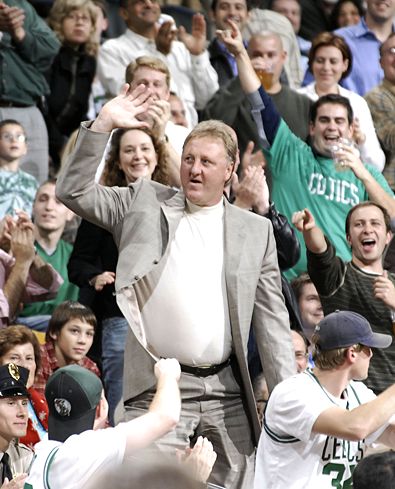
Great shot of Larry Bird getting some love at the Garden, or whatever they’re calling the Boston arena these days…nice pot Larry…

Attention K-Mart shoppers…he’s out for the season AGAIN after knee surgery…

"We wanted to come out and shock the world tonight," Vealy said, "and we did it." The qquote of the night from Oral Roberts university SG Reginald who hit his first seven 3-point shots as Oral Roberts outplayed No. 3 Kansas the entire game, defeating the Jayhawks 78-71 last night. "It may be the biggest regular-season win in school history," coach Scott Sutton said. "Our trainer has been here over 30 years and said it was the highest-ranked team we've ever beat." Vealy, a 6-7 sophomore who shot 1-for-13 on 3-pointers last season, finished 7-for-8 from behind the arc. His only miss came on his last heave, after the Golden Eagles had thoroughly taken command.

The Stache comes through….Bobcats forward Adam Morrison had 27 points in a 95-92 overtime win in San Antonio last night…many with Bruce Bowne draped all over him…

Scoop Jackson of wonders what’s happening with the Suns: http://sports.espn.go.com/espn/page2/story?page=jackson/061113

Zach Randolph will never learn…here are some of the excerpts from the actual criminal complaint filed in the Circuit Court of the Sate of Oregon, Multnomah County:

Randolph allegedly says "I'm a gangster not a Blazer." (Not sure why this is included, but it's in one of the very first paragraphs.)

He allegedly keeps a table at the Portland club Exotica.

Randolph allegedly routinely shares women with friends.

On the night in question, Randolph was allegedly distributing stacks of 100 $1 bills. Isn't that why they made the $100 bill?

Randolph allegedly offered $500 to a women he knew, and another he didn't, to perform a live sex show.

Randolph allegedly bought the woman he didn't know, the plaintiff, several drinks.

At the hotel, Randolph and friends allegedly shared a blunt.

Randolph allegedly wasn't happy with the sex show.

The plaintiff, having had a lot to drink, allegedly fell asleep.

The plaintiff allegedly woke up to Randolph, umm, forcing entry in the back door. Twice. Which she allegedly resisted and did not want.

Randolph then allegedly forces some more entry, through the front door.

The next morning, as the complaint alleges, the plaintiff sends a message to her friend saying "don't worry I have not cracked we good." Then she thinks about it some more, and allegedly realizes that she thinks she has been set up for a sexual assault, and starts asking for $10,000.

The plaintiff allegedly went to the hospital too late to collect any rape evidence (after slightly more than three days).

Allegedly neither Randolph nor his male friend have cooperated with the investigation.

I know everything is allegedly, but dude has a history…

1) Chad Ford of ESPN.com with a look at the draft eligibles in the NCAA:

Draft Watch: Who scouts will eye early in NCAA

The NCAA season gets into full swing this weekend, and NBA scouts will be out in force in search of the next NBA superstar. Insider spoke with a number of NBA scouts and front office executives to give you 10 guys scouts will be watching as the season begins:

Joakim Noah, PF/C, Jr., Florida - Noah passed up a chance to be the No. 1 overall pick in the 2006 NBA draft to return to Florida for his junior season. NBA scouts aren't so sure he made the right decision. Noah may have peaked at just the right moment last season. His team was winning, he was improving in every game and his style of play was infectious for both his teammates and the scouts in the stands. Now, reality gets a chance to check Noah out. Scouts have a checklist of questions for Noah this season: What position is he going to play? Will he develop any go-to moves on the offensive end? Now that teams begin to center their defense on stopping him, how will he respond? Is he a 7-foot version of Andrei Kirilenko or a role player like the Cavs' Anderson Varejao? Given the heights Noah achieved last season, he has nowhere to go but down as the scouting microscope focuses on him.

Al Horford, PF, Jr., Florida - Noah's teammate, Horford, is in a different position. Scouts believed that Horford was just scratching the surface of his ability at the end of last season. If he had declared for the draft last summer, NBA teams would have drafted him based almost entirely on potential. Now, with another season of development ahead for Horford, scouts are expecting big things. Horford already possesses a great basketball IQ, an NBA body and a motor that is constantly revving. If he can show some polish on the offensive end, continue to attack the boards and find a way to get out from under Noah's shadow, it's possible Horford, not Noah, will be the first Gator to hear his name called on draft night.

Josh McRoberts, F, So., Duke McRoberts' decision to pass up a shot at the lottery in last year's draft was a calculated risk. He was heralded as one of the best freshmen in the country last season, but had to play second fiddle to two first-team All-Americans, J. J. Redick and Shelden Williams. Now, with Redick and Williams earning paychecks in the NBA, this is McRoberts' team and scouts expect him to shine. He has it all. He can score inside and out, handle the ball, shoot the 3 and defend. To top it off, he's an above-average athlete. McRoberts could move himself into the high lottery with a great season. But if he struggles (and he might, given an unusually thin Duke supporting cast this season), he may wish he'd bolted for the NBA when he had the chance.

Julian Wright, F, So., Kansas - No one is exactly sure what kind of player Wright is … but scouts are still in love with him. For most of last season, Wright failed to stand out amidst a bunch of talented freshmen at KU. But toward the end of the season, Wright started putting things together and scouts began to drool. What Wright has going for him is great energy, terrific defense, great floor vision and a nose for the ball. If he can find a jump shot and a niche on the offensive end, he's got lottery written all over him. If not, scouts will be patient. There's too much talent there to ignore.

Tyler Hansbrough, PF, So., North Carolina Hansbrough blew scouts away with an amazing freshman season at UNC. His toughness, rebounding and ability to score around the basket were uncanny for a freshman. He's never been considered a surefire NBA prospect because of his average size and athleticism, but the kid knows how to play. Now he's poised to be showcased on one of the two or three best teams in the country. "If he's not a lottery pick next year, I don't know what a lottery pick is," one scout told Insider. "Nick Collison just got $33 million from the Sonics and this kid could wipe the court with Collison."

Greg Oden, C, Fr., Ohio State A broken wrist means that we might not see Oden on the basketball court until January or February 2007. No one in the NBA seems to care. That's how good this kid is. Oden already has the NBA size, body, athleticism and defensive prowess to be a starting center in the NBA, according to scouts. If he continues to progress on the offensive end and adds some urgency to his game, he could be the best big-man prospect to enter the draft since Tim Duncan. As it stands now, nothing short of injury woes will knock Oden from No. 1 on the prospect list … and the Buckeyes from contention for an NCAA title.

Kevin Durant, SF, Fr., Texas Texas head coach Rick Barnes has already called Durant the most talented kid he's coached. That's high praise coming from a guy who coached the No. 2 pick in the 2006 NBA draft, LaMarcus Aldridge. What Barnes and NBA scouts love about Durant is his versatility. He's long and athletic and he can score from anywhere on the floor. He can shoot the lights out but he also isn't afraid to put the ball on the floor and take it to the basket. He'll be featured in the Texas offense. If he thrives, and puts on a little muscle, there's a good chance he goes No. 2 in the draft, regardless of who else declares. That's how high NBA scouts are on Durant in the early going.

Chase Budinger, SG, Fr., Arizona Budinger is a bit of a dark horse -- a late bloomer who preferred volleyball to basketball until recently. An awesome senior season combined with some excellent play in the summer as a counselor at Jordan's Flight School has scouts buzzing. "He really dominated," one evaluator said. Budinger's athleticism, shooting range and body control when taking the ball to the basket have scouts saying he'll immediately be the best player on an already loaded Arizona squad.

Jeff Green, SF, Jr., Georgetown - Green is a do-it-all point forward who drew a lot of attention last season with his excellent play against Ohio State and Florida in the NCAA Tournament. He's not going to wow teams with his athleticism or his nightly point totals … but the guy can fill up a box score. If he can get more consistent with his jump shot, watch out. Given the quiet rise of Brandon Roy last season and the way NBA scouts fell for him in the midst of so much unproven talent in the draft, Green has the ability to be the Roy of next summer's draft.

DeVon Hardin, C, Jr., California - Scouts are always looking for centers, and Hardin has the combination of body, athleticism and footwork that scouts love in a big man. He played a limited role on the Bears last season, but with Leon Powe off to the Celtics, Hardin will be the main man in the paint for Cal this season. Scouts already love his defensive timing as a shot blocker. If he improves offensively, he has a chance to move way up the draft board.

2) Mike Kahn of Foxsports.com with his weekly 10 things:

10 things we learned: Yao got game

The inclination was certainly there to make the case for Yao Ming as the best center in the NBA going into this season. His overall growth as a player and skill level are extraordinary. But always standing there is the Big Dominator — Shaquille O'Neal, with four championship rings, career numbers and even bigger personality.

1. Item: Yao had 34 points and 14 rebounds to lead the Houston Rockets to an impressive 94-72 victory at Miami over the defending champion Heat on Sunday night, with O'Neal offering up 15 points and 10 rebounds. What this really means: The passing of the torch can't really be official until the Rockets go somewhere beyond the first round of the playoffs — or even get into the playoffs, which they didn't last season — and Yao remains healthy playing at this level. But from an individual performance standpoint, there is no comparison between where he's at now and where he was in the second half of last season. O'Neal is fading and Yao is blossoming. Yao, 26, is averaging 27.3 points, 10.0 rebounds and 2.0 blocks for the 5-2 Rockets compared to the 34-year-old O'Neal's 14.0 points, 7.5 rebounds and 1.0 block for the 3-3 Heat. Of course, it's early, but all the signs are there. In fact, the real question in this comparison between the two guys is really sitting somewhere in between the two franchises — the future of the Rockets shooting guard formerly known as the superstar T-Mac. Indeed, there are concerns about the future of Tracy McGrady, who is still only 27. Coming off a season fraught with back problems, he's returned heavier and slower, missing that burst of speed or jumping ability. His scoring average had dropped in each of the past four seasons. At his current pace of 17.6, he is almost five points below his scoring average and his shooting has been awful from both the field and free throw line. But he's also averaging 6.4 assists and 5.4 rebounds, which are very good and if he is indeed making the players around him better as they continue to win, isn't that how the status of both Yao and McGrady move up in terms of respect?

2. Item: NBA executive vice president Stu Jackson called into the TNT studio show to tell Ernie Johnson, Charles Barkley, Kenny Smith and anybody else who would listen that the new policy to stop histrionics after every call was not zero tolerance. What this really means: Well, Stu, if it talks like a duck, walks like a duck and looks like a duck ... chances are it is a duck. And the way the officials handled the first 10 days or so was as close to zero tolerance as it can get considering how it shook up the league. So much so that players association director Billy Hunter even tossed out the nonsense that it might be worth a lawsuit. That did it. Can we all just move on now please? The point was made by the officials, just as it always is every year with early traveling calls or moving screens. The players adjust and it's back to basketball. Of course, the players need to cut down on their whining, as do coaches. It's time to just concentrate on basketball now and the officials need to play a more benign part in this for that to happen.

3. Item: LeBron James scored 25 of his 38 points in the second half to lead the Cleveland Cavaliers back from a 19-point deficit with just over 10 minutes left in the game to a 94-93 victory. It came just four days after seemingly everyone in the basketball free world attacked James for angrily walking off the court in the final 15 seconds of a nine-point loss to the Atlanta Hawks. What this really means: LeBron-mania has hit both a new high and a new low. First of all, anyone who says he quit on his teammates with the final seconds ticking down of a bad loss is just looking for publicity. It's absurd. Maybe James shouldn't have begun walking off the court — but he was on the floor at the end of the game and didn't go to the locker room. He was angry and the game was virtually over — although he shouldn't do that anyway because it's bad sportsmanship and he has already said he wants to be a leader and role model. But more important, this guy has been an amazingly positive influence on the game not only because of his extraordinary talent, but the calm and unaffected way he carries himself on and off the floor. He's only 21, and yet there have been no problems with him as a teammate or as a citizen. To blow the slight error in judgment against Atlanta into a chorus of how LeBron is a quitter is the height of pack journalism — that is to say, embarrassing journalism. Just ask the Celtics what a quitter he is after Sunday night, or Tim Duncan after James blew him away on such a variety of drives, Heinz was considering naming ketchup after him. So all those who made a big deal about it — please go the locker room and take a cold shower.

4. Item: Heading into this season, the vogue player to get excited about was young Los Angeles Clippers point guard Shaun Livingston because of his exciting talent, flair and youth. But there was one factor nobody considered as the Clippers were coming off their first trip to the second round of the playoffs ever — Sam Cassell wasn't about to give up the position just yet. What this really means: The Clippers won their NBA-high fifth game in a row Sunday night and sit atop the Pacific Division after an opening night loss to Phoenix. And in case you haven't noticed, the soon-to-be 37-year-old point guard is still starting for the Clippers and thriving. Never mind that the Clippers are the seventh team of his up-and-down career. He's the one who lifted the Clips out of their losing culture last year and made them believe. That's not to denigrate the great job Mike Dunleavy has done the past three seasons working on just that, or the MVP-caliber play Elton Brand has now begun to exhibit. And there is no doubt that the 6-7 Livingston will be their point guard of the future — he'll be their point guard of the present plenty of times this year as well, even playing with Cassell — and be amazing to watch in the process. But right now, as the Clippers prove last season wasn't a fluke, they're riding the example set by the bald guy dominating the basketball. Don't ever underestimate his power of persuasion.

5. Item: The tall, skinny, smooth-as-silk shooting guard for the Sacramento Kings is draining shots from all over the gym, jumping into passing lanes and stripping dribblers to the tune of 1.8 steals per game. If you didn't know better you would think Doug Christie is back — only this guy is taller, only 23 years old and a more natural offensive player. And his name is Kevin Martin. What this really means: As the Kings have moved out to a 4-2 start, Martin is making an early run at the league's most improved player. Averaging 23.8 points and 4.8 rebounds, while shooting a sizzling .547 from the field and .932 from the free throw line, he's already scored 30 points twice for the Kings and is just getting started. The 26th pick overall in the first round of the 2004 draft from West Carolina, he had to put his shoes on to make 180 pounds at the draft combine, but the talent is unmistakable, and he'll physically grow into the NBA game. With Martin and Mike Bibby in the backcourt, along with a front court that consists of Shareef Abdur-Rahim, Ron Artest and Kenny Thomas and is versatile and mobile, the Kings have been a surprise in the wake of center Brad Miller's injured foot. But even before Miller was hurt, it was Martin providing the offensive energy and proficiency this team has been lacking the past couple of seasons. With Artest and Thomas adding defensive toughness, and Martin's overall athleticism, they are bound to make noise in the postseason this season.

6. Item: K-Mart quality has taken another hit in Denver, and this time, it's hard to know what will happen to the future of their top-scale power forward. Yes, Kenyon Martin went back to the operating table to have his highly publicized knee — the one that befuddled everyone after microfracture surgery — cleaned out again. What this really means: For all his bluster and physical capabilities on both ends of the floor, Martin's game has gone downhill considerably since he forced the contract issue and was traded by the New Jersey Nets to the Nuggets for three future first-round draft choices. He had a serious problem with a fan last year and even more of a problem with equally combustible coach George Karl that forced Martin to be suspended permanently in the playoffs. There is no doubt he can be a productive player in this league — and even dominant defensively from time to time — but only if he is healthy, only if he is mentally ready to play at a high level, only if he is ready to be involved as a team member focused on how he can best help the overall effectiveness of the group. All of that has come into question since his arrival in Denver, which is why they haven't been able to move him for a much-needed shooting guard. The question still remains — does Kenyon Martin care more about the success of the team or his own ego?

7. Item: Trumpets didn't sound, confetti didn't fly, nor were fireworks shot off — but Amare Stoudemire did have his first double-double since the playoffs of 2005 when he scored 25 points, grabbed 14 rebounds and blocked two shots in Saturday's 96-87 win for the Phoenix Suns over the Memphis Grizzlies. What this really means: Struggling dramatically to find his footing and rhythm after surgery on both knees last year, Stoudemire had been alternately stiff-legged, out of sync and flustered at both ends of the floor during the Suns' shocking 1-5 start. But Saturday was a breakthrough game. Stoudemire will turn 24 this week and it was just the right time to get off the schneid. No doubt, he will be up and down for quite some time yet this season before he is actually able to hit his stride. Some guys never do after microfracture surgery, but looking at how well Portland Zach Randolph is playing his second year after going under the knife (and 15 or so pounds lighter), it's encouraging to see young players responding from this surgery that had been becoming the death knell for so many careers. It's still early and Stoudemire has a long way to go to show he will return to All-Star caliber form. Nonetheless, Saturday was a good start, and if everybody in and around the Suns is patient, things will work out swimmingly for all involved ... probably.

8. Item: In case you haven't noticed, the first place team in the Southeast Division entering the week is not the Miami Heat — that distinction belongs to the Atlanta Hawks. What this really means: OK, it's not going to stay that way and the Hawks will have to shock more than just this world to make the playoffs, but they are no longer pushovers and don't figure to be any time in the near future. He will never get over taking another wing player in the 2005 draft — North Carolina freshman Marvin Williams — when two extremely high-level point guards in Chris Paul and Deron Williams were available for this point-guard challenged team. And yet, they are still competitive. Most of the credit goes to Joe Johnson — the everyday man's version of LeBron James, except Johnson is a better defender and more pure shooter. If you'll remember, he was the guy that fractured the ownership when the Hawks felt he was worth $70 million, Boris Diaw and two first-round picks. Well, that is an awful lot, and Williams has been a total bust. But with Johnson leading the charge, along with the talented Josh's — Childress and Smith — along with Za Za Pachulia and the Tyronn Lue/Speedy Claxton point guard combo, they'll be fun to watch. Winning consistently is a different story.

9. Item: Entering into this season, there was a lot of disagreement over which coach would be fired first — Dwane Casey in Minnesota or Mike Fratello in Memphis. Both for teams that figure to be out of the playoffs and due for major face lifts. What this really means: Casey never really has had a chance considering what a mess Kevin McHale has made around Kevin Garnett. The team never will win with McHale pulling the strings, but he's such an icon in Minnesota, owner Glen Taylor couldn't possibly considering firing an ex-athlete he admires so much. Consequently, both Casey and Garnett are suffering the consequences. Meanwhile in Memphis, the Grizzlies are going through an ownership change and dying on the vine without their All-Star Pau Gasol, still out at least a couple more months after a foot injury suffered in the World Championships. Fratello's arrogance has always gotten in the way of his exceptional coaching ability, but he has managed success despite long odds in the past. But it hasn't happened like this — with odds as long as these — and certainly not with new ownership coming in. In other words, both teams are doomed to failure and both coaches inevitably will be fired. Which one will come first? Flip a coin between the leader of the last-place team in the Northwest or Southwest Divisions.

10. Item: The talk around the league about the best pure perimeter shooters always centers around the same guys — Ray Allen, Peja Stojakovic, Dirk Nowitzki, etc. Not often enough do we hear the name of Milwaukee Bucks guard Michael Redd, but soon enough we will after his 57-point eruption during the Bucks 113-111 loss to Utah Saturday night. What this really means: The reality is Redd should be one of the first guys always sought by the USA Basketball as a key member of future teams just because he is such a natural scorer and pure shooter. He isn't exactly a natural ballhandler — especially at the guard position — but he's equally capable of posting up or bombing away from 3-point range. And he's getting better. Granted, it's never easy getting any kind of national recognition out of such a small media market as Milwaukee, but this is just a moment in praise of the best shooter in the NBA that a rare few west of the Mississippi are aware even exists. He is 6-6, 225 pounds, was a second-round draft choice from Ohio State after his junior year, and he is averaging 32.4 points a game. In fact, this is his seventh season and his scoring average has remarkably gone up every year — beginning with 2.2 his rookie year to 11.4, 15.1, 21.7, 23.0, 25.4. In other words, the man can put the ball in the hole — now if the Bucks can figure out how to stop the other team from scoring, they may actually return to the playoffs again.

Tuesday, November 14, 2006


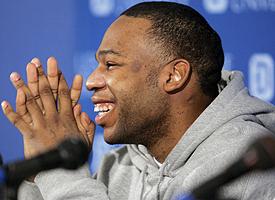
I'm not a particularly religious man, but to see Sam Ashoalu smiling at a press conference sure makes you believe in something...see the article later in the blog...

Crazy-ass trade rumour: Bulls send PF PJ Brown, PF Michael Sweetney, SG Ben Gordon and PF Tyrus Thomas to the T-Wolves for PF Kevin Garnett…the T-Wolves save $11 million under the cap because the contracts of Brown and Sweetney are both expiring…

Oh Boy…Did you see the Cavs-Knicks game last night? The MSG crowd booed Stephon Marbury (0-for-6, 2 pts) and Eddy Curry during introductions…

Tick, tick, tick…That ticking sound you hear is the NBA coaching clock ticking on Doc Rivers in Boston and Mike Fratello in Memphis…with Sam Mitchell in Toronto soon to be on the clock…

Speaking of Mitchell, demoting Mo-Pete to the 2nd unit and putting Fred Jones in his place as a starter was a good idea…Mo’s shooting percentage is down (43.6% to 40.3%) and his defence is a little lacking…

Did you see Yao destroy Shaq this weekend? The Rockets beat the Heat 94-72 with Yao going for 34 points on 11-19 from the floor and 12-13 from the line with 14 rebounds and 2 assists...while Shaq had 15 points going 6-14 from the field and 3-9 from the line with 10 rebounds, 1 assist and 1 block…Yao is becoming the best centre in the world, while Shaq-Fu is looking old…

With all the whining about the zero tolerance policy for player-whining here’s a comparison of the number of league-wide technical fouls and resulting ejections in the first 10 days of this season and last:

2005-06 - 26 technical fouls, 1 ejection

2006-07 - 70 technical fouls, 5 ejections

Wow…a 269% increase in techs and a 500% increase in ejections...

Here’s the inside scoop on what went out in a memo to league offices with respect to the policy:

While players are permitted to approach game officials with professional inquiries about foul calls or other issues, NBA referees have been instructed this season to issue technical fouls to players and teams when they engage in excessive complaining or other inappropriate conduct regarding officiating. Some examples of such complaining and conduct include: 1. Profanity aimed at an official, about an official, the officiating crew and/or calls/non-calls. 2. Inappropriate, disrespectful, or unprofessional overt action in response to a call or non-call. 3. Disrespectfully addressing an official by making statements that personally attack an official's ability or integrity. 4. Continuous criticisms and/or griping over a call/non-call. …hmmm…sounds rerasonable…

Ouch…Houston Rockets forward Chuck Hayes is expected to miss up to two weeks after injuring his left knee in a collision with Shaquille O'Neal.
The Rockets said Hayes bruised and hyperextended his knee when he collided with O'Neal in the third quarter of Houston's 94-72 win over Miami on Sunday night. Funniest part? After the game a reporter asked Shaq about the play where he clearly collided with the 6’6” 250 lb. Hayes, and Shaq said he didn’t even notice…

NCAA note: I watched Indiana beat Lafayette 91-66 last night in the NIT…some thoughts:

- wow Indiana sucks…without the late 28-5 run, due to overwhelming foul trouble for Lafayette and Indiana’s superior depth (more on that in a minute) the Hoosiers barely win
- Lafayette is fun to watch…they run around the court like their pants are in fire and then boom…backdoor layup and one…
- 44 turnovers and 52 fouls…it was like a YMCA game out there…
- fouls limited Indiana guard AJ Ratliff to only 16 minutes, but dude has crazy hops…he’ll be a highlight staple for years
- fouls also limited Hoosier low post threat DJ White to 8 minutes…
- eventually Indiana’s superior depth overwhelmed Lafayette, who had to play some serious minutes with serious scrubs due to foul trouble…

Self Proclaimed greatest shooter in the world: Damon Jones laid 29 on the Knicks, including 24 in the first half…mostly on threes, on which he hit 7…

1) Andy Katz of ESPN.com reports that Canadian Sam Ashoalu watched Duquesne win their home opener, which is a miracle in itself:

On Monday, all was good again for Duquesne

PITTSBURGH -- This was a day of images. Sam Ashaolu walked into his own news conference Monday afternoon, wearing a Duquesne sweatshirt, showing no signs of still having fragments of bullets in his head from a senseless shooting nearly two months ago. Seven hours later, even after his brother John said at the afternoon news conference that Sam was advised not to go to Duquesne's season-opener against Youngstown State, Ashaolu walked into the Dukes' locker room. He was trailed by friend Jason Campbell, who dropped everything in his life in their native Toronto to be with Sam during his rehab. They sat together in an observation box at the Palumbo Center. "He was really into the game," Campbell said. "He said to me, if he was in there, it wouldn't be as close." When you stop to think what this school, this program, this team, these players and staff have gone through over the past two months, it's amazing that they got to this day at all. "What did we have, 10-14 bullets, five players shot and no one died?" asked Duquesne athletic director Greg Amodio, still in awe of how fortunate this university and these players were after a disagreement with a few local youths after a campus party on Sept. 17 turned violent -- and nearly deadly. "[Sam] has made remarkable progress, an inspiration to us all," Duquesne president Charles Dougherty said. Ashaolu was the most serious of the five shot. Teammates Stuard Baldonado, who lost a piece of one vertebrae, was the next worst, followed by Kojo Mensah (shot twice in the arm and shoulder), Shawn James (foot) and Aaron Jackson (grazed hand). Ashaolu was in a pool of blood after he was shot. He was rushed to Mercy Hospital, where he was near death. "There wasn't a medical professional or EMT or policeman who thought he would [make it], and that's a fact," first-year Duquesne coach Ron Everhart said in the locker room about 30 minutes before tipoff. "I remember, it was Wednesday morning, three days after he was shot, and after he had a bad night, there was a nurse who came out of the ICU, and she was crying," Everhart said. "She said to me, 'Have everyone at Duquesne offer their prayers."' From that point on, though, Ashaolu started to improve. He hasn't gone back since, going from a medically induced state to surgery to remove a bullet to, amazingly, where he appears to be on his way toward the potential of a normal life. At one point during the news conference, Sam Ashaolu spoke, slowly and quietly. He thanked his family, friends, doctors and the Duquesne community. He then said he "hoped [his teammates] played hard and win the game [tonight]." The doctors said Monday there were no promises for Ashaolu and that he had a lot of work left to do, both physical and cognitive. Dr. Daniel Bursick, the chief of neurosurgery, said that Ashaolu's skull took the brunt of the bullet fragments, but that some did enter the brain. He did say that there are no plans to remove the remaining fragments and that scar tissue will form around them. He wouldn't rule out Sam one day playing basketball again. However, Dr. Hilly Rubinksy, a neuropsychologist, said there are still some visual and special deficiencies. Dr. Rubinsky stressed that it is still only six to eight weeks from the shooting and that from this point forward, things start to slow down as he goes through outpatient recovery. Ashaolu wasn't around before the game. His brother John, a graduate member of the coaching staff, was with the team in the locker room as Everhart gathered the players together about 50 minutes prior to the tip. "We've got to play hard, and make sure no one comes into our house and plays harder," Everhart implored. He went over the scouting report on Youngstown State. Sitting in the locker room was Kieron Achara. He was on crutches after suffering a stress fracture in his left foot; as if this team needed more drama, Achara, one of only two returning players, is out for at least two weeks. Before the team went out for a final warmup, they huddled together and chanted, "OK, Sam on 3 ... 1-2-3, Sam!" Everhart then went back into a side room for a quick pre-game ritual -- some chew. He doesn't let the players see him with the tobacco, but it's a nervous habit he goes through prior to tip-off. Everhart sat down to reflect on his first game at Duquesne after rebuilding McNeese State and Northeastern. None of those openers can compare to this one after going through a shooting that could have killed five of his players. "My whole life changed with this thing," Everhart said. "I used to get nervous butterflies and stuff like that but that's not the case. It's just different. I don't take anything for granted. I realized how quickly things can change. I've got a whole different mindset. I'm just glad this game is here. It's another step in the whole tragic part of this." Everhart said it was "great for all of us" to see Ashaolu come to practice twice. He said Ashaolu was expected to be an undersized power forward who could make 3s. "There's no question that we were looking at him coming in here and making a major contribution," said Everhart, who took over a team that went 3-24 last season under Danny Nee. The injury to Achara was brought up, too, since he said that made him sit and wonder, "What are we going to do now?" But it was the words from his new crosstown rival, Jamie Dixon of Pittsburgh, that still ring true. Dixon has gone through hell and is still standing after he tragically lost his sister, 28-year-old Maggie, when the former Army women's coach was fatally stricken on April 6 with a heart ailment. Standing outside the locker room of an NBA exhibition game last month here in Pittsburgh, Everhart said Dixon told him, "You have to hunker down and wrap yourself around your work and keep going." "That's the best advice I've had," Everhart said. "I can't look ahead or back or it will drive you nuts. He understands that you've got to stay focused." And with that, Everhart went for a quick meet-and-greet with actual Duquesne boosters who have gobbled up new courtside seats and a pregame meal set up in new Palumbo digs that were finished around the time Nee was forced out. Prior to the tip, James limped into the locker room with his crutches, too. Combine him with Achara, and the two players (both of whom are 6-10) had about 20 feet of crutches. Baldonado was there, too. He said that he's improving and getting more movement in his arm but he isn't opposed to redshirting the season. Mensah said he's about two weeks from practicing. He, after transferring from Siena, and James, a transfer from Northeastern who led the country in shot-blocking last season, both had to sit out this season anyway. "We're like a M*A*S*H unit out here, aren't we?" Everhart said. There were no names on the Duquesne uniforms. They just arrived Monday morning, so there was no time to stitch anything on the back. The Dukes' crowd offered up a decent college hoops atmosphere. The student section was three-quarters packed and sports information director Dave Saba said that you could have put the students from every game last season and still not filled it as well as it was Monday. The announced attendance was 1,830, but that supposedly was a true number, as opposed to the 1,411 claimed for last season's season-opening loss to Arkansas-Pine Bluff -- a game for which the Dukes paid a $65,000 guarantee. They averaged 1,529 a game last season, but that, too, could be an inflated number. Head coach Ron Everhart was proud of his team's comeback victory."It was like a new atmosphere. It's like I'm at a new school," Jackson said. "Coach Everhart has energized the campus." "I think we had 200 people at my first game at Northeastern," Everhart said. The Dukes squeaked out to a 40-39 lead at the half. "OK, take care of the ball, rebound and get back in transition," Everhart told the team in the locker room. "We're fine." The Dukes got off to a slow start in the second half and were down by eight with 11:41 remaining, but didn't quit. Duquesne started three freshmen on this night, with the grittiest of the bunch being Scott Grote, a tough, hard-nosed player from Centerville, Ohio, who was recruited by Bowling Green and East Carolina. Grote finished with a team-high 23 points, finding his way to the basket when need be and making big shots to lead the Dukes to a comeback 81-75 victory. Grote's father, Bob, a radio analyst on Wright State basketball games, said he was at Duquesne the day of the shooting. He drove home that night and got a phone call from Scott at 3 a.m., telling him of the shootings. "The best thing is that they're playing again," Bob Grote said. "If they win, that's second. I just told Scott to take care of the fellas." "Coach, here is the game ball!" Amodio said as he handed it to Everhart in the locker room. Everhart passed it over to Robert Mitchell, who in turn passed it to Baldonado. "We're supposed to win," Everhart said of the opener. "I'm proud of you guys. You toughed it out, especially on the defensive end. It's the first time out of the box. It's not bad. We'll take it." And then, appropriately, they all gathered together and said, "1-2-3 Sam!" Little did they know, though, that he was about to walk into the locker room. When he did, the reaction was giddy. Ashaolu came in and slapped everyone's hand. He took a seat next to Mitchell, grabbed a protein shake, and started yukking it up with his teammates. "We've waited so long for this," James said. It just seems that way. It's still only been just shy of two months since the shooting, but it probably feels like a lifetime. "It's very satisfying," Everhart said after finishing his postgame talk. "We scrapped and fought and we played unselfish." Later, Everhart told a news gathering that the expectations have increased every day. That in of itself is hard to fathom. There were no expectations when Everhart got the job, with only two returning players. Now, throw in five players getting shot -- one still recovering with bullet fragments in his head, two others going through extensive rehab and a fourth with a cast on his foot after having the bullet removed last Friday -- and you can see how beating Youngstown State in a season-opener is cause for unbridled joy.

2) Ian Thomsen of Si.com reviews the 12 undrafted starters in the league:

Overlooked gems - Twelve players who went from undrafted to starters

NBA games are filled with dazzling stars, guys whose spectacular talents were apparent the first time you saw them playing in college, or even earlier, in the McDonald's All-American Game. Many were household names to basketball fans before they needed to shave. From a distance, it sometimes seems like every player who ends up succeeding in the NBA was a sure thing from the very beginning. Step One, hear your name called on draft night. Step Two, place the hat of the team that just made you an instant millionaire on your head. Step Three, shake David Stern's hand and smile for the cameras. But some of the NBA's best players never even got to Step One: hearing their name called during the NBA's two-round draft. And despite being overlooked, underrated or just plain forgotten about, there are 12 current NBA starters who persevered and made it, anyway. One of them is a perennial NBA All-Star. A few have championship rings. And one particularly special player has, at age 29, played more NBA minutes in the past two weeks than he did in his first six seasons out of college combined.

Ben Wallace, Chicago Bulls center

Then: Despite two big rebounding years at Charles Oakley's alma mater, Virginia Union, and a solid effort at the Portsmouth Invitational Tournament, Wallace went undrafted in 1996. He was signed as a free agent by the Washington Bullets (in their last season with that moniker) and his work ethic won him a job as a practice body, where he banged with stars Chris Webber and Juwan Howard. Wallace was the 11th man as a Bullets rookie, playing only 197 minutes in 34 games.

Now: Wallace is enjoying his first season with Chicago after signing a reported four-year, $60 million contract that overnight stamped the Bulls as a serious title contender. He's played in the last four All-Star Games and has averaged at least 11 rebounds per game each of the past six seasons, all with Detroit. He won an NBA championship with the Pistons in 2004.

Brad Miller, Sacramento Kings center

Then: Miller got better and better each of his four seasons at Purdue, culminating with a senior season in 1998 in which he averaged 17.3 points and 8.8 rebounds in the rugged Big Ten. Miller played pretty well in the postseason camps, and most draft experts felt he would be chosen either late in the first round or early in the second round. Miller was thought to be a comparable prospect to Michael Doleac (drafted 12th) and Nazr Mohammed (29th), but inexplicably went undrafted in the 58-player draft. Even though the 1998 draft was strong, with players like Rashard Lewis, Ruben Patterson and Cuttino Mobley lasting until the second round, there's no explaining how Miller was overlooked in favor of big men like Bruno Sundov or Ryan Stack.

Now: Miller, a two-time All-Star, is one of the NBA's best perimeter shooters playing the center position. Comfortable in either the high or low post, Miller is a deft passer (4.7 assists per game last season), reliable rebounder (7.8 career mark) and double-figure scorer.

Bruce Bowen, San Antonio Spurs forward

Then: Bowen was regarded as a defensive specialist even in college, although he averaged 16.3 points a game as a senior for Cal State Fullerton in 1993. Most NBA people didn't regard Bowen as a major prospect, although NBA director of scouting Marty Blake listed him as a sleeper "who can play two positions." Bowen went undrafted in 1993 and played in the CBA and France for four seasons before the Heat signed him to finish out the 1996-97 season. He played for Boston and Philadelphia and had a second stint with Miami before San Antonio signed him to a long-term contract at age 30 in the summer of 2001.

Now: Bowen has played the role of defensive specialist and 3-point shooter in San Antonio for six seasons. He was a starter on NBA championship teams in 2003 and 2005.

Udonis Haslem, Miami Heat forward

Then: Haslem was a durable, reliable college player at Florida, playing in 130 straight games and starting his final 99 games. Some scouts were disappointed he didn't have a breakout season as a senior, averaging 16 points and 8.2 rebounds, similar to his numbers as a junior. Despite his durability, Haslem's conditioning was questioned by scouts. After going undrafted in 2002, Haslem played a year in France for Chalon and finagled a spot on the Heat's summer league team in 2003. His rebounding and work ethic made him a favorite of then-Heat coach Stan Van Gundy, and Haslem earned a spot on the roster.

Now: Haslem is now a three-year starter and helped the Heat to the 2006 championship. He owns an effective medium-range jumper to go with his rebounding and excellent interior defense.

Mike James, Minnesota Timberwolves guard

Then: James was evaluated as a shooting guard at Duquesne, and most scouts felt he was too small at 6-2 to play that position in the NBA. While he displayed some point guard skills, no team was willing to help James make the transition to the position he would have to play in the NBA. He went undrafted in 1998. James played in Austria, France and the CBA before Miami gave him his first NBA shot in 2001. Through stints with Boston, Detroit, Milwaukee and Houston, James was regarded as a defensive point guard who could make the occasional 3-pointer. His breakthrough came with Toronto last season, when he averaged 20.3 points per game.

Now: This summer, James signed a four-year contract worth more than $23 million to take over the point for the Wolves. James (15 ppg) is the second-leading scorer behind Kevin Garnett, but Minnesota has started 2-4.

Raja Bell, Phoenix Suns guard

Then: Bell scored in double figures all four college seasons, two apiece at Boston University and Florida International, but NBA teams didn't consider him special enough to merit a draft selection in 1999. So Bell took his game to Yakima of the CBA and became a more well-rounded scorer and a top defensive player. Philadelphia signed him late in 2001 and he ended up playing key minutes for the Sixers and even appeared that season in the NBA Finals. After a year each with Philly and Dallas, Bell got the first multiyear contract of his career with Utah and spent two seasons with the Jazz, scoring in double figures both years. He then signed a free agent deal with Phoenix in the summer of 2005.

Now: He became so important to the Suns in his first season with the team that some pointed to his injury during the 2006 Western Conference finals as the reason the Suns lost that series to Dallas.

Quinton Ross, Los Angeles Clippers forward

Then: Ross was a big-time scorer at SMU, averaging 20.3 points as a senior in 2003. But his slender build and inconsistent shot prevented him from being drafted. After both NBA teams from L.A. looked at him during the summer, Ross was off to Belgium where he played for Oostende, one of the country's top teams. The next summer, Ross went back for another go-around with the Clippers and this time earned a roster spot.

Now: Ross has worked on his perimeter game to at least keep opposing defenses honest, but his major role with the Clippers continues to be his feisty defense against great athletes at shooting guard and small forward.

Smush Parker, Los Angeles Lakers guard

Then: Parker played just one season of Division I basketball, for Fordham in 2001-02, before entering his name in the 2002 draft. Although he was not selected, he managed to make the Cavaliers' roster for the 2002-03 season. The Cavaliers did not re-sign him, however, and he split the next season between Greece and the CBA. In 2004-05, he had brief trials with Detroit and Phoenix, but spent most of the season playing in the NBA Development League.

Now: After being out of the league for most of two seasons, Parker made the most of his chance with the Lakers last year and ended up starting all 82 games. While most teams still give Parker the outside shot, he's made enough to keep his starting spot for now.

Ime Udoka, Portland Trail Blazers forward

Then: Udoka bounced around the college level, playing for three different schools, the last of which was Portland State, where he averaged 14.5 points in 1999-2000. He wasn't considered even a longshot NBA prospect, though, so Udoka took the minor league route to work on his skills. After becoming one of the more reliable players in the NBA Development League, Udoka earned short stints with the Lakers and Knicks, mixed in with parts of seasons in France and Spain. Entering this season, he had 12 NBA appearances to show for six professional seasons. But at 29, Udoka got his big break. He was signed by the Trail Blazers six years after leaving Portland State.

Now: Injuries to Darius Miles and LaMarcus Aldridge gave Udoka a real chance at playing time in preseason, and he worked all the way into Portland's starting small forward spot. He's averaging 7.7 points per game.

Chuck Hayes, Houston Rockets forward

Then: Hayes was a tough customer in a high-profile program at Kentucky, but he never compiled the eye-catching stats that would cause an NBA team to get excited. As a senior, he averaged 10.9 points and 7.7 rebounds. After being passed over in the 2005 draft, Hayes went to the NBA Development League's Albuquerque Thunderbirds, where he opened some eyes by averaging 11.4 rebounds and 10.8 points. The Rockets, whose 2005-06 season was ruined by injuries, added Hayes in January and he played in 40 games last season.

Now: Hayes had worked his way into the starting lineup before injuring his knee against the Heat on Sunday night.

Fabricio Oberto, San Antonio Spurs center

Then: Oberto was eligible for the 1997 draft and while a few teams knew a bit about him, but his skill level was not thought to be on par with his feisty, aggressive play. At the time of that draft, he was still playing for Atenas de Cordoba of Argentina and had not been scouted heavily. He played well before NBA eyes at the McDonald's Championship in Paris in October 1997, but by then he was no longer eligible to be drafted. Instead of coming to the NBA at that time, Oberto played one more season in Argentina before moving to Europe for a season in Greece and six seasons in Spain. At 30, Oberto became an NBA rookie with the Spurs last season, but played rarely.

Now: With Rasho Nesterovic and Nazr Mohammed elsewhere, Oberto seized the opportunity to gain the starting center position and has played well. His intelligence and mastery of fundamentals make him ideal for the Spurs.

Kevin Ollie, Philadelphia 76ers guard

Then: Ollie was a low-turnover, role-playing point guard at UConn, playing setup man for Ray Allen his final two seasons. Ollie wasn't even a cinch to stick in the CBA when he started his pro career in 1995, but he persevered and got better and better each season. After a couple of solid seasons for the CBA's Connecticut Pride, Ollie was given his first NBA shot by Dallas in 1997 and has beaten the odds to fashion a 10-year NBA career, playing for 10 different teams.

Now: As the only true point guard on Philadelphia's roster, Ollie is starting and averaging about 22 minutes per game. His assist-to-turnover ratio is a bit better than his superb career average of 3-to-1.

Friday, November 10, 2006


Donyell meet your doppelganger….Ludacris…

Speaking of donyell…Cavs F Donyell Marshall, who went over the 10,000-point plateau on Tuesday, joined Clifford Robinson, Sam Perkins and Scottie Pippen as the only NBA players to get at least 10,000 points, 5,000 rebounds, 750 3-pointers and 750 blocks. Marshall is in his 13th season. The other three played 17 seasons apiece.

Too Funny…Former Nets president Jon Spoelstra, now president of Mandalay Baseball Teams, was speaking at a news conference to announce that the New York Yankees and Mandalay were taking over operation of the Staten Island Yankees of the New York-Penn League, said the team was filled with "convicts and criminals" during his tenure with New Jersey. Spoelstra, president of the Nets from 1993-95, said that his players were in so much legal trouble then, team publications could have been filled with "mug shots." "One year we had six guys in jail," he said Thursday. "Not together, because that would have meant teamwork." Some highlights: C Jayson Williams was arrested after being accused of shooting at the hubcap of an empty security truck. The charges were dropped after he completed a program for first offenders…F Derrick Coleman was arrested on charges of disorderly conduct, a case that ended in a mistrial. At the time it was alleged that he vomited on a police car during a routine traffic stop…

Attention K-Mart shoppers: Martin will undergo yet another knee surgery and be out 8 weeks…

I saw the highlights and I’m not sure what the big deal was…James was widely criticized on sports talk radio and by TV pundits for leaving the floor in the final seconds Tuesday night in a 104-95 overtime loss to Atlanta. After missing a 3-pointer with 15 seconds left, he began walking off the floor toward Cleveland's locker room while the Hawks dribbled out the clock. James stopped near the baseline by Cleveland's bench and watched until the final horn sounded. "It's not like I walked off the court and came to the locker room while there was still time left on the clock," he said before Thursday's game against Chicago. "I stood on the court the whole time, until the buzzer's end, I even said something to (Hawks forward) Joe Johnson on his way out. It was kind of frustrating for us to lose that game, but as far as quitting on my team or anything like that, it's crazy. If we would have won the game, it would have never been mentioned. Say if we was winning the game and I did the same thing. Would it have been mentioned? I don't think so."

1) Fascinating article by Bob Hohler of the Boston Globe about athletes carrying guns:

Many players regard firearm as a necessity

A tower of power, he stands 7 feet 1 inch, weighs 325 pounds, and bears a tattoo of Superman's signature "S" on his massive left arm. Yet NBA great Shaquille O'Neal protects himself off the basketball court with more than his physical might and inky bond with the Man of Steel. So are many other American sports figures, including NBA stars Paul Pierce and Vince Carter, NFL standouts Edgerrin James, Marvin Harrison, and Daunte Culpepper, and New York Yankee pitcher Carl Pavano, according to players and a Globe review of concealed weapon permits in states where the names of license holders are public record. In an era in which rich and famous athletes increasingly perceive danger in the worlds they inhabit, legions have armed themselves against muggers, carjackers, jewelry-snatchers, and various other predators they consider potential threats. Players and team officials estimated a vast majority of NBA and NFL athletes carry firearms -- legally or illegally -- and that the number of handgun owners among them has reached an all-time high. Handgun ownership is much less prevalent in Major League Baseball and rare in the National Hockey League. "I would say about 90 percent of players in the league have guns to protect themselves," said New England Patriots receiver Jabar Gaffney, who holds a Texas license to carry a concealed weapon. In the NBA, the figure "is closer to 100 percent than it is to 50 [percent]," said a team official who requested anonymity. By adding handguns to their evening accessories, athletes not only have raised the stakes in their pursuit of personal security but may have increased the likelihood they could face criminal charges, as Gaffney learned last summer. Gaffney is one of at least 27 elite athletes who have been investigated in the last 21 months for incidents involving firearms, according to news reports. He was charged after a traffic stop in New Jersey in June with illegal possession of a handgun (nearly 30 states honor concealed weapons permits from Texas, but New Jersey is not among them). While Gaffney's case unfolded peacefully, some professional athletes fear the potential consequences of the proliferation of handguns in their ranks. Last month, police seized pistols from three Indiana Pacers and charged one, Stephen Jackson, with felony criminal recklessness after Jackson allegedly fired five shots in the air during an early-morning fight outside an Indianapolis strip club. All three players -- Jackson, Marquis Daniels, and Jamaal Tinsley -- were licensed in Indiana to carry concealed weapons.
"Fortunately, nobody has gotten killed" in recent years, said Boston Celtics center Theo Ratliff, who said he does not carry a firearm but has seen handgun ownership rise among NBA players during his 11 seasons in the league. "If something like that happens, it would put a big X on the situation Many players, however, worry more about their safety than how the public perceives them packing guns. "We make a lot of money and have nice things, like nice cars and stuff, and we need protection," said Patriots defensive back Asante Samuel, who obtained a license in Florida to carry a concealed weapon. "Most of us have kids and family and we want to be able to protect ourselves and our families from any harm or danger." Pierce said he obtained licenses in Massachusetts and California to carry concealed weapons after he narrowly escaped death in 2000 when he was stabbed eight times, suffering a collapsed lung and a wound near his heart, at a nightclub in Boston's Theater District. Pierce, who said he keeps his handgun at home, described the attack as "a reality check." "Earlier in my career, I was more outgoing and pretty much thought I could go anywhere and not get bothered, even though people knew who I was," he said. "But that's not the case. There's a lot of jealousy in the world." Now, Pierce said, "I know we're in a position where every time you go out and people see you driving a nice car and wearing a fancy watch, it's in the back of your head that somebody might come up on you." Somebody came up on Pierce's teammate, Sebastian Telfair, last month near Justin's, a New York nightclub, and ripped a $50,000 chain from Telfair's neck. Police investigated whether the robbery was connected to the shooting less than three hours later of the rapper Fabolous at the same location. No charges have been filed in the robbery or shooting. Carrying firearms for personal security is not new to professional athletes. In the late 1980s and early 1990s, police discovered handguns in vehicles owned by Irving Fryar of the Patriots and NBA stars Charles Barkley and Scottie Pippen. And more than a decade has passed since NFL linebacker Bryan Cox famously referred to the dangers of his childhood neighborhood in explaining why he owned handguns. "Where I'm from," said Cox, who was raised in East St. Louis, Ill., "a gun is like a credit card -- you don't leave home without it." While it's impossible to tally how many athletes illegally carry firearms, the total number of those who are licensed to carry concealed weapons also is incalculable because of laws backed by the National Rifle Association that prohibit the vast majority of states from license disclosure. Of the 46 states that require permits to carry concealed weapons, only a small number have made those records public, including Alabama, Florida, Indiana, Louisiana, Ohio, and South Carolina. Two states -- Alaska and Vermont -- allow individuals to carry concealed weapons without permits, while two other states -- Illinois and Wisconsin -- prohibit carrying concealed weapons. Some law enforcement officials said they recognize the danger high-profile athletes may face. "Sometimes I worry about giving permits to young people, but these guys have a lot of money and sometimes people want to do stuff to them," said David Warren, the sheriff of Macon County, Ala., where New York Giants cornerback Frank Walker is licensed to carry a concealed weapon. "We've got to consider the circumstances they're in. It's sad, but they need some form of protection." In Massachusetts, 203,302 residents were licensed to carry concealed weapons as of August, according to the state Criminal History Systems Board. That's about one of every 23 residents among the 4.6 million who are at least 21 years old, the minimum age to obtain a license. But state law bars authorities from releasing the names of permit holders to "prevent individuals with devious motives from ascertaining who possesses firearms," according to a guide published by Secretary of State William F. Galvin. Critics contend the prohibition prevents the public from knowing whether individuals with devious motives may possess firearms. "Denying the public access to these records significantly impairs efforts to analyze the effects of concealed weapons laws on public safety and even to determine whether the permitting process is working properly," said Laura Cutilletta, a staff attorney for the San Francisco-based Legal Community Against Violence, which monitors gun laws. The Globe, in a review of the small number of states that disclose the names of permit holders, found more than 50 professional athletes had obtained licenses to carry concealed weapons. (Many states that seal records from the public rank among the largest, including California, Texas, New York, Pennsylvania, Michigan and Georgia .) The license holders identified in the Globe review included eight players selected for the 2006 NFL Pro Bowl (Harrison, James, Santana Moss, Jason Taylor, Bob Sanders, Cato June, Jeff Saturday, and Marcus Stroud) and three members of the NBA's 2006 All-Star team (O'Neal, Pierce, and Carter). There were former college criminology majors, such as Willis McGahee of the Buffalo Bills, Marquand Manuel of the Green Bay Packers, and Aaron Stecker of the New Orleans Saints. There were 10 Jacksonville Jaguars, including a 350-pound lineman, Stockar McDougle. And seven Indianapolis Colts, including June, a former member of the National Honor Society. The list included Marlon McCree of the San Diego Chargers, who once received an honorary key to the city of Orlando; Michael Lewis, a former man of the year for the New Orleans Saints; Stephen Davis of the St. Louis Rams, the former ambassador of physical fitness in South Carolina; and Jevon Kearse of the Eagles, whose brother, father, grandfather, uncle, and cousin all died in separate incidents of gunshot wounds. The players ranged in age from Jacksonville cornerback Chris Roberson, who turned 23 in June, to Cleveland Browns defensive lineman Ted Washington, 38, formerly of the Patriots. And they shared a common concern: safety. "It's a sad thing, but there are people out there who see us as targets," Gaffney said. "We never know who might want to do us harm, so we have to take steps to make sure we're safe." Beyond their wealth and celebrity, many athletes are linked by a culture in which images of firearms abound. “We're seeing a generation of athletes coming into professional sports who have grown up with the glamorization of carrying a handgun," said Peter Roby, director of the Center for the Study of Sport in Society at Northeastern University. "But there's also a practical side to" players carrying firearms, Roby said. "These are young people who have an awful lot of money and are worried about whether they are going to be a target of somebody who wants some of that money." Many wealthy athletes, including LeBron James of the Cleveland Cavaliers and Jermaine O'Neal of the Pacers, hire private security guards for protection. Some take other precautions. "A lot of guys in the league don't have the money to pay for around-the-clock security, so they go out with entourages," Pierce said. "With entourages, you can use the people close to you as a shield so you don't have to put yourself in a position that you have to pull out a gun." Ratliff said entourages are especially common among players who frequent late-night venues . "The guys who go out to nightclubs, they either run with a lot of guys to try to offset people getting at them or they carry a gun," Ratliff said. Had Pierce been carrying a gun the night he was stabbed, he was asked, how might things have been different? "It probably wouldn't have been any different," he said. "Stuff happens so fast, who knows if it would have changed the outcome." Pierce's coach, Doc Rivers, said nothing is gained by athletes packing guns. An NBA player from 1984-96, Rivers described the rising prominence of firearms among sports figures as "a generational thing," driven in part by the enormous celebrity of many contemporary athletes and the public's emphasis on their lucrative salaries, particularly on talk radio. "Their celebrity and all the talk about their money puts a target on their back," Rivers said. "They have to be concerned about their safety." But Rivers echoed NBA commissioner David Stern, who -- in a stunning plea by the head of a major professional sport -- urged players to leave their guns at home. Both the NBA and NFL have policies that bar players from carrying guns on league business and have stepped up efforts through seminars and other educational programs to discourage players from carrying handguns. The trouble is, many athletes believe danger lurks at nearly every turn. "Even when I do charity work, there's always a couple of kids who say, 'I can beat you up,' " said Patriots tight end Ben Watson. "They see you on TV and they want to do the tough act and all that." Watson and several other professional athletes who shun carrying handguns said their challenge is avoiding potential trouble. "As far as what happened to [Telfair] and those guys, a lot of it is about where you go and what situations you put yourself in," Watson said. "For me, it's about trying to stay out of those situations." Another player's suggestion: Don't advertise your wealth. "My thing is, if you don't wear the $50,000 chain, you don't need a gun to protect yourself," said Patriots lineman Jarvis Green, who said he goes unarmed. Several ranked self-restraint among their best defenses. "You have to learn to walk away if somebody starts something," said Patriots receiver Doug Gabriel, who expressed no interest in carrying a gun. The alternative could be devastating, especially for an armed athlete, according to Roby. "It's inevitable that players are going to get into situations either by their own doing or somebody provoking them," Roby said. "But there's always the concern that somebody's going to get hit with an athlete's stray bullet or that an athlete is going to feel his life is threatened and shoot somebody and go to jail for a long time if it's proven not to be self-defense." Pierce opts for entourages and private security to avoid such a possibility. "But if someone comes in my house," he said, "that's a different story." Samuel said he has never felt compelled to draw his gun since he obtained his license to carry a concealed weapon in 2002, his senior year at the University of Central Florida. He said growing up in Florida convinced him he needed the license. "There's a lot more crime down South, so you have to watch your back at all times," Samuel said. "I knew I was going to have a chance to make it to the NFL and I needed protection, for whatever reason." Florida, like most states, requires individuals who apply for licenses to document they have been trained in firearm safety. "I wanted to do it the right way," Samuel said. "I didn't want to get in trouble." Gaffney said he joined a group of teammates in a firearm safety course during his rookie season with the Houston Texans in 2002. And though he remains concerned someone "might be out there trying to do us harm," he said he has yet to grow fearful enough to draw his gun. "Hopefully," Gaffney said, "that day will never come."

2) Chad Ford of ESPN.com with a draft update:

Yi Jianlian: China's next big thing?

News that Chinese big man Yi Jianlian will enter the 2007 NBA Draft was met by serious buzz among international scouts. "Depending on who's in the draft, I think he could be in the mix for a top five pick," one NBA scout who recently returned from China told me. "I've been watching him practice and play. He's really improved. He's got to the chance to be pretty special," the scout continued. "He's got a lot of tools. Everyone's going to think Yao, but this kid is totally different in a good way." Another scout said he'd be a lock for the lottery, but wouldn't go as far as a top five ranking. A general manager who's been to China to watch him play thinks he'll be one of the most intriguing international prospects to come into the draft in several years. With the exception of Yi and Brazilian big man Tiago Splitter, there aren't any top international prospects for the 2007 draft, which is expected to be dominated by college underclassmen. Splitter has zero sex appeal. He's entered and withdrawn from the last three drafts because he's been unable to secure a promise in the lottery -- now, according to the rules, he's in to stay. While he's improved every year he's played in Spain, his upside isn't huge. He's a talented big man who will probably make a bigger impact on defense than on offense. In a draft with so much upside, that's hard to fall in love with. Yi, however, has the right ingredients to be in consideration for the high lottery. He is about 7-feet tall and athletic, has quite a bit of international experience and had a good showing against Team USA in the World Championships this summer in Tokyo, posting a line of 13 points, seven rebounds and two blocks in 24 minutes. The inevitable comparisons to Yao Ming will surely come, and Yi is the best prospect to come out of China since Yao. But that's where the comparisons stop. Yi plays more like Toni Kukoc than like Yao. He runs the floor, shoots the J and, unlike Yao, has a real bounce to his step. Agents are lining up to get their shot at Yi. Yao's agent, Bill Duffy, has been considered the front runner for years, but he may get resistance from Yi's camp, which wants to make sure Yi gets a separate identity from Yao.

3) Ian Thomsen of SI.com reports on T-Mac getting old and other things:

Diminishing returns - McGrady says he's lost a step ... at ripe old age of 27

The enigma of Tracy McGrady continues. "I'm young,'' he says. "But I'm old.'' McGrady is 27, yet he's entering his 10th season with a sensitive back that sidelined him for 34 games last season. He feels much older than he looks. "My first year here,'' he says, referring to his 2004-05 debut with Houston after being traded by Orlando, "I felt like I was that same type of guy that was in the Magic uniform, that I could go out and get 30 or 40 every night. At this point right now, I don't feel that way. I feel like the last few years my game has diminished a little bit. I don't know if it's because I'm older, because of the injuries or what, but I feel that I'm a step slower.'' McGrady is an interesting test case for the NBA. Personnel people are studying him, Kevin Garnett and other teenaged draft picks in hope of recalibrating the standard graph for NBA longevity. The traditional thinking has been that NBA players reach their peak at 28 into their early 30s, but that traditional model was based on rookies who used to enter the league in their early 20s after three or more years of college. McGrady was drafted as a 17-year-old in 1997. When Larry Bird had played as many NBA games as McGrady -- 617 -- Bird was a 30-year-old whose body was already starting to break down, leading to his retirement five years later. "The last six years I've been playing a lot of minutes,'' McGrady says. "In Orlando I was playing 40-plus, and what I had to do for them -- guarding the best players and scoring the ball -- really took a toll on my body. I don't feel 27. It's not so much the years that you play in this league, it's more so the mileage and the minutes and everything that you do that takes a toll on you. It's definitely done that to me. "I had a very quick first step, and I've lost a little bit of that. I've put on some weight, but hey, man, as you get older you slow down a little bit and that's what's happened to me. I look at Kobe Bryant. He's still a great player, but he had to sort of change his game a little bit because we're getting older. He's breaking down as well with the surgeries. I saw him [Friday] night and he doesn't look the same. He doesn't look the same at all. He looks heavier and he looks slower.'' Bryant, by the way, is 28. Is McGrady ready to cash out? On the contrary. He compares himself to the pitchers who lose something off their fastball yet compensate with a better understanding of how to work the plate. "Roger Clemens doesn't throw as hard as he used to throw, but he's very smart, he knows how to mix his pitches up and keep the batters off balance,'' McGrady says. "Obviously I'm not 40-something years old, but just the whole mentality of knowing that you don't have that overpowering [presence] that you would normally have when you were younger. As you get older you don't have that, so you got to find another way -- and that's got to be by smarts.'' McGrady's career seemed to be at risk last year when Rockets owner Leslie Alexander personally decided to hold him out for the final month in order to get to the bottom of his back injury. McGrady spent the summer getting leaner and now swears that he doesn't worry about reinjuring his back. "My back was so jacked up, I was healthy -- this is no lie -- for one game last year, and that was the first game of the season,'' he says. "I kind of lost my passion for the game, but I worked my ass off to get into tip-top shape just to bounce back and come into training camp more focused than ever. "I think I'll be healthy to play out this contract,'' says McGrady, who is signed through 2009-10, when he'll be making $23.2 million as a 30-year-old. "But after that it's a big question mark.'' By acquiring Shane Battier and Bonzi Wells, the Rockets have assembled a contending roster around Yao Ming and McGrady, whom coach Jeff Van Gundy routinely refers to as "one of the great decision-makers in the league.'' "A lot of guys would have trouble accepting me saying to the team that Yao is our No. 1 option in the halfcourt, but Tracy's fine with that,'' Van Gundy says. "I hear all this 'Me-Mac' stuff from down in Orlando. I don't know what happened, but if he was that way there, he hasn't been that way from Day One here. This guy has been all about the team.'' McGrady is the best player in the league to not have won a playoff series, but Van Gundy objects to the category. "We were up 2-0 two years ago and we should have won,'' says Van Gundy, referring to the Rockets' seven-game loss to Dallas. "Or I don't know if we should have won; we lost to a team that played better than us during the regular season, but we had the ability to win. I don't think he could have possibly done more in that series. That's what bothers me about 'McGrady has never won a first-round series.' I know there were reasons we lost in that series, and not one of them had to do with McGrady.'' He has made the playoffs five times but never on a team with homecourt advantage. "I've always been the underdog,'' says McGrady, who averaged 30-plus points in each of his four series with Orlando and Houston. "But I can honestly say this is the first time in my 10 years that I came into training camp and I felt like I'm finally going to get out of the first round. "When I was younger I was extremely happy and excited to win a scoring title and accomplish all of these individual accolades, but now I don't even care about all this stuff. I watched Dwyane Wade [win the championship] and LeBron -- he's in his third year and he's advancing to the second round -- that's motivation. That's where I want to be because I see how much fun those guys are having out there. And that's what I want to do.'' It's as if McGrady has been abandoned by the new Wade/LeBron/Carmelo era. "It's like everybody's forgotten him all of a sudden,'' Rockets GM Carroll Dawson says of McGrady. "He used to be one of the stalwarts, but you never see his name anymore.'' What does that mean to McGrady? "Nothing,'' he says. "I know what I'm capable of, and you ask those guys -- they respect me.' Before breaking out with a 32-point performance on 11-of-19 shooting in Houston's win at Milwaukee on Wednesday, McGrady had started slowly in averaging 16.5 points and hitting a career-low 35.8 percent from the field. But he was more concerned with the 3-2 Rockets up-and-down start, though he recognizes that all the newcomers will need time to learn Van Gundy's complicated system. "I'm in a situation where I don't have to score like that anymore,'' says McGrady, referring to his not-so-distant past. "If I was put in the situation where I had to do that, I think I'm still capable of doing it. But I'm playing with the best center in the league so I don't have to go out and be that guy anymore. And that will prolong my career.''

Memo to Morrison: Shoot! - Adam Morrison is not your typical rookie gunner. "He's not shooting enough,'' complains Bobcats coach Bernie Bickerstaff. "He's got the shots and we want him to shoot more, but I think he's trying to bring his teammates into the play.'' His teammates must like that. "They want him to shoot also,'' Bickerstaff responds. Through four games Morrison was the Bobcats' No. 3 scorer with 15 points a game off the bench, though he was shooting just 37.3 percent from the field. Morrison admits he is adapting to the speed of the NBA game, but it's a normal growth curve: Elders like Ray Allen will tell him that they too were forced to develop a quicker shot release as NBA rookies. "It is something I need to work on, coming off screens and being able to shoot,'' says Morrison, referring to the speed of NBA defenders. "I could do it in college at my own pace. But here sometimes I thought I wasn't open but the coaching staff thought I was, that I had plenty of time to shoot.'' In other words, Morrison needs to develop a quicker trigger. It's a sure thing that he will, because Morrison is too aggressive and competitive to not adapt. He isn't shy either. In the third quarter of Charlotte's 110-108 overtime loss Wednesday at Boston, Morrison clapped his hands for the ball at the three-point line but was ignored by point guard Brevin Knight. "Hey!'' cried Morrison. Without looking at him, Knight pointed in Morrison's direction to let him know he would get the ball next time. The most disappointing aspect is that Morrison isn't weaving and cutting more often without the ball; instead he has spent a lot of time spotting up from the three-point line. He struggled to a 2-for-11 performance Wednesday, but instead of forcing shots he drove his way to the foul line for the bulk of his 12 points. "They just tell me to put it up when I'm open,'' Morrison says. "When I feel comfortable I'm going to let it fly. But I think it's a team game and we've got good players, and I'm not going to come here and be one of those prima donna-type guys that demands his shots and is bitching and all that. I'm just trying to do what's best for the team.'' Counters Bickerstaff: "He's got to shoot the basketball, it's that simple. Probably the most difficult thing coming into this game is knowing when and when not to. If you're open, you're raising your teammates' play by making the shot.''

In his own words: Jerry Colangelo - The 66-year-old Colangelo has emerged as the NBA's most powerful owner -- a shadow commissioner who, with David Stern's blessing, not only revamped NBA rules to quicken the pace of play but also overhauled the men's Olympic program as the new managing director of USA Basketball. Colangelo joined the expansion Phoenix Suns in 1968 as the youngest GM in pro sports, and purchased the team for $44.5 million in 1987. In 2004 he sold the Suns to Robert Sarver for $401 million, embarking on a three-year transition in which Colangelo has remained team chairman and CEO. His leadership of the Suns concludes at the end of this season. Will the Suns deliver him a long-awaited NBA championship in his final year? In this interview he responds to a variety of topics from Mark Cuban to the viability of Las Vegas. He acknowledges the difficulties of selling off his Suns as well as his future in sports, including the possibility of buying another franchise or even taking over for Stern someday as NBA commissioner. On his decision to sell the Suns: "The transition was much more difficult than I would have ever imagined, though I would do the same thing again for all the right reasons. I did it to set up my family financially because I've been a working stiff my whole life, and this was my opportunity to show something for the work and effort I've put into it. I was different than any other guy to come along in ownership: I was a player [at Illinois], I was in scouting, coaching, managing and owning in the NBA, so I've been a lifer through the system. This was my time to cash in and have something to show for it. "In reality I have been more than willing to acquiesce to Robert. I think it's only appropriate -- when [he] wrote that check it was unrealistic to think that everything would remain the same for those three years. The last two years I've acquiesced quite a bit, it really was my call, and I was willing.'' On son Bryan Colangelo's departure as Suns GM last season to become Toronto Raptors president: "When the sale took place it was an almost inevitable possibility that Bryan might not be part of the future of the Phoenix Suns, because new ownership has the right to maintain or change management. Bryan and I discussed that before the sale, and he encouraged me to do what's right for the family and don't worry about him, he was going to be OK. He was right. "It was time for him to go out on his own, because as long as he was part of the Phoenix Suns I would still be casting something of a shadow. For him to make a break was in his best interests professionally. Though it's been personally difficult because he's part of our family, that's all part of this business.'' On how he pushed through the rules changes: "I'll take the full blame or responsibility for that one. David Stern and I were meeting in New York and I shared with him my concern for the game at that time. I felt the game had lost its appeal and allure, and if it was starting to affect me then that was a serious issue. I had some very specific ideas about how to quicken the game, and David said, 'Put together a committee and do what needs be done.' Normally this kind of thing would take place within the competition and rules committee, and the coaches would discuss these things to ad infinitum. So it was my strong opinion that this was not going to be done by democratic opinion. A lot of times when people are voting on rules changes, their vote is based on their own talent. When you have coaches and GMs voting on rules, that is an issue. "So when I appointed my committee -- the members were people like Jack Ramsay, Dick Motta, Jerry West, Rod Thorn, Bob Lanier -- we had about 10 people who came in for the meetings in Phoenix, and I outlined what needed to be done to the rules. We discussed them, tweaked them and then we changed the rules. After the fact we met with the GMs, who had their nose out of joint, and the coaches, who may have started with their nose out of joint. I told them be patient but it would work. It would take a couple of years to implement and for people to change. So it had been done differently than it had been done before, but I thought it was necessary because otherwise it may have taken forever.'' On the rule permitting zone defenses: "When we came up with the idea that we were going to allow any defense to be played, we came up with the three-second rule for the offensive guy and the defensive guy -- and that protected us. We cleaned up play in the middle, speeded up play by changing the 10-second halfcourt rule to eight seconds -- we almost went to seven seconds, by the way -- and bringing more emphasis on shooting the ball and smarts. "I'm going to make a statement, and sometimes people have misinterpreted this: When we started playing the game in this country above the rim rather than below the rim, when athleticism was the key, then coaches started clinging to the athleticism and the fundamentals got sidetracked. How to pass, how to go without the ball, how to shoot the ball. I really believed because of these rules changes that scoring would increase, percentages would improve, it would put more of a premium on intelligence and people would have to get back to the fundamentals of the game. In so many ways it's a better game than we had seven or eight years ago.'' On reorganizing the Dream Team: "I felt that the system really didn't work. Committees were selecting the players, with a different set of players for the World Championships than for the Olympics, and politics were involved, and there wasn't any continuity because we were putting together a group for each competition. I looked around the world at the countries where playing for the national team is the ultimate. But here in the States the ultimate is the NBA. I respected and appreciated what they'd done with their continuity, having the same players and coaches in their program for years. I came up with the idea that the head coach, assistant coaches and players would make a three- to four-year commitment so we could build continuity and we wouldn't be throwing guys together. This is the ultimate team game, and you need to have players together for a period of time, and the more experience they have together the more opportunity they have to be successful.'' On adding Kobe Bryant to a 2008 Olympic team already loaded with scorers: "The game plan is to look at players who did not participate last summer: Amaré Stoudemire, Shawn Marion, Kobe Bryant, Lamar Odom, Michael Redd, Paul Pierce, Greg Oden -- I may be missing someone, but it's a pretty healthy group. Somehow someway they need an opportunity to show how they fit into our plan as we start to prepare our summer camp before the trials competition. There may be a few deletions and a few additions. We have flexibility because it was left up to me to implement the system; I'm the one who created the system.''

4) From Randy Hill of Foxsports.com thinks the techs are getting serious:

Tolerating the no-tolerance policy

An NBA season that will drag its All-Star party to Sin City has been defined by the league's embargo on bad on-court behavior. Who said irony can't be entertaining? For the record, I endorse commissioner David Stern's commitment to curb the whining. But I'm a high school coach, who — like my coaching cronies — anticipates NBA players setting a slightly better conduct example for aspiring players. Similar thumbs-up approval has been rendered by casual fans that applaud any legislation working against the wishes of handsomely compensated pro athletes. But in the long term, how will these quick whistles actually impact players and coaches working in the league? Reviews and expectations are mixed. According to the interpretation of one NBA assistant coach, the obvious opposition of coaches and players may not be shared by team officials. "Just like the league, the teams think any disrespectful attitude is a poor reflection on the franchise," said the coach, whose anonymity coincides with his interest in not being fined. And poor reflections often are presumed to be bad for business, suggesting that a key motivation is money. In a memo sent to NBA executives from the league office, the new zero-tolerance policy lingo was peppered with references to marketing partners. Fine, the league believes in self-preservation. But moving forward, how will zero tolerance change the league? Well, with three big-name players tossed in the season's first three nights, it's conceivable that feelings of entitlement — in regard to referee calls — may be taken from the stars. This suggests that even mediocre players will be shooting free throws in the fourth quarter. But there are even greater concerns: Fines from the technical-foul explosion may cut into wardrobe budgets needed to reach dress-code standards. An inability to bark at referees could diminish the players' street cred. Giving referees the license to T-up players and coaches with abandon will alter the singular grace of Steve "Quick Draw" Javie. To be sure, there are benefits to an upgrade in on-court behavior. If Stern's anti-whining tactic succeeds, the subsequent reduction in complaining may speed up the game, giving beat reporters enough time to solicit quotes before deadline. OK, bad example. Here's a better one: instead of studying Kobe Bryant's reaction to a perceived bad call, young American players may actually pay attention to his footwork. "Just like everything else, players and coaches will adjust," the assistant coach said. "They'll see how far they can go and act accordingly. We won't have dozens of games lost by star players who refused to shut up." He may be right. I'm just wondering when Stern will get around to sanctioning players who continue to complain about his new basketball.

Wednesday, November 08, 2006

Add LeBron to the list of players whining about the new ball…"It's not a good basketball," the Cleveland Cavaliers' superstar forward said. "It kind of feels like a basketball you buy for your kids at Christmas or something." Sometimes you can grip it, and sometimes during the game it sticks to your hand," he said. "It won't bounce, it will just roll on you. I don't know why we can't get used to this ball. But it's just not good."

Some chestnuts from Elias: The Mavericks lost to the Warriors Monday, dropping them to 0-3 on the season. Over the last 25 seasons, the only other team to lose its first three games of a season following an appearance in the NBA Finals was the 76ers, who dropped their first five games in 2001…The Bulls and the Bucks have met 197 times in regular-season competition since the Bucks entered the NBA in 1968. Monday's game gave Chicago a 99-98 edge in wins. Entering the game, it was the most games played in any NBA team-vs.-team series in which the games had been evenly split…The Wizards lost in Orlando Monday, which is nothing new. Washington has lost 18 of its last 20 games there and has posted an all-time record of 6-29 (.171). The only team with a worse record than the Wizards at Orlando is the Nuggets (2-16, .111).

According to the Washington Post, Wizards centers Etan Thomas and Brendan Haywood were got into a scarp Thursday at the team's arena…Apparently, Thomas approached Haywood over comments made by Haywood's agent, Andy Miller, who was critical of coach Eddie Jordan's decision to start Thomas over Haywood…eventually, Thomas began arguing with Haywood over the comments, then threw a punch. Haywood responded by slamming Thomas to the ground and tearing out two of his dreadlocks…Teammates then quickly separated the two…Thomas and Haywood have a history of altercations. Haywood was suspended one game last season after a fight with Thomas during practice…

1) Allan “Swiss Cheese Knees” Houston is now a reporter for ESPN.com…here’s his first column:

AI still elevating his game

When I was playing for the New York Knicks we often used a team approach to defend Allen Iverson. Like many teams, we tried to channel him into one area, and then have the help come. Trying to play a scorer like him straight up is not a good idea -- here comes the crossover! -- so you want to send him where some help of the longer variety can step in. Now, teams can still try that, but they're dealing with the more experienced Iverson now. Instead of driving into three people, he'll step back and shoot. He'll spot the open man. Right now, he just might be at the top of his game in skill and smarts. When you have more miles on your career, you have to be efficient. And Iverson is just that early this season, helping send Philadelphia off to a 3-0 start. He made 49 percent of his shots in averaging 34 points per game before Monday's loss to Indiana. He had 20 points in that 97-86 defeat. But in some ways, at 31 and in his 11th year in the league, he's still the same on court. You see his fearlessness, both mentally and physically, and that extreme energy he had when he first came into the league from Georgetown. So on the court, he's the same, but just better, more mature, these days. And I think he now realizes fully the kind of responsibility he has to his teammates. I believe the same is true off the court. I get the sense, reading and hearing his quotes lately, that he's seeing his career from a bigger picture, not just his legacy on the court, but off it too. He's got his own family, and he may be thinking about how he's going to be remembered. I've found myself in the position of having to defend Iverson on the court. Not easy. Same for trying to do it off court, whether it's his "practice" comment, the gun questions, the league's dress policy and on and on. But overall, I think he's misunderstood. He's from a different world than David Stern. Take the practice comment. My father was a coach who drilled "you play like you practice" to me since I was nine years old. But I think Iverson didn't realize the way that comment would be received. Would he say the same thing now? Probably not. Iverson's wrapped up in the game first and foremost. He's not thinking that his shirt is hanging out, or that his reaction to the officials might be seen as excessive. Now, he's got to carry a team that finished out of the playoffs despite having his best scoring (33.0 ppg) and shooting (44.7 percent) seasons last year. As for their outlook in the playoff race, despite all that AI brings, I still wouldn't put Philly in as a favorite for that eighth spot in the East. But it's hard to count out a team with the experience of Iverson and Chris Webber. Kyle Korver is a shooter, and with players like Samuel Dalembert and Andre Iguodala, this team is going to be in most every game. The Answer will see to that.

2) Chris Mannix of SI.com on the Knicks, Hornets, and other musings:

Get rid of Isiah

It didn't take long, did it? How many hours did it take before the Knicks morphed from the united-we-stand-divided-we-fall bunch that spent the preseason telling us their problems were gone -- now that a certain senior citizen had been pushed out the door -- back into the dysfunctional bunch that ended last season? 72? 96? How long did it take for the Knicks to stop playing defense? Did they ever start? The lone bright spot in a season beginning its slow swirl down the drain was the opening-night win at Memphis. Congratulations. You beat Memphis. Forget the fact that the Grizzlies were playing without their star player (Pau Gasol), are starting a glorified small forward (Hakim Warrick) in his stead, and still had enough firepower to erase a 10-point lead in the final five minutes and force overtime. Three of them actually. How long did it take for the Knicks to stop passing the ball? New York had 14 assists in Saturday night's loss to the Pacers. This from a team that allegedly starts two point guards in their backcourt. Indiana's Jamaal Tinsley had 14 by himself. The ball movement that was supposed to be an integral part of Isiah Thomas' read-and-react offense is just not there. Who knows if it ever will be. How long before we accept that this was not Larry Brown's fault? Brown is old school. I'm not talking about Rick Adelman old school. I'm talking Red Auerbach old school. Don Nelson old school. If a guy is stinking up the joint, Brown's not going to cover for him. You ever hear Red pull any punches? Have you heard Nelson recently? Just from picking up the newspaper, you know that both Adonal Foyle and Baron Davis have, at one time or another, stunk. There are no sources close to Nelson. No cryptic messages sent through the press. Just Nellie standing in front of a Warrior backdrop saying some of his guys aren't getting it done. It was the same thing with Brown, only in New York you are saying it into a megaphone funneled through a bullhorn. Answer me this: Anyone think Brown was wrong? This is gut-check time for James Dolan, who if he doesn't have Kiki Vandeweghe's phone number memorized by now he should have it tattooed to his forearm. The formula doesn't work. Isiah Thomas isn't the coach for this team. Nor the GM for that matter. Stephon Marbury isn't the building block Thomas foolishly hoped he would be. It's time to cut bait. Vandeweghe built Denver from the ground up. He brought in Jeff Bzdelik to get the ball rolling. Then he brought in George Karl to finish the job. He's not a miracle worker. But he knows how to create a product. Winning is the endgame. Time to take the keys away from those who can't and pass them off to someone who can.

Where will Hornets settle down? Having spent a lot of time recently in Sooner country for a story that will appear in this week's Sports Illustrated, I feel I'm as qualified as any to opine on the future of the NBA in Oklahoma City. So here it is: I have no idea. The league (and more specifically, David Stern) is faced with a classic conundrum: Should the NBA walk away from a lucrative market that has embraced pro hoops with the same passion it embraces college football? Or does the league stay and deal another blow to the New Orleans area that can't take many more punches? I will say this: Stern is no fool. The NBA is a revenue-driven league and at the end of the day, Stern has a responsibility to the owners to put teams in the best possible position to turn a profit. And let's not forget, the Hornets are not the Celtics or the Knicks. This is not a team with deep ties to the community. In fact, the New Orleans community barely supported them; the Hornets were at the bottom of the league in attendance in their last two seasons there. Expect the NBA to do everything possible to keep the team in Oklahoma City.

Raving about Rondo - Celtics executive director of basketball operations Danny Ainge deserves to be criticized for failing to surround Paul Pierce with any semblance of serviceable veteran support. But give credit where it is due: the man knows how to draft. Following up on solid picks Kendrick Perkins ('03), Al Jefferson ('04), Delonte West ('04) and Gerald Green ('05), Ainge has found a diamond in the rough in point guard Rajon Rondo. Boston coaches have been raving about Rondo's playmaking (4.5 assists per game) and several people in the Boston front office feel that if Rondo was a better outside shooter, he would have been a lottery pick.

Waiting on Jalen - Jalen Rose was a solid pickup for the Suns, who were actively seeking help for their bench. But Rose's conditioning was suspect while he was in New York and it will take him some time to adjust to Phoenix's marathon pace. When he does, expect Rose -- who will play small forward and shooting guard with Phoenix -- to provide the kind of instant offense Tim Thomas gave the Suns last season.

Fairy tale beginning - Great story developing in Portland with forward Ime Udoka, who found out he made the team just days after the sudden death of his father. Udoka, a defensive presence at two positions, is a Portland native who has had cups of coffee in New York and Los Angeles before settling into the Trail Blazers starting lineup this season. Let's clear up one thing: Udoka is not a rookie. According to an NBA spokesman, a player loses his rookie status once he plays a game, so Udoka, who played eight games with the Knicks last season and four games with the Lakers in 2004, is technically a third-year player.

Farewell, Red - As a former Celtics employee, I've been asked a lot the last week about my experiences with Red Auerbach. The truth is only a few people in this world can actually claim they knew Red, who kept his inner circle private (or as private as you can be in the middle of a Chinese restaurant). However, one memory that jumps out comes from my first season as a Celtic ballboy. I was 15-year-old kid who didn't know Red Auerbach from Red Holzman (at least not visually) and was just starting out on what would be the greatest experience of my life. Well, a few games into the season I was asked by one of the older staffers (whose identity shall remain nameless) to go into the Celtics locker room and "tell the old guy to put his cigar out." I'd like to say I did it, but the truth is I only got within a few feet of Red before being whisked away by a member of the P.R. staff who scolded me for even thinking of approaching the Boston patriarch with such a question. Over the years, it would become a running joke among a few of the ballboys that whenever a newbie came aboard, we would try and pull the old cigar gag on them. Far as I know, I'm the only one who even came close to falling for it.

3) Mike Kahn of Foxsports.com with his 10 things:

10 things we learned this week in the NBA

Very quietly, the Utah Jazz are off and running in the Northwest Division ... and we mean running. Yes, a Jerry Sloan-coached team has averaged 107 points a game on the way to its first 3-0 start — winning by an average of 12.8 points — including victories over Houston, at Phoenix, and blowing out Golden State the next night.

1. Item: The high-scoring Jazz don't represent a dramatic turn of strategy from defensive-guru Sloan as much as a sign of the times in the NBA. Scoring is what it's all about — the shutdown defense only matters down the stretch of games. What this really means: The Jazz should be the best team in the weak Northwest Division, where the Minnesota Timberwolves don't quite look like they know what they're doing around Kevin Garnett; there's always something askew with the Denver Nuggets; the Portland Trail Blazers are as young as some college teams; and the Seattle SuperSonics don't know whether they're coming or going ... literally. Three games into it, and Carlos Boozer — finally after two injury-marred seasons — looks like the guy they invested $68 million in. He's averaged 20.7 points and 15 rebounds — a double-double in each game — and is dominating inside on offense. Mehmet Okur is the second coming of Bill Laimbeer's shooting and rebounding (without the severe case of the "ugs") and Andre Kirilenko is the best all-around defensive small forward in the league. Add second-year point guard Deron Williams and a slew of youngster like C.J. Miles and Dee Brown, with veterans Derek Fisher and Matt Harpring coming off the bench — and this is the first Jazz team equipped to seriously compete in the West since the end of the Stockton-Malone Era.

2. Item: The 76ers were an even less likely bet than the Jazz to come out of the gate so quickly. But Philly handled a young Atlanta club easily, won a tough one at Orlando, then overcame an 11-point third-quarter deficit to easily handle the defending champion Miami Heat. What this really means: Say what you will about Allen Iverson off the court, or even the way he dominates the ball on the floor, but the guy is relentless and just as everyone was about to write them off, he has taken control. Averaging 34 points, 9.7 assists and shooting .493 from the field, Iverson has shaken off all the trade talk and proven once again that nobody has ever played the game with more passion to win than he does. More importantly, his leadership appears to now be getting the mandatory productivity out of Kyle Korver (18.7) and Andre Iguodala (15.3). If those two consistently score in that area, while Iverson and Chris Webber continue to put up close to double-double numbers, then Samuel Dalembert will only have to maintain his present status in the middle (8.3 points, 7.3 rebounds, 2.8 blocks) for the Sixers to seriously push the New Jersey Nets in the Atlantic Division.

3. Item: Not only did the Miami Heat set an NBA record by losing 108-66 at home to the Bulls in their opener, but Shaquille O'Neal is already day-to-day with a bruised left knee that kept him out of Sunday's loss to the Sixers. What this really means: It's way too early to arrive at any conclusions about the Heat, but with Shaq already hurting and Dwyane Wade already saying he's tired from all the off-season demands, this is going to be a rugged regular season for the Heat. A big part of the reason the Heat have been the consensus pick to repeat as Eastern Conference champions is by default. They won't be challenged to win the Southeast Division, and the experience of having won the title will go a long way toward helping them in the playoffs. More interesting will be the way coach Pat Riley juggles the lineup and how much Alonzo Mourning will be capable of contributing in the middle to relieve the burden from Shaq as his annual maladies take him out from time to time. But it will come down to Wade and just how bright his star will shine when it matters most. So far, it's been blinding.

4. Item: In case you weren't sure about how the demonstrative the officials would be with their "zero tolerance" for complaints from players and coaches, they have already made themselves — in the inimitable words of Richard Nixon — perfectly clear. Of course Rasheed Wallace was ejected after 23 minutes in his opener for the Pistons, and Carmelo Anthony also suffered the wrath with an ejection after just 20 minutes of his opener for the Nuggets. And just for frosting, both of their teams lost. What this really means: It's always obvious when commissioner David Stern implements any change of rule, the officials begin the season over the top just so there are no misconceptions by the players. But this has been crazy. According to the Boston Globe, 30 technical fouls — including four ejections — had been leveled in the first 17 games. During the first 17 games last season, seven technical fouls were called and no ejections. Those numbers are ridiculous enough that the point has been already. Enough said. Not only do the players need to calm down as instructed, but so do the officials. It has been true forever that when the players whine too much about the officiating — however bad it is — calls are NEVER changed. So drop it. On the other hand, basketball is a highly emotional game and players are going to react to a tough call. A reaction is inevitable and common sense from the officials has to come into play here. They have to remain cool and not call a technical every time a play sticks his arms out with a momentary plea — whether it's Wallace or Tim Duncan. This is still about basketball. And the decorum edict has to be in the background or it can hurt the legitimacy of the game.

5. Item: Coming off a six-game loss in the Finals — their best season in franchise history — the Dallas Mavericks have begun 0-2 without leaving the state. They lost their home opener to the Spurs by six, then went down to Houston and were humiliated in a 31-point defeat to the Rockets — the first time in 13 years they were winless after two games. What this really means: The Spurs victory was not a surprise considering how upset they were after the seven-game loss in the thrilling conference semifinals in May, but the way the Mavericks lost to the Rockets and Yao Ming's 36 points was a warning shot. Just a week into it, and this could very well mean the Mavs will have their hands full repeating, not only with the Spurs but the Rockets as well. Keep in mind, the Mavs are still in unchartered waters. They've never defended a conference title before and we'll see how well they handle being targets this season. This will be all about leadership. Only so much of it can come from coach Avery Johnson. We have to see Dirk Nowitzki play like one of the top five players in the game and Josh Howard improve his consistency. But more than anything one of the guards — whether it's Jason Terry or young Devin Harris — have to step up and consistently make plays for either themselves or their teammates. Despite all the moving parts and depth, without that consistent leadership, there are too many other exceptional teams in the West for them to repeat.

6. Item: The legend of LeBron James traveled to San Antonio, and the result was the end of a losing streak that dated back to 1988 for the Cleveland Cavaliers — when James was just a 4-year-old. What this really means: James was spectacular at times with 35 points, often taking the ball right at Tim Duncan with a variety of drives that gave the Cavs the confidence to pull out an 88-81 victory. But excluding James, who was 14-of-26 from the field, the rest of the team shot an anemic .328. The Cavs are one of the teams that a lot of prognosticators feel have a shot at winning the East this season, but unless the rest of the team figures out how to contribute offense on a consistent basis, it's not going to happen. Larry Hughes was great in their opening night win over Washington with 27 points, 9 rebounds, 5 assists and 2 steals. But since then he's averaged 14 points, 2.5 rebounds and an assist — plus he's made just 10-of-27 shots. It's only three games, but Hughes, Drew Gooden and Zydrunas Ilgauskas have to contribute to the offense so it's not all resting on James' shoulder — regardless of how broad they are.

7. Item: Panic hasn't hit quite yet in the Valley of the Sun despite the 1-3 start for the Phoenix Suns. And by Friday, they had signed swingman Jalen Rose, who was bought out by the New York Knicks, for a minimal contract. What this really means: Perhaps the Suns have decided they don't need big players ... rather they'd just rather have interchangeable parts altogether and just ignore their fatal flaw. But it's painfully obvious that the Suns have plenty of issues when you look at their complete lack of defense and rebounding. They're 30th (last) in rebounds allowed per game, 29th in rebounding differential and points allowed, 28th in rebounds themselves, and 26th in defensive field goal percentage. In other words, Amare Stoudemire is a long way from making the kind of impact they hoped he might after spending virtually all of last season rehabilitating the microfracture surgery on one knee and arthroscopic surgery on the other. Kurt Thomas is back and helping inside, but they are just getting manhandled inside and Stoudemire too often has that stiff-legged gait that is so disconcerting after knee surgery. Sure, it's just four games into it, but he's got just 28 points, 11 rebounds and 5 blocks — which is what he averaged in the playoffs two years ago. Instead, he's playing just 16 minutes and is very uncertain. Now that they have Thomas and Stoudemire — unlike the stretch run last — an identity crisis could linger.

8. Item: Just like their NFL counterparts — the New Orleans Saints — the NBA Hornets won their first two games on the road before coming to New Orleans for their opener. And just like the Saints, the Hornets didn't disappoint the sellout crowd — beating the Houston Rockets. What this really means: The Hornets are in first place in the stellar Southwest Division at 3-0, thanks primarily to the superb performance of second-year point guard Chris Paul's 16 assists and the underrated play of forward David West. With the moves of signing Peja Stojakovic and Bobby Jackson, along with trading for Tyson Chandler, coach Byron Scott — a far better mentor than anyone cares to admit — has a team that is eminently capable of making the playoffs. What we all want to know, of course, is whether or not they will return to New Orleans next year after playing 35 games in Oklahoma City again this season. Commissioner David Stern again promised the Hornets would be back in New Orleans next year, bringing the 2008 All-Star game with them. But long-range ... well, that would be anybody's guess — the predominant rumor has the Hornets moving back to Oklahoma City as part of a swap with new Seattle owner Clay Bennett and Co., and that would leave it up to George Shinn. He could either keep the Sonics in Seattle, move them to New Orleans, or move them somewhere else. Sunday's game was great and special for the city and the team — but it is no way indicative of what the future holds for this franchise.

9. Item: The Los Angeles Lakers raced to a 3-0 start as well until running into a buzz saw Sunday night in Seattle — a 117-101 loss to the Sonics. Nonetheless, this version of the Lake Show already has an interesting look about them — especially considering Kobe Bryant didn't play until the third game as he is recovering from knee surgery. What this really means: Led by Lamar Odom's all-around play, young center Andrew Bynum and forward Luke Walton, there was an energy about the Lakers without Bryant that looked totally different than with him. Odom, recovering from the stunning loss of a child during the off-season, seems more resolute and comfortable with what he has to do to make this team go as a leader. The 7-1 Bynum, still only 19, is huge at 285 pounds, agile, and very talented. Now we'll see how they look as Bryant tries to fit back in. They were awful and sloppy Sunday night with 22 turnovers, but the Sonics' energy had a lot to do with that. But just like it unfolded during the playoffs when they blew a 3-1 lead to the Suns, it's on Bryant to fit back in with his teammates as opposed to the other way around. With Odom's maturity, it should be a lot easier and once Bryant gets his legs and timing back, this team has a chance to be a significant factor in the Pacific Division.

10. Item: For just one night, it was a night of celebration for the Sonics — indeed the 40th anniversary of the franchise. They forgot about the first two defeats to start the season that featured a continuation of the worst defense in the NBA last year, they thrilled the sellout crowd that came to see the best players in the history of the franchise honored at halftime. What this really means: The win prevented the Sonics from taking their worst start in 21 years out on a five-game road trip. Had that happened, this season could have quickly spiraled out of control — what with all the negative publicity about the likelihood of new ownership moving the club to Oklahoma City. Instead, Ray Allen, Rashard Lewis and Luke Ridnour led an aggressive defense that forced 22 turnovers to pin the first loss of the season on the Lakers. All of the honored players except Gary Payton (playing with the Miami Heat), Nate McMillan (coaching the Portland Trail Blazers) and Dennis Johnson (previous commitment) were on hand, with beleaguered Shawn Kemp (claiming he's bound for Italy) drawing by far the biggest ovation. For all the criticism and unsettled stature, the Sonics are not as bad as so many believe them to be if only because so many other teams don't play defense either. They have a lot of scoring capability and a decent rotation. They have the look of a 40-45 win team that may or may not be able to slip into the playoffs. But on this one night, none of it mattered — not having missed the playoffs three of the past four seasons, not the prospect of the team leaving after this season, and not the previous two losses. For one night, they all basked in the bubble of Sonics history and everybody in attendance deserved it.

Wednesday, November 01, 2006

Opie gets his money…Guard Kirk Hinrich and the Bulls agreed Tuesday on a five-year extension, the maximum length allowed under league rules. The deal, which kicks in at the start of next season, is believed to be worth about $47.5 million….Sonics extended PF Nick Collison for 3 years and around $15 million, to which Collison responded by doing what he’s done since he was drafted…which is nothing…Point guard T.J. Ford and the Toronto Raptors agreed Tuesday on a contract extension. Ford signed a three-year deal with an option for a fourth year. The extension could pay the guard as much as $33 million….

Bulls KILLED the Heat last night 108-66…other than the Heat getting their rings, which was entertaining, this was maybe the most boring game I’ve ever seen, although Tyrus Thomas’ put back dunk was impressive…in the other TNT game was a little more entertaining, but somehow the Suns coughed one up to Lamar Odom and the nobody’s losing 114-106…although Andrew Bynum looked good as the starting centre, and someone will get all excited and put him on their fantasy team, the real surprise, or maybe disappointment was Amare Stoudamire who, other than a huge dunk on a feed from Steve Nash, was basically useless...he was stripped a couple of times in the post by Odom and just couldn’t seem to find his place in the offence…he also started to look a little stiff in the 2nd half, which can’t be good…

Wow…apparently Miami owner Micky Arison purchased rings for all 415 team employees…Janitors, servers, everybody…

Oh and as good as the Bulls looked, consider this…There will be plenty of money under the cap to re-sign Nocioni this summer and Deng and Gordon the next…Oh and the Bulls can swap picks with the Knicks this year as per the terms of the Eddy Curry deal, which means the Bulls might have a shot of drafting Ohio State centre Greg Oden…

Huh? Charlotte Bobcats coach Bernie Bickerstaff said Tuesday that veteran Brevin Knight will start at shooting guard ahead of Morrison, the No. 3 pick in the draft, in today's season opener against the Indiana Pacers…I’m sorry, but Bernie has lost his mind, starting his backup PG, who is maybe 5’11” over his 6’8” 3rd overall pick who is a true shooter/scorer…I can’t be the only one who thinks this is absolutely crazy…

Fantasy note: Wiz forward Darius Songaila is out for 3 months after back surgery…

I didn’t see the movie “The Devil wears Prada” starring Anne Hathaway but oh my goodness:

http://msn.foxsports.com/other/pgStory?contentId=5609578&pageNumber=2

1) Kelly Dwyer of SI.com has 10 things:

Preseason trends - Ten things we learned from all those exhibition games

Astute NBA observers will agree that the league's preseason can hardly be looked upon as a benchmark for how the rest of the season will turn out. And yet, there are some telling signs emanating from October that are worth breaking down. Here are 10 things that stood out in the preseason.

1. Bryan Colangelo's internationally flavored Raptors win five of six preseason games. What it means: This obviously won't cement Sam Mitchell's status as Raptor coach for the duration of 2006-07, but the strong preseason should allow him to keep his job past the first month. GM Colangelo has taken a patient approach with Mitchell, who could be the right guy to mold this group of youngsters into shape before a more orthodox voice takes over. Besides, Suns assistant (and potential future Raptors coaching candidate) Marc Iavaroni might not be ready to leave Arizona's dry heat just yet.

2. The new-look Bulls win six of eight preseason games. What it means: Scott Skiles' bunch have a tough early schedule, playing 11 of their first 15 regular-season contests on the road, while burdened with the expectations that come with the acquisition of two lottery picks and the offseason's biggest free-agent pickup. Early in training camp, Skiles emphasized getting prepared for the initial challenge, while insisting that his starters be prepared to stay on the court beyond the typical preseason playing time allotment. The Bulls appear to be in the proper frame of mind. But one disturbing trend: Ben Wallace's free-throw shooting. He made just 7 of 32 attempts (a 22 percent clip) during the preseason; and the stroke (way too much arc, right wrist in the wrong place) looks as pitiful as ever.

3. Trail Blazers center Jamaal Magliore averages nearly 22 minutes per game, but contributes just five points, four rebounds, one block, and 3.6 turnovers per contest. What it means: The points you can explain away; Magliore shot 58 percent during preseason and was rarely the initial focus in any of Portland's half-court sets. The rest is bad news for a Portland team that wants to use Mags as bait to bring in something special before February's trade deadline. With Joel Przybilla having won the starting center gig, and rookie LaMarcus Aldridge due to return from the injured list soon, the Blazers can ill-afford Magliore's pitiful play -- whether it comes in short or long stretches. Another note from Portland's preseason: it appears as if coach Nate McMillan will be giving his 22-year old rookie, Brandon Roy, all the minutes he can handle. Roy averaged 35 minutes and 15 points per game during the preseason.

4. Don Nelson's up-tempo Golden State Warriors win five of six, Baron Davis leads team in scoring at 27 points per game. What it means: Davis looked fantastic, shooting 55 percent from the field, making half his three pointers (attempting just two a contest, down from 6.6 a year ago), while leading a Warrior team through a promising preseason. Better yet, young guards Monta Ellis (13.7 points in 28.5 minutes) and Dajuan Wagner (12.7 points in 24 minutes) have found a way to contribute even with Baron playing 37 minutes a night. Still, it's easy to remain skeptical about these Warriors. Opponents eventually will learn to be patient on offense and work the clock to exploit Golden State's weaknesses; that should bring the Warriors back to Earth. Until then, it'll be a fun watch.

5. The Heat's Gary Payton averages 5.3 points and 2.3 assists in nearly 24 minutes per game, shoots 31 percent from the floor. What it means: Payton was a liability on both ends for the Heat during the preseason, and coach Pat Riley can't afford a slow start with Jason Williams on the injured list. Even after J-Will returns, will Riley have it in him to scour the ranks of the NBDL (he lambasted the NBA's minor league two weeks ago) or available NBA point men to shore up his backcourt? The latter could alienate the touchy and already frustrated Payton beyond repair, but Miami's chance at a repeat will rely heavily on a competent point guard to sop up minutes alongside Dwyane Wade.

6. The league's best rookie in the preseason wasn't Andrea Bargnani, Tyrus Thomas, Rudy Gay or Randy Foye, but Rockets sharpshooter Steve Novak. What it means: Yao Ming can function in the post, and Tracy McGrady can work his magic off the dribble safe in the knowledge that Novak can make defenders pay for sagging off of him on the outside. The Marquette product averaged 12 points in 24 minutes per game, shooting 53 percent from the floor and 48 percent from behind the three-point line. Boston Rajon Rondo isn't far behind, averaging 11 points, five assists and two steals in 30 minutes per game for the Celtics.

7. The Mavericks average 82.6 points, lose five of eight games, shoot 38 percent from the floor. What it means: Dallas is as good a championship contender as any, and most of its offseason replacements (upgrading Adrian Griffin to Devean George, Darrell Armstrong to Anthony Johnson, Keith Van Horn to Austin Croshere) should fit in nicely. But it will take a while, especially with Dirk Nowitzki pacing himself after a brilliant stretch at the World Championships, and the rest of the team coming off a 105-game run in 2005-06. The early returns haven't been pretty, as Dirk (41 percent) and newly extended forward Josh Howard (48 percent) are the only Maverick perimeter performers to hit more than 40 percent from the field. The good news? The squad is dominating the boards, and the defense has looked sound in spite of having to recover quickly from all those long misses.

8. Youngsters J.R. Smith and Linas Kleiza average a combined 28 points for the Nuggets in 45 combined minutes. What it means: The Nuggets are developing some perimeter threats. Both Smith and Kleiza shot 40 percent from behind the three-point arc, and though they don't contribute much in other areas, they'll at least provide Denver's stable of power forwards with some breathing room down low.

9. Kevin Martin leads Kings in scoring with 17 points per game, shoots 52 percent from the floor, 48 percent from three-point range, and 83 percent from the free throw line. What it means: He averaged 1.63 points for every shot he took in the preseason; by comparison, Kobe Bryant averaged 1.30 points for every shot he took last season while throwing in 35 points a game. Martin's True Shooting Percentage, a number that takes into account a player's efficiency on all types of attempts and free throw performance, was 65.1. That's a mark that would have led the league last year, when Martin was fourth (behind Steve Nash, Chris Wilcox and Josh Childress) with a 60.4 True Shooting Percentage. In other words, Martin is a flat-out marksman.

10. The Knicks' Jalen Rose doesn't score a point in 28 preseason minutes, while Malik Rose plays all of one game and 14 total minutes. What it means: As poor a judge of talent and chemistry as Isiah Thomas is when it comes to trading for and signing players, he at least has an advantage over Larry Brown in knowing when to award minutes to washed-up, overpaid veterans. Jalen Rose was released on Monday. Where will he end up? See No. 5.

2) Mike Kahn of Foxsports.com also has 10 things:

NBA players should honor Red's legacy


There has to be a bigger reason why basketball icon Arnold "Red" Auerbach died at the age of 89 over the weekend — perhaps not coincidentally on the eve of the 2006-07 NBA regular season.

1. Item: The thought process that occurs with the mention of Auerbach obviously begins with his nine championships in 11 seasons as coach and president of the Boston Celtics. Frequently it ends with the audacity of him lighting a cigar from the bench (or later in the stands) whenever the game was in hand for his Celtics. What this really means: He brought so much more to the game than just winning, but only if you were able to get past the gruff exterior to notice. He shattered racial myths with the genius of Bill Russell and his teammates, stressed defense and rebounding — and the fast break often appeared to be choreographed by Bob Fosse. Auerbach made the sixth man a vital cog of every team and consistently stressed the importance of winning over statistics. Rather than merely sticking a needle in Wilt Chamberlain when he became the first NBA player to earn $100,000 a year, he gave Russell $100,001 as a symbolic representation of the importance of winning over individual statistics. So as we begin this NBA season it is imperative to keep in mind all of these "Red on Roundball" rules. While the hand-wringing over the new ball is bound to persist, chances are the concerns over the zero tolerance for verbally attacking the officials will vanish once the players learn to control themselves. More importantly, this NBA season should be dedicated to him in a more simple fashion — with teamwork, defense, fast breaks and the sixth man. It's about everybody understanding the big picture instead of the snapshot in the mirror. And then — perhaps only then — the epiphany will hit everybody else precisely why Auerbach was so proficient at winning. It was about far more than the desire to smoke a cigar, and this could be the year that today's Celtics president, Danny Ainge, proves he finally gets it as well.

2. Item: This past week has been historic for the Seattle Sonics, but while there is this incredibly overt celebration of their 40th season, it smacks far more of a final-season farewell tour with the NBA Board of Governors' approval of the sale to the eight-man partnership from Oklahoma City led by Clay Bennett. What this really means: Within days, young starting center Robert Swift tore the ACL in his knee, CEO and president Wally Walker was fired, and Bennett's group was officially welcomed to the fold. Thus far, there isn't even a murmur of a new arena in the Seattle market despite the hopes of the naive, and the clock has been ticking since Bennett gave the area a year to prove it cared enough in his first press conference. But even that would be naive to believe considering he rejected local offers to join his ownership group, and then added four more from Oklahoma City. Meanwhile, the loss of Swift will be but a blip on the map compared to the emotions that surround the exit of Walker, who stunningly left the broadcast booth in 1994 to become president of the team. They were superb for four years as he retained the core of players and coach George Karl from the Bob Whitsitt era. And then slowly, the collapse and resentment began to erode all the good that had been built. He even orchestrated the sale of the team from Barry Ackerley to Howard Schultz, while adding the titles of partner and CEO to his resume. But the problems worsened and they won only one playoff series after 1998. And by the time the team was sold, the acrimony that had developed between the politicians, fans and Walker was too great, so it was a relief when he was set adrift. Now, however, as the Sonics hope to somehow garner local support for a new arena, it seems Walker and Schultz made sure that if they couldn't make it work locally, they'd make sure nobody else did either. What a sad commentary for what should be a celebratory season for the Sonics and their fans.

3. Item: Unlike Seattle, the Orlando Magic market and owner Rich DeVos proved they do care about retaining the NBA. This season could be the turnaround on the heels of DeVos agreeing to contribute to a $350-million-plus arena. What this really means: Such a move can only mean good karma for this team that suffered so after committing $90-million-plus contracts to both Tracy McGrady and Grant Hill, only to see them play together all of about five minutes. But with McGrady gone and Hill in the final year of his contract following incessant ankle operations, the hopes are immense that he will be able to contribute not only on the floor but also leading this exceptional young group. Center Dwight Howard has superstar written all over him, and the beleaguered 7-1 Darko Milicic has grown up and appears to have found a home to make them potentially the most dynamic power duo in the game. Add in young point guard Jameer Nelson, Carlos Arroyo, Hedo Turkoglu and rookie J.J. Redick, and they could be the new rising power in the East — which would really be a tribute to the patience of DeVos. Two years ago, they were awful and appeared to be the next team to sell. Now we're actually talking about them as a model of development.

4. Item: Apologies for belaboring my fascination with the Los Angeles Clippers, but after 23 years of watching owner Donald Sterling essentially embarrass the NBA, he proved last year and continues to prove he finally gets it. What this really means: Over the weekend, he signed young center Chris Kaman to a five-year, $52-million extension, so he now has Kaman, Elton Brand, Corey Maggette and Tim Thomas for the foreseeable future. Add to that the potential brilliance of young point guard Shaun Livingston — with veteran Sam Cassell hanging around a couple more years to help — and this team will be a contender in the West this season.
The final piece of the puzzle appears to be closure on a new contract for Dunleavy, who has been the architect of this redesign. Is Dunleavy worth $6 million or $7 million a year on the open market? Not likely. But what he did to magically extract the losing culture that had pervaded the franchise makes him worth more to Sterling's billion-dollar wallet and ego than he could possibly be to any franchise. Close the circle with Dunleavy and the Clippers are headed for bigger and better things this season than anyone could have imagined prior to last season.

5. Item: People kind of forgot about the fine job Bernie Bickerstaff did assembling young talent on the Charlotte Bobcats, if only because virtually all of them were injured last season. But now, with Michael Jordan becoming a minority partner and president, people are noticing again. What this really means: Fans, media and the like will always take a disproportionate view of whatever Jordan does — although that hasn't amounted to much other than a brand name since his retirement. That in no way diminishes what Bickerstaff has done, adding Adam Morrison to the group that includes Gerald Wallace, Raymond Felton, Sean May and the forgotten 2005 rookie of the year Emeka Okafor. The hope is, this group will rekindle the spirit of the original Charlotte Hornets before owner George Shinn ran them into the ground and out of town. But if the city is patient and allows this impossibly young group time to mesh and understand the NBA game on and off the court, they've got a chance to be very special. That's not to say they're going to compete for the playoffs this season ... but if they catch some breaks health-wise, they could make enough noise to play a role in who does.

6. Item: Speaking of patience, it's a brand new word for Portland Trail Blazers coach Nate McMillan — also on and off the court. So much animosity has developed between the Blazers and the largest newspaper in the state — The Oregonian - that the newspaper hired an independent reporter to study and report on what went wrong. What this really means: Meanwhile, McMillan has a group of youngsters, led by rookie Brandon Roy, that will take time to regroup. When he left Seattle in the midst of all the problems with Walker and Schultz, he was thrilled to be able to stay in the Pacific Northwest for family reasons. But what he didn't realize in the wake of his big contract became apparent quickly in president Steve Patterson's issues in the media and in the Blazers office. He didn't know how badly things had deteriorated with players Darius Miles and Zach Randolph. But with Kevin Pritchard on his side as the assistant general manager and director of player personnel, they had a great draft and finally see some light. Heck, Randolph even lost 15 pounds to add bounce. That's not to say the Blazers are going to cause ripples in the Western Conference playoff race, nor will losing get any easier for McMillan — far too competitive to accept status quo. But once they're able to unload Miles (it would be worth it to eat the money just to get his negative demeanor off the court and out of the locker room) and figure what to do with Patterson (on the last year of his contract as president), they'll make enough progress to allow McMillan to settle into his job. And once that happens, they'll start sneaking up on teams and this disheartening turn of events that ruined the once powerful Blazers market could gradually begin the healing process.

7. Item: They've brashly put signs up in the bright lights of Times Square — right in the New York Knicks backyard — claiming the real NBA team plays across the Hudson River in the swamp of the Meadowlands. What this really means: Indeed, the New Jersey Nets are in a far better place than the Knicks are — heck, the Rutgers basketball program is too. But the Nets remain a long way from locking up their dream move to Brooklyn and really cutting into the Knicks market. There is a history with the Knicks that supercedes the horrific moves by Cablevision and president/coach Isiah Thomas. There is a fan base that will always be there. Meanwhile, the core of the Nets is very good, but not great. Richard Jefferson and Nenad Krstic are both young and very talented. But Jason Kidd is very close to the age where his performance will drop off dramatically — particularly after the microfracture knee surgery. Vince Carter can opt out of his contract next summer and their two prized rookies — Marcus Williams and Josh Boone — are both out indefinitely with injuries. Granted, the Nets should feel good about their chances to repeat as Atlantic Division champions — if only because the division is so weak. And if they stay healthy, they could contend in the East, but it isn't likely. And unless they do, it would be a good idea to stay on their own turf.

8. Item: The one team that is impossible to get a read on would be the Houston Rockets. One day, they look great with Tracy McGrady and Yao Ming providing spectacular inside/outside play, the next day one or the other continues with his chronic bout with injuries. What this really means: It will be interesting to see how patient owner Les Alexander is with all the money he is paying Yao and McGrady. Yao's foot problems moved to his ankle last week, and everybody is just waiting for McGrady's back to act up again. But the funny thing for coach Jeff Van Gundy is how close they are to being serious contenders in the West. The additions of Shane Battier and Bonzi Wells give the Rockets more defense and offensive explosiveness. And that can come inside or outside — which is depth and versatility the Rockets have sorely lacked around their stars. So if for just one season Yao and McGrady can avoid injuries — this team is as capable as any of challenging the Spurs and Mavericks in the West. In other words, the Texas two-step just became three..

9. Item: Now that the Golden State Warriors have struck a deal to rename the Oakland Arena, "Oracle Arena," with the naming rights going to the software enterprise company from Silicon Valley, the timing sure is odd. What this really means: Deep down, does anybody else believe they named it "Oracle Arena" because they really consider the return of Don Nelson as coach the renaissance of the Bay Area basketball oracle? Whatever owner Chris Cohan and general manager Chris Mullin believe about Nelson, he is a 66-year-old who was content wearing flowered shirts and sipping whatever he wanted on Maui. But he also loves money and basketball — in that order. And he couldn't say no. So Nellie is back for a second trip with the Warriors and the hope is he can end this horrendous run of 13 years out of the playoffs — the longest in the NBA — dating back to his last decent year with the Warriors before getting fired. But playing smallball and point forwards is nothing new or innovative now. Some teams just do it better than others. More importantly, is he going to be able to get through to Baron Davis, Jason Richardson, Mike Dunleavy and Mickael Pietrus? Can Troy Murphy actually play center in this manner? All of this will come out in the wash, whether it is really an oracle leading the way to The Oracle or not.

10. Item: Evidently, it was just fine with the NBA front office and the Board of Governors for Mark Cuban to be the Dallas Maverick. But now that it has become clear that he is also the NBA maverick ... it's not OK. What this really means: Numerous reports have the Board of Governors now implementing an "owners" code of conduct and Cuban has remarked that it certainly appears aimed at him. It so addled him that he resigned the NBA show on Sirius Satellite radio he had agreed to do on behalf of the NBA because he's tired of the double-talk from the other owners. On one hand they love that he's out there and promoting the league. On the other hand, when he's criticizing the obvious holes in their game, they want him to put a sock in it. Well, in case you haven't noticed, folks, Mark Cuban doesn't work that way. He marches to his own beat, whether others like it or not. Usually, it isn't harmful (verbally) unless he's biting back. He's no more arrogant than a lot of the other owners, just a lot more vocal about it. Of course, he shouldn't be mouthing off about the officials publicly any more than coaches or players — regardless of their ineptitude. They're all allegedly in this together. But if the NBA wants to be significant in its marketing plans because of his personality, charisma and business acumen, then they'd better be willing to take some of his critical remarks. In the high-powered world of the NBA, there is no more potent figure than Cuban — the rest of the BOG just has to accept him as a maverick for life. And with that, we'll float away in a cloud of cigar smoke ... vintage red.